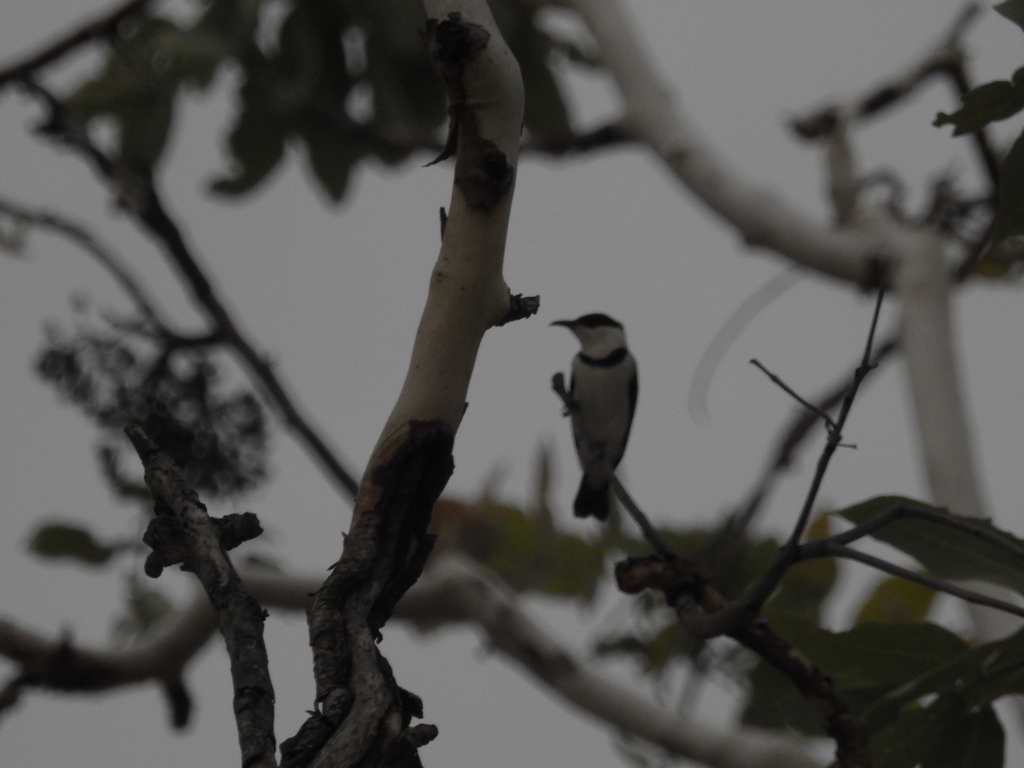
Banded Honeyeater
Photo © Nathan Ruser
Photo © Nathan Ruser — CC BY 4.0 — Source: iNaturalist #105078596The banded honeyeater (Cissomela pectoralis) is a species of honeyeater in the family Meliphagidae with a characteristic narrow black band across its white underparts. It is endemic to tropical northern Australia. == Taxonomy and systematics == The scientific name for the banded honeyeater is Cissomela pectoralis (Gould, 1841). The holotype was Holotype ANSP 18224 male, Australia: north coast, held in the Academy of Natural Sciences of Drexel University, Philadelphia. The banded honeyeater was previously placed in the genus Certhionyx, but was moved to the monotypic genus Cissomela after a molecular phylogenetic analysis, published in 2011, showed that the original genus was polyphyletic. The genus name Cissomela (Bonaparte, 1854) means "honey magpie" from the Greek kissa for 'magpie', thus referring to the black and white colouring, and mela meaning 'honey' for its feeding habits. The specific epithet pectoralis comes from the Latin pectoris for 'breast', referring to the distinctive banded breast of this bird. == Description == The banded honeyeater is a small, pied honeyeater with a distinctive black breast band across white underparts. It has a black back, tail and head, a long curved bill and long legs. It has a wingspan of 12–14 cm (4.7–5.5 in), the bill measures…
Uluru-Kata Tjuta National Park
Petermann, Australia
+146 birds+10 mammals
Uluru-Kata Tjuta National Park is one of Australia’s most iconic protected areas, renowned for its breathtaking desert landscapes, extraordinary geological formations, and deep cultural significance. Located…
VIEW NATIONAL PARKKakadu National Park
Kakadu, Australia
+273 birds+46 mammals
Kakadu National Park is Australia’s largest national park and one of the world’s most remarkable protected areas, covering nearly 20,000 square kilometres in the tropical north…
VIEW NATIONAL PARKDaintree National Park
Dedin, Australia
+362 birds+37 mammals
Daintree National Park is one of the world’s oldest and most biologically diverse tropical rainforests, protecting an extraordinary landscape where ancient forests meet the Great Barrier…
VIEW NATIONAL PARKEndeavour River National Park
Philadelphia, Australia
+203 birds+1 mammals
Where the Endeavour River winds through northeastern Queensland's tropical lowlands, a compact mosaic of rainforest, open woodland, and riverine corridor creates one of Australia's most ecologically…
VIEW NATIONAL PARKRinyirru National Park
Lakefield, Australia
+258 birds+7 mammals
Where the savanna grasslands of far north Queensland meet seasonal wetlands and eucalypt woodlands, Rinyirru National Park sprawls across more than 12,500 square kilometres of rugged,…
VIEW NATIONAL PARKLitchfield National Park
Australia
+175 birds+15 mammals
Where weathered sandstone plateaus rise above the savanna woodlands of Australia's Top End, Litchfield National Park unfolds as a landscape of dramatic contrasts shaped by a…
VIEW NATIONAL PARKNitmiluk National Park
Australia
+186 birds+27 mammals
Dramatic sandstone gorges carved by the Katherine River slice through the tropical savanna of Australia's Top End, creating a landscape where escarpments tower above crystalline pools…
VIEW NATIONAL PARKGirringun National Park
Australia
+231 birds+10 mammals
Where granite gorges cleave through subtropical woodland in North Queensland, Girringun National Park unfolds across rugged terrain shaped by millions of years of weathering and erosion.…
VIEW NATIONAL PARKBoodjamulla National Park
Australia
+142 birds+3 mammals
Where red sandstone gorges carve through the semi-arid interior of far north Queensland, Boodjamulla National Park reveals a landscape shaped by seasonal water availability and ancient…
VIEW NATIONAL PARKPurnululu National Park
Australia
+114 birds
Towering sandstone domes and dramatic gorges carved by seasonal watercourses define this remote corner of the Kimberley, where ancient rock formations create a maze of narrow…
VIEW NATIONAL PARKNo community photos yet. Log in to add the first one.
No community observations of this species yet.