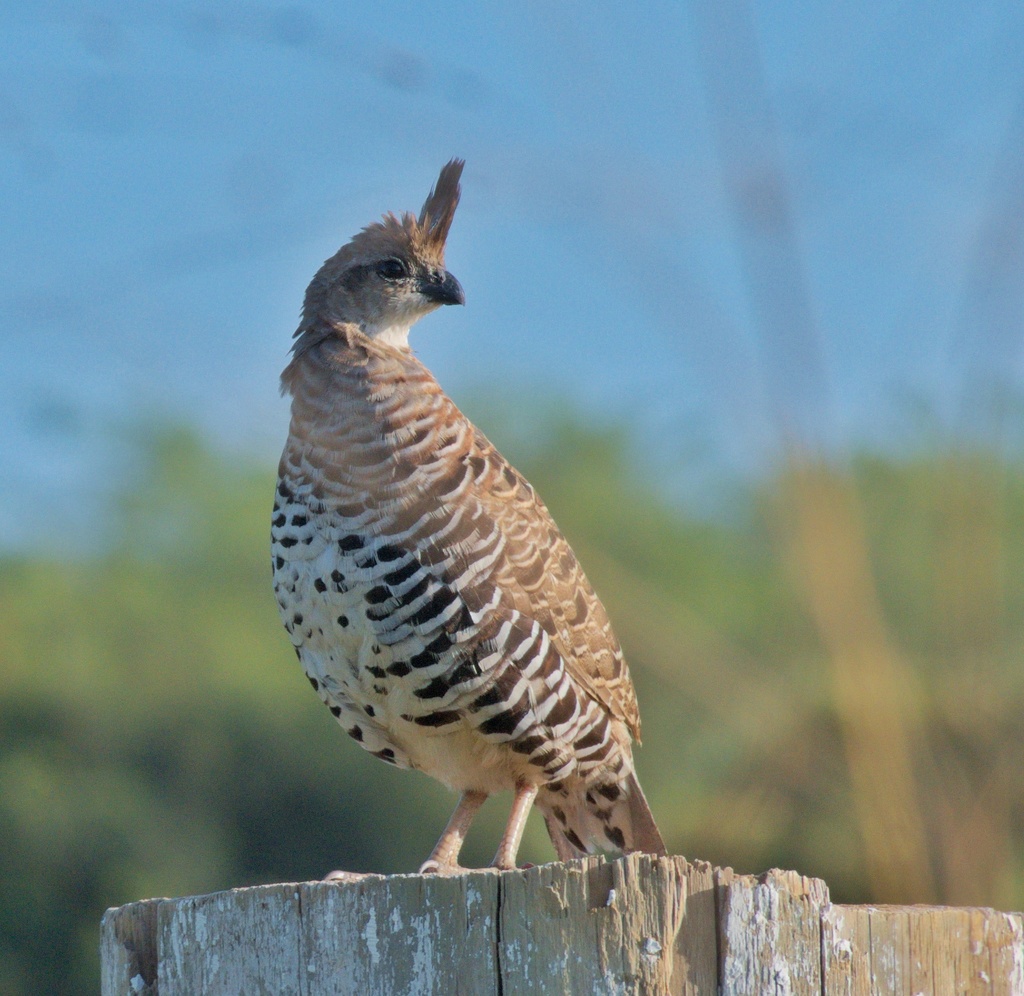
Banded Quail
Identification
The banded quail is an inconspicuous brown bird with a comparatively long tail for a quail. Most distinctive is its dark crest, which sits prominently atop the head. The throat is noticeably pale, and the under tail-coverts are barred in striking black and white—a useful field mark when the bird flushes. Juveniles initially show white streaking in their plumage, but after a moult at eight to twelve weeks, they resemble adults except for a nearly black face and throat. Full adult plumage develops by sixteen to twenty weeks of age.
Range & Habitat
The banded quail is endemic to western central Mexico, making it a species of interest for birders focused on Mexican endemics. It is most commonly found in the region bordering the Balsas River. This quail favours dry scrubby countryside with scattered shrubs, though it occasionally ventures onto cultivated land and pasture. It occupies an impressive elevational range, from sea level up to approximately 1,800 metres (5,900 ft), and is a non-migratory species, remaining in its territory year-round.
Behaviour & Diet
The banded quail is a ground-dwelling bird that typically moves in groups of about a dozen individuals, though groups of up to thirty have been recorded. True to its name and nature, it is a shy species that seldom strays far from cover. When threatened, it characteristically runs rather than flies; however, when a group does take to the wing, the birds scatter in different directions, a dispersal strategy that may confuse predators. The diet consists of a variety of seeds, along with tubers, buds, and insects—the latter becoming increasingly important when chicks must be fed.
Breeding occurs between August and September. During this period, males use their prominent crest in display behaviour to attract mates. Females lay approximately five eggs in a grass-lined nest that may be partially roofed, and the incubation period lasts about twenty-two days.
Best Time & Places to See It
The banded quail's breeding season, from August through September, is an excellent window for locating this species, as males are more active and vocal during courtship. The region bordering the Balsas River in western central Mexico is your best bet for encounters. Early morning visits to dry scrubby areas with scattered shrubs will increase your chances of spotting birds before they retreat into cover during the heat of the day. Patience and a willingness to listen for calling birds are essential, as this is a shy and inconspicuous species.
Photography Tips
Photographing banded quails requires patience and caution, as they are wary birds that prefer to remain hidden in scrub. Position yourself quietly near suitable habitat and wait for birds to emerge, rather than pursuing them directly. Early morning light is ideal for capturing the subtle beauty of their brown plumage and the striking black-and-white barring of the under tail-coverts. When birds flush, they scatter in different directions, offering multiple photo opportunities—be ready to track fast-moving targets. The dark crest and pale throat are key identifying features worth emphasizing in your images.
No community photos yet. Log in to add the first one.
No community observations of this species yet.