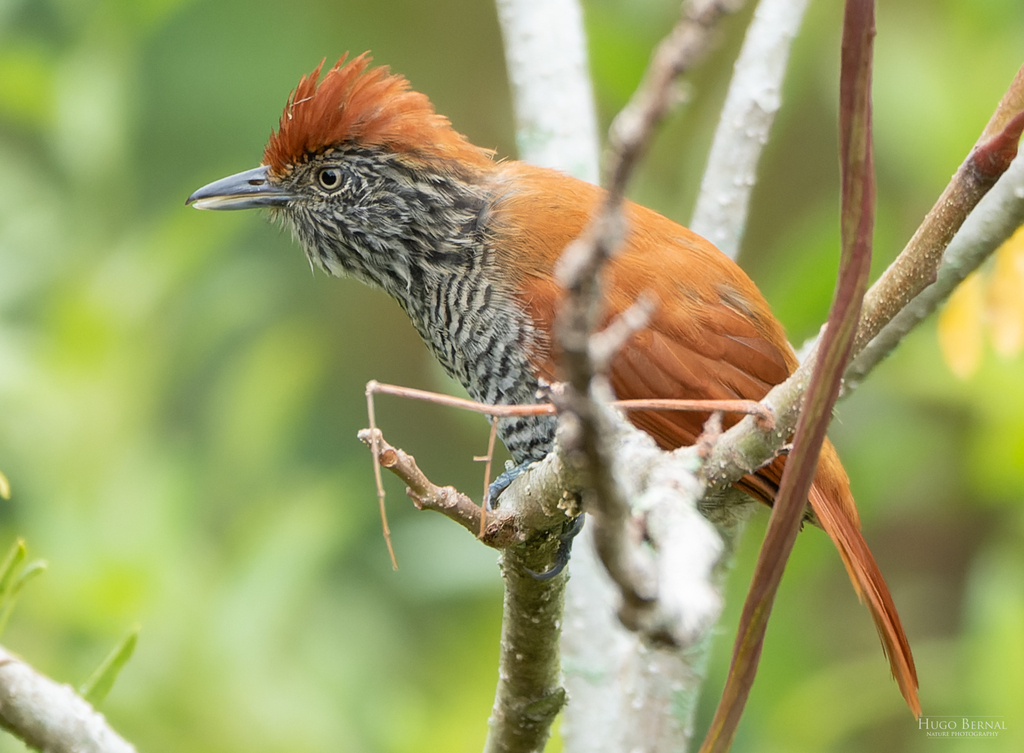
Bar-crested Antshrike
Photo © Hugo Bernal Hernández
Photo © Hugo Bernal Hernández — CC BY 4.0 — Source: iNaturalist photo #323178334Identification
The bar-crested antshrike is a compact bird, measuring 15 to 16.5 cm in length and weighing 21 to 23 grams. Like all members of its genus, it possesses a stout, hook-tipped bill characteristic of antbirds. Both sexes sport a distinctive crest, making this species instantly recognizable in the field. Adult males of the nominate subspecies are boldly patterned with alternating black and white bars across most of the body, including the crest, while the face and throat are streaked in black and white. Females are more subtle, featuring a warm cinnamon-rufous crest, crown, and upperparts, with a narrow black-and-white band on the nape and streaked sides on the head and throat. The underparts show black-and-white barring with a reddish-brown tinge on the lower flanks. Both sexes display a yellowish iris. Subspecific variation exists, particularly in tail length and the width of body barring.
Range & Habitat
The bar-crested antshrike is endemic to the Andes of Colombia, with a disjunct distribution across multiple subspecies occupying different slopes and regions of the Central, Western, and Eastern Andean ranges. A nominal presence is recorded for extreme western Venezuela, though recent sightings there are extremely rare. The species favors forest edges, thickets, and shrubby borders in both dry and humid deciduous and evergreen forests, as well as second-growth scrub. It adapts well to semi-open habitats including cultivated lands, gardens, orchards, and well-vegetated parks. Elevation-wise, it typically occurs between 900 and 2,200 meters, though it ranges lower—occasionally as low as 250 meters on Colombia's Pacific slope.
Behaviour & Diet
The bar-crested antshrike is a year-round resident throughout its range, showing no migratory tendencies. While its diet has not been comprehensively documented, it is presumed to feed primarily on insects and arthropods, likely foraging in a manner similar to its congener, the barred antshrike. Its breeding season appears to span March through June, though full breeding biology remains poorly documented. The species produces a song reminiscent of the barred antshrike but delivered in a lazier manner, typically comprising 6 to 10 notes with a distinctive acceleration toward the end.
Best Time & Places to See It
The bar-crested antshrike is considered locally fairly common to overall common throughout its Colombian range and is accessible year-round. Visiting the appropriate Andean elevations—particularly between 900 and 2,200 meters—offers the best chance of encounters. The species' preference for edge habitats and second-growth vegetation means that forest margins, scrubby areas, and cultivated lands with adequate tree cover are productive locations. The bird's adaptability to disturbed habitats increases the likelihood of sightings near populated areas with suitable vegetation. During the breeding season (March to June), birds may be more vocal and active, aiding detection.
Photography Tips
The bar-crested antshrike's striking plumage and prominent crest offer excellent photographic opportunities, particularly for males with their bold black-and-white patterning. The species' preference for edges and open areas within vegetation means it is often more visible than forest-interior antbirds. Early morning hours typically yield the best light and activity levels. Patience and familiarity with the bird's song will greatly aid in locating individuals. The sexual dimorphism between males and females provides opportunities to capture the full diversity of the species' appearance. A telephoto lens of at least 300mm is recommended to capture satisfying detail while maintaining appropriate distance from this small, active bird.
Natural Munchique National Park
El Tambo, Colombia
+194 birds
Where the Western Cordillera rises steeply from the Pacific plains of southwestern Colombia, Natural Munchique National Park sprawls across 1,078 square kilometers of montane forest that…
VIEW NATIONAL PARKNatural Serranía de los Yariguíes National Park
El Carmen de Chucurí, Colombia
+320 birds+3 mammals
Where the northern cordilleras of Colombia rise toward cloud forest, the Serranía de los Yariguíes unfolds across nearly 1,820 square kilometers of some of the most…
VIEW NATIONAL PARKNatural Farallones de Cali National Park
Buenaventura, Colombia
+733 birds+27 mammals
Where the Pacific coastal plain meets the western slopes of the Andes, Farallones de Cali National Park sprawls across nearly 3,500 square kilometers of dramatic topography…
VIEW NATIONAL PARKGuácharos Cave National Natural Park
Acevedo, Colombia
+359 birds
High in the Andean foothills of southern Huila, where mist-laden slopes rise above 1,600 metres, lies a landscape carved by underground rivers and crowned by karst…
VIEW NATIONAL PARKNo community photos yet. Log in to add the first one.
No community observations of this species yet.