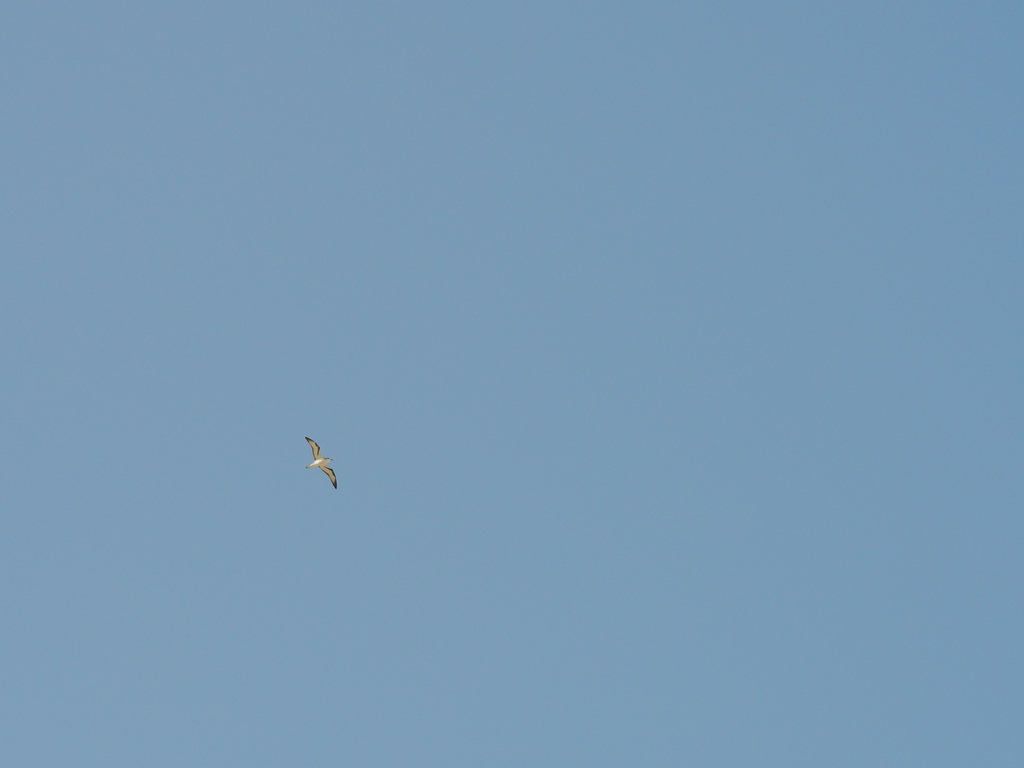
Barau’s Petrel
Photo © Yakov Uzan
Photo © Yakov Uzan — CC BY-SA 4.0 — Source: iNaturalist #246952863Identification
Barau's petrel is a medium-sized gadfly petrel approximately 40 cm long, easily identified by its striking plumage contrast. The bird displays white undersides and forehead, while its upper parts are dark grey to blackish. A distinctive moderately defined "M" pattern crosses the wings and back—a field mark characteristic of many petrels. The bill is entirely black, providing another useful identification feature in the field.
Range & Habitat
This Indian Ocean endemic ranges from Réunion westward to Western Australia and Indonesia, though its presence outside the breeding season remains poorly understood. The vast majority of the global population nests on the volcanic island of Réunion, with only a single nest recorded on nearby Rodrigues. Barau's petrels are highly pelagic, spending most of the year far from land across open ocean waters.
Behaviour & Diet
At sea, these petrels are specialist hunters, capturing small fish (around 10 cm) through surface-seizing and plunge-diving techniques. They often associate with other seabird species while feeding. Breeding biology is remarkable: unlike most petrels, colonies occupy remote inland sites at high elevations of 2,400–2,700 m, where birds excavate burrows beneath forest cover. Adults begin returning to colonies during daylight hours—unusual for burrow-nesting petrels—arriving in late afternoon and using thermal updrafts to minimize energy expenditure. Chicks fledge from November through February following an inferred incubation period of 55 days and fledging period of 100–120 days.
Best Time & Places to See It
Observing Barau's petrels requires travel to Réunion, where the species is endemic as a breeder. The critical breeding season runs from late summer through early summer of the following year, with chicks fledging between November and February—the window when nocturnal activity around colonies is most pronounced. The Grand Bénard–Tapcal and Piton des Neiges–Gros Morne Important Bird Areas (IBAs) are recognized conservation sites where breeding colonies exist and may offer opportunities for dedicated birdwatchers.
Photography Tips
Photographing Barau's petrel presents significant challenges given its remote breeding habitat and nocturnal colony behavior. At-sea photography during daylight hours is possible but demanding, requiring boat access to productive feeding grounds in the Indian Ocean. The bird's dark upperparts and white underparts create strong contrast in good light. For any colonial work around Réunion, night vision or infrared equipment becomes essential, combined with a deep understanding of the species' conservation status and local permits. Work with local conservation organizations to ensure all activities support rather than disrupt ongoing rescue and light-pollution reduction programs.
No community photos yet. Log in to add the first one.
No community observations of this species yet.