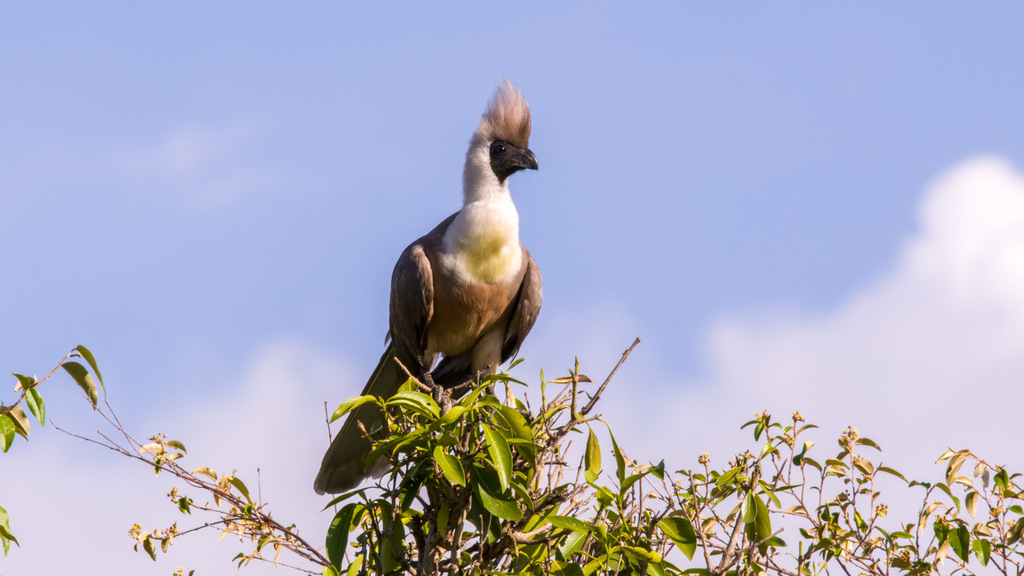
Bare-faced Go-away-bird
Photo © Will Sides
Photo © Will Sides — CC BY 4.0 — Source: iNaturalist photo #246643621Identification
The bare-faced go-away-bird is a striking turaco measuring 48 cm from beak to tail and weighing 210–300 grams. Its most distinctive feature is its uniquely bare, black face—a characteristic that immediately sets it apart from other turaco species. The bird's plumage is predominantly green, though the extent of green on the breast and underside varies between the two recognized subspecies. Males have a black beak, while females display a distinctive green beak, making sex identification straightforward in the field. The species is notably noisy and restless, and its distinctive call—a double or repetitive "kow-kow"—is often the first sign of its presence.
Range & habitat
This eastern African species occupies two geographically isolated ranges. One population is found in Ethiopia, particularly in the Ethiopian Rift Valley, while the second ranges more widely across the eastern and central regions, occurring in Burundi, the Democratic Republic of Congo, Kenya, Malawi, Rwanda, Tanzania, Uganda, and Zambia. The two populations show subtle differences in plumage, with the Ethiopian race (C. p. personatus) displaying more extensive green breast plumage and minute brown plumes on the face, while the southern and eastern race (C. p. leopoldi) has a completely bare black face and less green on the breast.
The bird favors open woodland, thickets, and cultivated areas with scattered trees. It typically occurs at altitudes up to 1,400 metres, though at Loita it has been recorded at elevations reaching 2,200 metres among scattered cedar, acacia, and evergreen scrub. This adaptability to various woodland types makes it a relatively common sight across much of its range.
Behaviour & diet
True to its colloquial name's implication of a dismissive attitude, the bare-faced go-away-bird is a notably noisy and restless species. It is often observed moving about singly or in small groups, seldom remaining in one location for long. Its vocal nature and active foraging behavior make it conspicuous despite its woodland habitat.
These birds are primarily frugivorous, feeding on fruits, leaf buds, and seeds. During breeding season, pairs construct their nests in tall acacia trees, where females lay two to three greenish-white eggs—a clutch size typical of turaco species. This breeding strategy, combined with their food preferences, ties them closely to the acacia-dominated woodland ecosystems of their range.
Best time & places to see it
The bare-faced go-away-bird is most reliably encountered in the eastern and central African regions of its range, particularly in Tanzania, Kenya, and Uganda, where it is more widespread than in Ethiopia. Open woodland areas with scattered acacia trees are the most productive habitats for locating this species. The bird's noisy and restless nature means that visitors to suitable habitats often locate birds by ear before spotting them visually.
Photography tips
Photographing the bare-faced go-away-bird requires patience due to its restless habits. Position yourself in open woodland with good sightlines and listen for its distinctive "kow-kow" call to locate birds. The species' striking bare black face and green plumage photograph well in bright morning light, which emphasizes these diagnostic features. Photographing birds in tall acacia trees can be challenging; a telephoto lens (400mm or longer) is advisable to capture detailed images of the face and beak coloration that distinguish males from females.
Serengeti National Park
Tanzania
+558 birds+57 mammals
Across Tanzania's northern plateau, where volcanic soils meet acacia woodland and open grassland, unfolds one of Earth's most dynamic ecosystems. The Serengeti National Park sprawls across…
VIEW NATIONAL PARKArusha National Park
Tanzania
+555 birds+16 mammals
Where the slopes of Mount Mawenzi rise above the Arusha region, a compact yet ecologically rich national park unfolds across montane forest, moorland, and alpine zones.…
VIEW NATIONAL PARKBwindi Impenetrable National Park
Kanyashogi, Uganda
+603 birds+26 mammals
Steep ridges cloaked in montane forest rise from Uganda's southwestern borderlands, where the landscape grows so dense and tangled that early explorers named it impenetrable. At…
VIEW NATIONAL PARKMurchison Falls National Park
Uganda
+608 birds+33 mammals
Where the Victoria Nile compresses through a narrow gorge and explodes across a 45-meter precipice, the landscape speaks in thunder. Murchison Falls National Park sprawls across…
VIEW NATIONAL PARKMgahinga Gorilla National Park
Cyanika, Uganda
+429 birds+6 mammals
Where the Virunga Mountains rise steeply from the Uganda–Rwanda–Democratic Republic of Congo frontier, montane forest cloaks the volcanic slopes in a dense, moisture-laden embrace. Mgahinga Gorilla…
VIEW NATIONAL PARKAmboseli National Park
Etonet/Lenkism ward, Kenya
+501 birds+43 mammals
Where the Amboseli basin opens toward the Tanzanian frontier, a shallow alkaline lake mirrors vast skies across one of East Africa's most iconic savanna landscapes. The…
VIEW NATIONAL PARKTarangire National Park
Tanzania
+527 birds+50 mammals
Acacia woodland and grassland sweep across the Manyara Region where the Tarangire River carves through low hills and volcanic soils, creating one of East Africa's most…
VIEW NATIONAL PARKNgorongoro Conservation Area
Tanzania
+626 birds+55 mammals
Volcanic calderas and open grassland dominate this high plateau in northern Tanzania, where the landscape rises above 2,000 metres and ancient geological forces have shaped both…
VIEW WILDLIFE MANAGEMENT AREAMabamba Swamp
Memere, Uganda
+464 birds+2 mammals
Across the Central Region of Uganda spreads one of Africa's most biodiverse freshwater wetlands, a sprawling nature reserve of roughly 283 square kilometres where papyrus swamps…
VIEW NATURE RESERVEZiwa Rhino and Wildlife Ranch
Nakasongola, Uganda
+359 birds+11 mammals
Where papyrus wetlands merge into sprawling savanna, Uganda's central landscape opens into one of East Africa's most vital rhino recovery zones. Ziwa Rhino and Wildlife Ranch…
VIEW WILDLIFE SANCTUARYAbijata-Shalla Lakes National Park
Ethiopia
+438 birds+7 mammals
Two crater lakes of contrasting chemistry define this remote corner of Ethiopia's Rift Valley, where soda lakes and freshwater basins create a mosaic of distinct aquatic…
VIEW NATIONAL PARKAwash National Park
Didiga, Ethiopia
+473 birds+23 mammals
Where the Ethiopian Rift Valley carves through volcanic plateaus, a ribbon of riverine forest winds through acacia scrubland and grassland, creating a mosaic of habitats that…
VIEW NATURAL PARKYabelo Wildlife Sanctuary
Bedewera, Ethiopia
+359 birds+5 mammals
Where acacia woodlands meet volcanic plateaus in southern Ethiopia, a landscape of austere beauty unfolds across nearly 2,500 square kilometers. Yabelo Wildlife Sanctuary sprawls across semi-arid…
VIEW WILDLIFE SANCTUARYNo community photos yet. Log in to add the first one.
No community observations of this species yet.