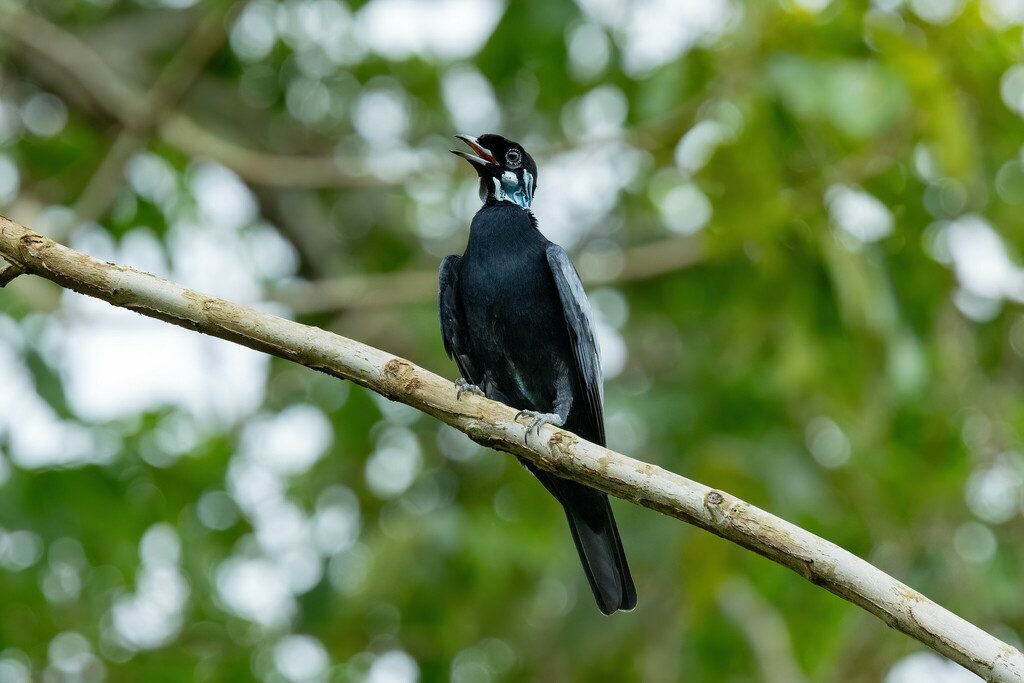
Bare-necked Fruitcrow
Photo © Thibaud Aronson
Photo © Thibaud Aronson — CC BY-SA 4.0 — Source: iNaturalist photo #343526283Identification
The Bare-necked Fruitcrow is a large cotinga, measuring 34–39 cm in length. Both sexes display the species' most distinctive feature: bare blue or bluish-white skin on the lower face and neck, which drapes in pronounced folds—especially prominent in males. The head is covered in short, velvety feathers, and the flanks display large patches of powder down.
Sexual dimorphism is marked. Males are mostly black with silvery-gray wing coverts, creating a striking contrast. Females are considerably smaller and predominantly slaty gray with a faint paler scaly pattern. Juveniles are mostly white and take two to three years to acquire adult plumage, passing through various immature stages during this transition.
Range & Habitat
This species is found across the Amazon Basin and Orinoco River system, occurring in every mainland South American country except Argentina, Chile, Uruguay, and Paraguay. One range extends from far eastern Colombia and southwestern Venezuela through the Guianas to the Atlantic coast, while the main bulk spans from south-central Colombia, eastern Ecuador, and eastern Peru eastward through northern Bolivia and north-central Brazil.
The Bare-necked Fruitcrow inhabits humid forest, including várzea and terra firme types, typically below 500 m elevation in Colombia, 300 m in Ecuador, 600 m in Peru, and 150 m in Venezuela. It shows a strong preference for riverine and lacustrine habitats, being most frequent along waterways and around lakes.
Behaviour & Diet
Often encountered in small flocks along rivers and crossing water bodies, this species' movement patterns remain poorly understood—whether they represent local movement or seasonal migration is unknown. The Bare-necked Fruitcrow is unusually active among cotingas, foraging singly, in pairs, or in flocks while running and hopping along branches.
Its diet comprises mostly fruit supplemented with small and large insects. While many cotingas are sedentary canopy foragers, this species hunts insects in mid-air with sallies from treetops—including aerial hawking of flying ants. Breeding season varies latitudinally, becoming later from south to north. Nests are shallow cups constructed from lichens and plant fibers coated with fungus, typically placed 6–10 m above ground on horizontal branches, though some reach 40 m in the tree crown. Clutch size is believed to be one egg, though breeding biology remains largely unknown.
Best Time & Places to See It
The Bare-necked Fruitcrow is common in Colombia, Ecuador, and Brazil; fairly common in Peru; and uncommon in Venezuela. It occurs within several protected areas throughout its range. As with many Amazon basin species, the wet season typically offers better visibility as birds congregate around fruiting trees and waterways. Early morning and late afternoon hours are optimal for locating flocks moving along rivers.
Photography Tips
The striking bare facial skin and contrasting plumage of males make this species highly photogenic, though females' subtler coloration requires careful exposure metering. Position yourself along river corridors and lakeshores during dawn hours when flocks are most active. The species' habit of running and hopping along branches—rather than remaining perched—demands fast shutter speeds and patience to capture clear images.
This cotinga is notoriously vocal despite its reputation as silent, producing a distinctive deep bellowing call described as fog-horn-like. Recording vocalizations may help locate birds in dense canopy. Its relatively low altitude preference and riverside habitat association make it more accessible than many Amazon species, though expect to work through river-travel logistics to access prime locations.
Amacayacu National Park
Amazônia National Park
Anavilhanas National Park
Bahuaja Sonene National Park
Campos Amazónicos National Park
Cordillera Azul National Park
Jaú National Park
Manu National Park
Mapinguari National Park
Nothing matches these filters.
No community photos yet. Log in to add the first one.
No community observations of this species yet.