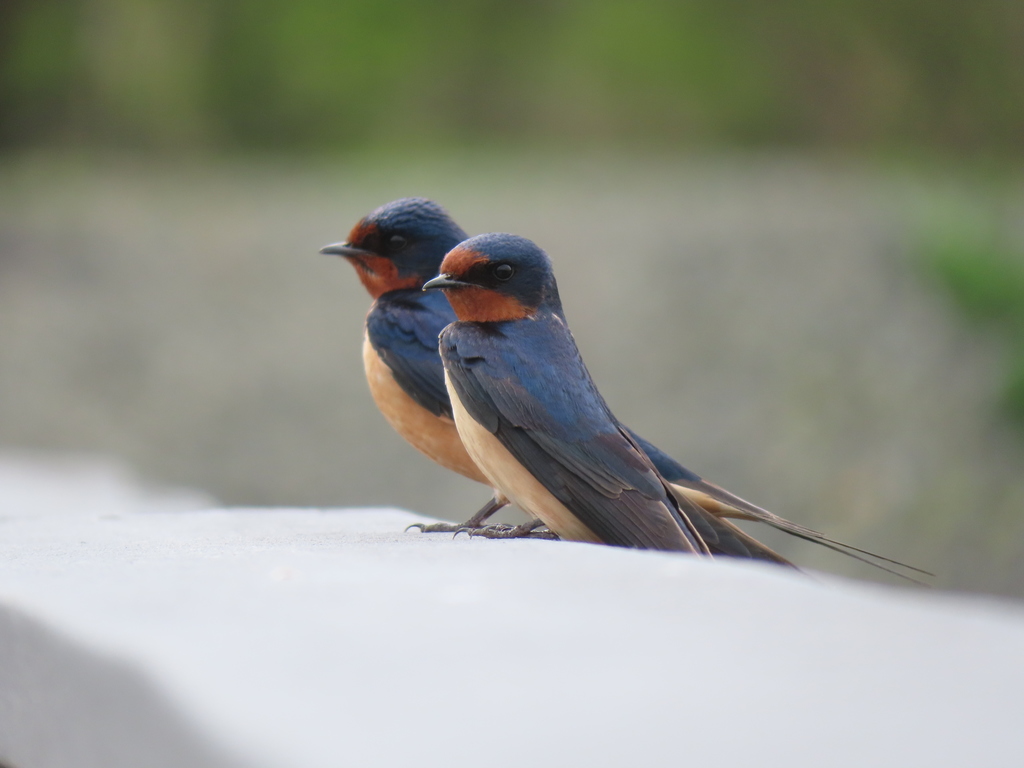
Barn Swallow
Photo © Mila C.
Photo © Mila C. — CC BY 4.0 — Source: iNaturalist photo #190318146Identification
The barn swallow is unmistakable in flight: a sleek, dark-backed bird with distinctive steel-blue upperparts, a deeply forked tail, and a striking rufous-red face contrasting with a broad dark-blue breast band. Adults measure 17–19 cm long with a wingspan of 32–34.5 cm, their most characteristic feature being the elongated outer tail feathers that create the iconic "swallow tail" silhouette. A line of white spots crosses the outer tail feathers, visible in good light. Males are more glossy than females, whose tail streamers are noticeably shorter and underparts paler. Juveniles are browner overall with a paler rufous face and lack the elongated tail streamers entirely.
The barn swallow's red face and blue breast band make it easy to distinguish from other swallows across its range. When excited or defending its nest, it utters a loud splee-plink call, while sharp siflitt warns of predators like cats, and flitt-flitt alerts to aerial hunters. Both males and females sing, though females' vocalizations were only recently formally described.
Range & Habitat
The barn swallow is the world's most widespread swallow species, occurring on all continents with vagrants even reaching Antarctica. Eight subspecies breed across the Northern Hemisphere, with two having fairly restricted ranges in the Nile valley and eastern Mediterranean, while the other six are highly migratory, wintering across much of the Southern Hemisphere. The nominate European subspecies breeds from Europe and Asia north to the Arctic Circle, ranging south to North Africa, the Middle East, and Sikkim, and east to the Yenisei River, before migrating on a broad front to winter in Africa, Arabia, and the Indian subcontinent.
This species is fundamentally a bird of open country that has thrived alongside human settlement. It builds its distinctive mud-cup nests in barns and similar man-made structures, having spread dramatically with human expansion. Its insect-eating habits have made it tolerated and even welcomed by people, a relationship reinforced historically by superstitions surrounding both the bird and its nest.
Behaviour & Diet
Barn swallows are aerial insectivores, catching their entire diet of flying insects in flight—a specialization that explains their streamlined form and exceptional agility. They live in close association with humans, nesting colonially in barns, outhouses, and under eaves where they construct their characteristic cup nests from mud pellets. This intimate relationship with people has made them culturally significant across their range, with frequent references in literary and religious works.
The species is highly migratory, with some populations undertaking extraordinary journeys; European barn swallows wintering in southern Africa have been recorded covering up to 11,660 km on their annual migration. During winter, the species is generally quiet, but breeding birds are vocal and active, with both males and females contributing to the soundscape of human settlements.
Best Time & Places to See It
Barn swallows are most visible during the breeding season when they are actively nesting and hunting around human habitations. Look for them in open agricultural landscapes, near farmsteads, barns, and villages across the Northern Hemisphere during spring and summer months. Their aerial hunting style makes them conspicuous, skimming low over fields and water in pursuit of insects, often visible from dawn through dusk.
The species' strong cultural significance has made it the national bird of Austria and Estonia, reflecting its prominence across European landscapes. In regions where it winters, such as Africa, Arabia, and the Indian subcontinent, barn swallows appear during their non-breeding season. Their preference for human-modified landscapes means they are remarkably accessible to travellers, often visible near accommodations and farms throughout their range.
Photography Tips
Photographing barn swallows requires patience and fast shutter speeds due to their rapid, erratic flight patterns. Position yourself near nesting sites—barns, bridges, and human structures—where birds return predictably. Dawn and dusk often provide the best lighting, with the low angle of sun highlighting the iridescent blue plumage and rufous face markings. Shoot in burst mode to increase chances of capturing sharp images of birds in flight.
The deeply forked tail and white tail spots are key identifying features worth capturing; shoot from angles that showcase these details. Static perching moments occur regularly as birds rest between feeding bouts, allowing you to obtain sharp portraits showing the contrasting blue breast band and red face. Females and juveniles offer different plumage variations worth photographing separately, and nest-building or feeding behavior provides compelling documentary opportunities for patient observers.
Delta de l’Ebre Natural Park
Bwindi Impenetrable National Park
Kanha Tiger Reserve
Lake Mburo National Park
Mabamba Swamp
Minneriya National Park
Murchison Falls National Park
Queen Elizabeth National Park
Tombstone Territorial Park
Nothing matches these filters.
No community photos yet. Log in to add the first one.