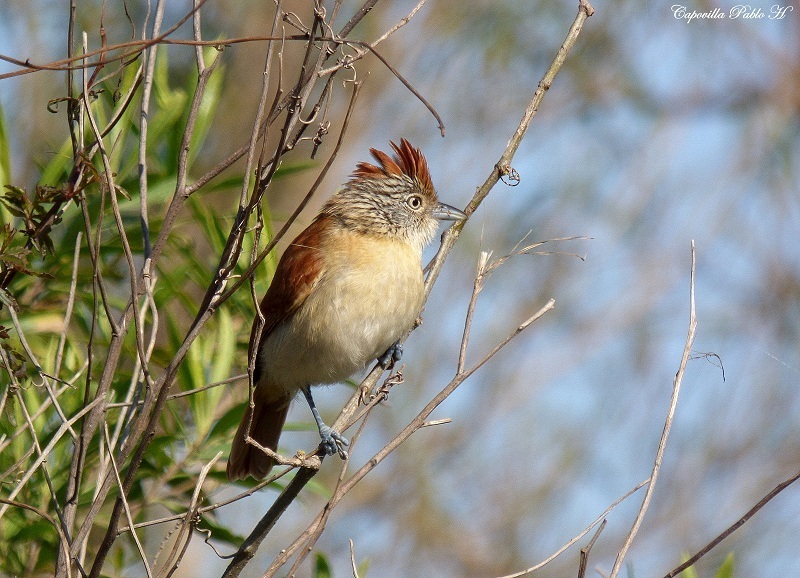
Barred Antshrike
Photo © Pablo H Capovilla
Photo © Pablo H Capovilla — CC BY 4.0 — Source: iNaturalist photo #67270905Identification
The barred antshrike is a small passerine measuring 15 to 18.5 cm long and weighing 24 to 32 g. It belongs to the typical antbirds (Thamnophilidae), characterized by stout, hooked bills resembling those of true shrikes. Both sexes display a distinctive bushy crest, but sexual dimorphism is pronounced. Adult males of the nominate subspecies are striking: almost entirely clad in alternating black and white bars, with thicker black bars on the upperparts and thinner black bars on the underparts. Their face, throat, and chin display thin black and white streaks, while the crest is black with white bases on the middle feathers. Adult females present a markedly different appearance, featuring a cinnamon-rufous crest and upperparts, with black-and-white or buff streaking on the head and neck sides, a buff chin, and ochraceous-buff underparts. Both sexes share a pale yellow iris, black maxilla, bluish-gray mandible, and lead-gray legs and feet.
The barred antshrike comprises 12 recognized subspecies showing considerable geographical variation. Some populations differ significantly: males in darker subspecies display wider black bars or reduced barring on the belly, while females range from heavily streaked to nearly unmarked. The capistratus subspecies of eastern Brazil is particularly distinctive, with males showing entirely black crowns and white tail spots, and both sexes possessing reddish or chestnut irises.
Range & Habitat
This widespread Neotropical species occurs from Mexico through Central America to South America, inhabiting Mexico, every Central American country, Trinidad and Tobago, and every mainland South American country except Chile and Uruguay. A single accepted record documents its occurrence in southern Texas. The 12 subspecies occupy distinct ranges across this vast area, from the Pearl Islands in Panama to southern Bolivia and northeastern Argentina, with the nominate subspecies dominating the northern Amazon basin.
The barred antshrike shows considerable habitat flexibility, though it consistently favors thick undergrowth over open or elevated areas and avoids mature forest interiors. Across most of its range—Mexico, Central America, northern South America, and much of Peru—it inhabits scrublands (especially second-growth vegetation), riparian thickets, woodland edges, secondary forest, and even gardens. Notable exceptions include tropical deciduous forest on Coiba Island, humid mature forest on Tobago, and caatinga and restinga habitats in eastern Brazil. In Amazonia, it occurs almost exclusively on river islands and riverine belts. Elevational range varies geographically: sea level to 1,500 m in Mexico and Central America, reaching 2,000 m in Venezuela, 1,400 m in Peru, and 250 m in Ecuador.
Behaviour & Diet
As a member of the antbird family, the barred antshrike actively forages in dense undergrowth, pursuing insects and other small arthropods. Its preference for thick vegetation and edge habitats positions it as an active, restless gleaner within the lower canopy and shrub layers. The species' marked sexual dimorphism suggests distinct behavioral or ecological roles between males and females, though detailed behavioral studies remain limited for this widespread species.
Best Time & Places to See It
The barred antshrike is best observed in second-growth scrub, riparian thickets, and woodland edges throughout its range. In Amazonian regions, focus on river islands and riverine vegetation belts. Early morning hours typically offer the best viewing opportunities when birds are most active. The species' preference for dense undergrowth requires patience and careful observation. In Central America and northern South America, dry season months often bring clearer visibility as vegetation thins slightly. The nominate subspecies is readily encountered in the Guianas, Trinidad, and Venezuelan lowlands.
Photography Tips
Photographing the barred antshrike demands a fast shutter speed and high ISO, as the species skulks within dense, shadowy vegetation. Focus on the early morning when light penetrates the canopy more effectively and birds are vocally active. A telephoto lens of at least 400mm is essential for reaching birds concealed in undergrowth. Patient staking-out of riparian thickets or scrub edges may reveal regular perching spots. The striking sexual dimorphism—bold black-and-white males versus warm rufous females—offers compelling compositional opportunities. Include vegetation context to showcase the species' preferred habitat. For subspecific variation documentation, target known sites for capistratus in eastern Brazil or albicans in Colombia to capture regional plumage differences.
Amacayacu National Park
Amazônia National Park
Anavilhanas National Park
Arenal Volcano National Park
Bahuaja Sonene National Park
Barra del Colorado National Wildlife Refuge
Baru Volcano National Park
Brasília National Park
Braulio Carrillo National Park
Nothing matches these filters.
No community photos yet. Log in to add the first one.
No community observations of this species yet.