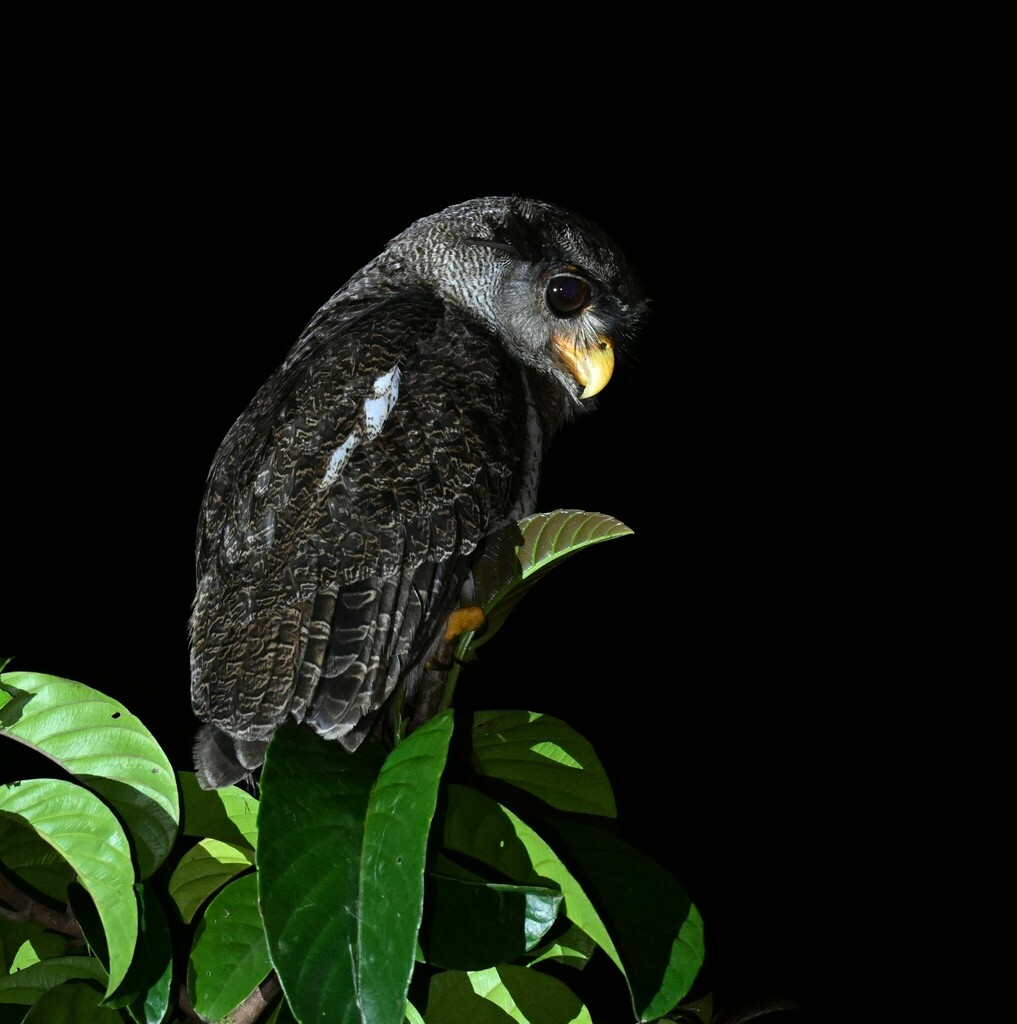
Barred Eagle-Owl
Photo © Chrissy McClarren and Andy Reago
Photo © Chrissy McClarren and Andy Reago — CC0 1.0 — Source: iNaturalist #253901060Identification
The barred eagle-owl is a fairly large owl but relatively small eagle-owl, measuring 40 to 48 cm in length. Most distinctive are its barred underparts, large but sideways-slanting ear tufts, and a white bar running from the eyebrows through the front of the ear-tufts. The breast is much more heavily marked than the belly. The face and lores are dirty grayish-white, with dark brown eyes (occasionally yellow). The bill and cere are pale yellow, sometimes with a greenish tinge. Upperparts are grey-brown, crossed with zigzag bars of rufous-tawny colour, broadest on the back. The upper tail is dark brown with about six whitish or tawny bars. Tarsi are feathered to the toe joint.
Confusion with the brown wood owl is possible but unlikely, as that species lacks ear-tufts and has more rufous-brown colouration. Fish owls lack tarsal feathering and the distinctive white head stripe. The dusky eagle-owl, found in the northern part of the range, has a sandy warm-brown colour with vertical underpart barring and yellow eyes. The larger spot-bellied eagle-owl, with which this species forms a superspecies, has bolder spotting below but does not overlap in distribution.
Range & Habitat
Found in Brunei, Indonesia, Malaysia, Myanmar, Singapore, and Thailand, ranging from the southern Malay Peninsula through several larger Southeast Asian islands to Borneo. The species inhabits subtropical and tropical moist lowland forests, typically evergreen forests with pools or streams. It also adapts to large gardens with tall, densely foliated trees and wooded groves in cultivated areas, sometimes near human habitations such as the Bogor Botanical Gardens in West Java.
Elevation ranges from sea-level to roughly 1,000 m, with records up to about 1,600 m or more at locations like Mount Gede in West Java and Mount Singgalang in West Sumatra. Three subspecies are recognized: the relatively small K. s. sumatrana on Sumatra, Bangka and the Malay Peninsula; the considerably larger K. s. strepitans on Java and Bali with broader belly barring; and K. s. tenuifasciata on Borneo with finer, closer-set bands.
Behaviour & Diet
The barred eagle-owl has a very broad, opportunistic diet reflecting its large, powerful feet and heavy, slightly curved talons. Known prey includes large insects such as grasshoppers and beetles, birds, small mammals (especially rodents including mice and rats), and reptiles, largely snakes. The species is capable of taking relatively large prey, with at least one documented instance of predation on a young crab-eating macaque.
The territorial song is a deep hoot or hoo-hoo, sometimes transliterated as whooa-who, whooa-who, with hoots dropping slightly in pitch towards the end. A double-hoot typically has an interval of about two seconds between calls. Other vocalizations include a noisy cackle of various syllables, fearful shrikes, and strangulate noises, normally uttered in the early evening. In Borneo, the flight call is described as several hoots followed by a groan. In some Javanese local mythology, this species' calls are considered those of demons.
Best Time & Places to See It
The barred eagle-owl is a resident species throughout its range, so timing is less critical than habitat selection. Focus on primary and secondary evergreen forests with water features such as streams or pools. Gardens and botanical settings with tall, densely foliated trees offer good opportunities, particularly near lowland areas. Early evening is the best time to encounter the species, as this is when vocalizations are most frequent. Listen for the distinctive deep hooting calls to locate birds.
Within its range, areas in West Java, Sumatra, and Borneo offer the most reliable chances of encounter. The species is relatively little-known and can be elusive, so patient observation combined with listening for calls significantly improves detection rates.
Photography Tips
The barred eagle-owl's nocturnal habits and preference for dense forest cover make photography challenging. Use high ISO settings and fast lenses (f/2.8 or wider) to work in low-light conditions typical of evening and night. Red or near-infrared illumination, if permitted, may reduce disturbance compared to white light. The species' large forward-facing eyes and distinctive ear-tufts are key features to capture.
Position yourself near suitable habitat during early evening when the owl may become more active and vocal. Remote camera traps placed near known roost sites or near streams within evergreen forest can produce excellent results with minimal disturbance. Patience is essential, as this relatively secretive species offers limited but rewarding photographic opportunities for dedicated observers.
Gunung Mulu National Park
Kerinci Seblat National Park
Taman Nasional Baluran
Taman Negara National Park
Way Kambas National Park
West Bali National Park
Nothing matches these filters.
No community photos yet. Log in to add the first one.
No community observations of this species yet.