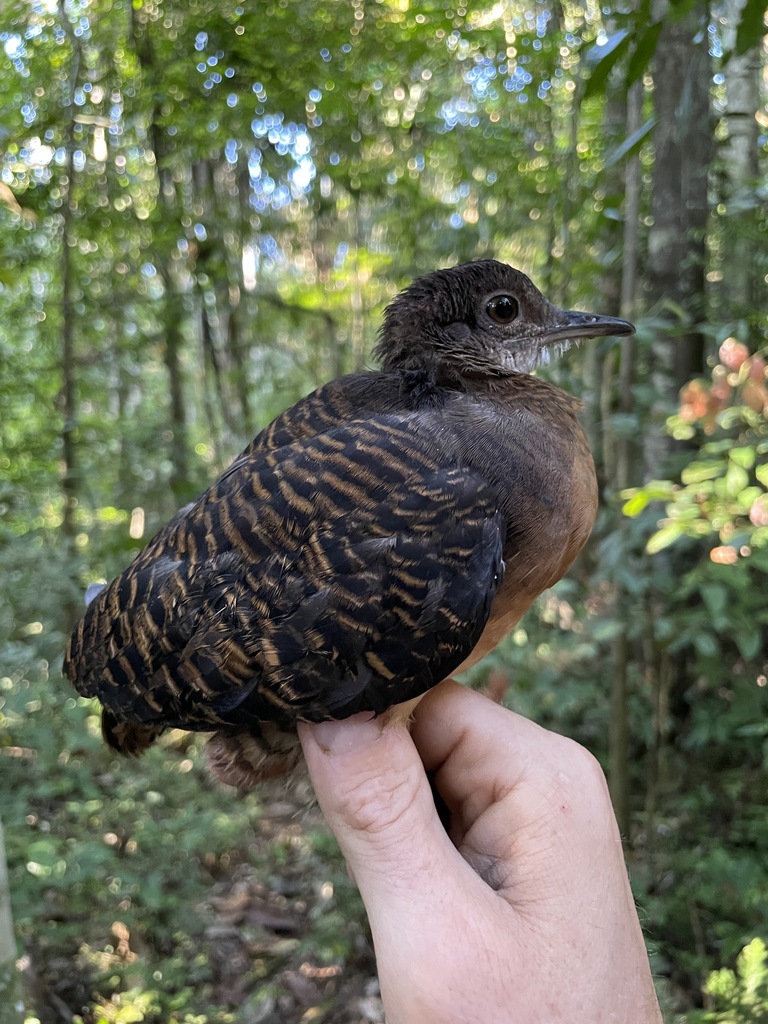
Bartlett’s Tinamou
Photo © Rajan Rao
Photo © Rajan Rao — CC BY 4.0 — Source: iNaturalist #238520757Identification
Bartlett's tinamou is a small bird, measuring approximately 27 cm (11 inches) in length. It has distinctive plumage with brown upperparts barred with black, a blackish crown, and white throat and belly. The remainder of the underparts are rufous, while the flanks are barred with black. This combination of features makes it recognizable among the tinamou family, though sighting this uncommon species remains a challenge for most birdwatchers.
Range & Habitat
This monotypic species is native to western Amazonian Brazil, northern Bolivia, eastern Peru, and eastern Ecuador, where it inhabits swamp and lowland forests in subtropical and tropical regions at elevations up to 500 m (1,600 ft). Across its range, which covers approximately 1,990,000 km² (770,000 sq mi), Bartlett's tinamou is considered uncommon, making it a sought-after sighting for dedicated birders exploring South American lowland forests.
Behaviour & Diet
Like other tinamous, Bartlett's tinamou forages on or near the ground, feeding primarily on fallen fruit from low-lying bushes. Its diet is supplemented with small amounts of invertebrates, flower buds, tender leaves, seeds, and roots. The species exhibits an unusual breeding system in which males incubate eggs that may come from as many as four different females. After hatching, the male raises the chicks until they are independent, typically around 2–3 weeks of age. Nests are simple structures built on the ground in dense brush or nestled between raised root buttresses of forest trees.
Best Time & Places to See It
Travelers seeking Bartlett's tinamou should focus their efforts on lowland forest regions of the western Amazon basin, particularly in Peru, Ecuador, Bolivia, and Brazil. Given the species' uncommon status throughout its range, patience and early morning searches—when the bird is most active—offer the best chances of encounter. Hiring a local guide familiar with tinamou calls and behavior significantly improves sighting prospects in these remote habitats.
Photography Tips
Photographing this elusive ground-dweller requires patience, a telephoto lens, and the ability to move quietly through dense forest understory. Since Bartlett's tinamou forages on or near the ground among dense vegetation, approach slowly and look carefully at the forest floor and low brush. Early morning light is preferable for capturing the subtle barring and rufous tones of the plumage. Be prepared for challenging lighting conditions in the shadowy lowland forest environment, and have high ISO settings ready to compensate.
Yasuní National Park
Aguarico, Ecuador
+601 birds+43 mammals
Where the western Amazon basin converges with Ecuador's Orellana Province, lowland rainforest reaches toward the horizon in an unbroken canopy of staggering botanical density. Yasuní National…
VIEW NATIONAL PARKMapinguari National Park
Brazil
+354 birds
Vast tracts of western Amazonian rainforest blanket the remote terrain of this 56,827 square kilometre national park in Amazonas state, where seasonal rivers wind through dense…
VIEW NATIONAL PARKSerra do Divisor National Park
Brazil
+448 birds+10 mammals
Where the western Amazon meets the Andes foothills, Serra do Divisor National Park sprawls across one of South America's most biodiverse and least accessible frontiers. Spanning…
VIEW NATIONAL PARKManu National Park
Manu, Peru
+892 birds+26 mammals
Across the eastern slopes of the Peruvian Andes, tropical rainforest descends into the Amazon basin with a complexity that few terrestrial ecosystems match. Manu National Park…
VIEW NATIONAL PARKBahuaja Sonene National Park
San Pedro de Putina Punco, Peru
+602 birds+8 mammals
Where the Madre de Dios and Heath rivers converge in southeastern Peru rises one of South America's most biodiverse wilderness regions: a vast protected realm of…
VIEW NATIONAL PARKNo community photos yet. Log in to add the first one.
No community observations of this species yet.