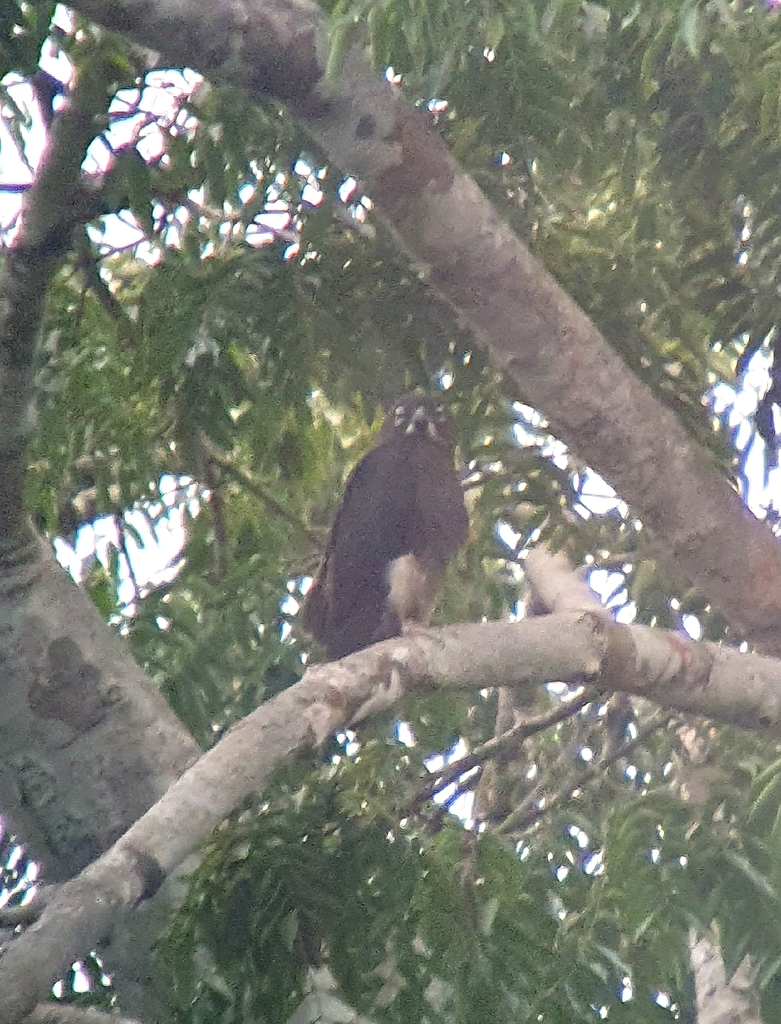
Bat Hawk
Photo © Antoine Thivolle
Photo © Antoine Thivolle — CC BY 4.0 — Source: iNaturalist #331355545Identification
The bat hawk is a slender, medium-sized raptor measuring 45 cm long and weighing 600–650 grams. It has long wings and a distinctly falcon-like silhouette in flight. Adults are dark brown or black with a striking white patch on the throat and chest, and white streaks above and below each eye. Juveniles are mottled brown and display considerably more white plumage than adults. One of the bat hawk's most distinctive features is its unusually large gape—the largest of any raptor relative to body size—an adaptation similar to insectivorous birds like swallows and nightjars that feed on the wing.
Range & Habitat
The bat hawk is found across sub-Saharan Africa and south Asia to New Guinea. Despite its specialization on bat prey, it is remarkably adaptable and inhabits diverse environments ranging from dense rainforest to semi-arid veld. The species requires open space for hunting, making forest clearings, woodland edges, and open savannas particularly suitable habitat.
Behaviour & Diet
As its name suggests, the bat hawk feeds primarily on bats, though it will also hunt small birds such as swallows, swifts, and nightjars, as well as insects. The species is crepuscular, hunting at dusk when bats emerge in swarms from caves and roosting sites. Hunting success rates are remarkably high at 49.3%. Prey is captured using small talons and swallowed whole in flight, with an extraordinarily rapid ingestion rate—prey typically reaches the stomach within 6 seconds of capture. This rapid feeding is essential, as bats only emerge for approximately 30 minutes at dusk, creating a narrow temporal window for hunting. The bat hawk employs high-speed aerial pursuits and complex aerial manoeuvres to capture prey, employing multiple approach and attack angles similar to those used by other aerial hunters. Breeding is synchronized with bat breeding cycles, allowing young hawks to exploit recently fledged juvenile bats. Both parents participate in raising young, though the female alone incubates the clutch. Eggs hatch about a month after incubation begins, and young fledge 30–45 days later. Bat hawks breed annually and construct stick nests approximately 90 cm across and 30 cm deep.
Best Time & Places to See It
The best opportunity to observe bat hawks is during dusk, when they can often be spotted perching near caves or bat dwellings prior to bat emergence. The species' crepuscular habits and specialized hunting niche mean that sightings require patience and timing. Look for them in open areas adjacent to suitable bat roosting sites, whether in rainforest, woodland, or savanna habitat across their range in sub-Saharan Africa and south Asia.
Photography Tips
Photographing bat hawks presents significant challenges due to their crepuscular activity. Fast film speeds or high ISO settings are essential for capturing images during the low-light conditions of dusk. Position yourself near known bat roosts before dusk and use a fast shutter speed to freeze the bird's rapid aerial manoeuvres. The bat hawk's distinctive white facial markings and pale throat patch provide good contrast and are key identification features to capture. Patience is critical—successful photography may require multiple visits timed precisely with bat emergence.
Lake Mburo National Park
Mabamba Swamp
Murchison Falls National Park
Queen Elizabeth National Park
Arabuko Sokoke Forest Reserve
Arusha National Park
Bwabwata National Park
Chobe National Park
Etosha National Park
Nothing matches these filters.
No community photos yet. Log in to add the first one.
No community observations of this species yet.