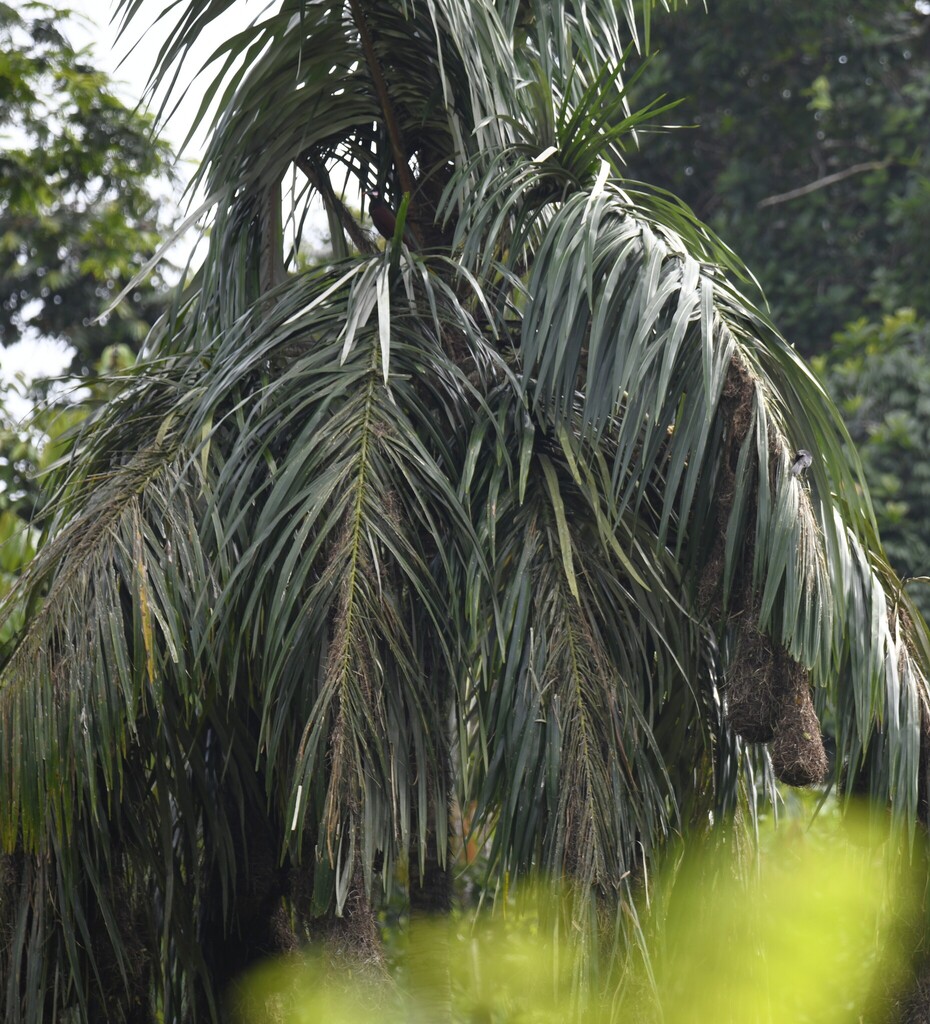
Baudo Oropendola
Photo © Zac Peterson
Photo © Zac Peterson — CC BY 4.0 — Source: iNaturalist #323599545Identification
The Baudo oropendola is a large bird, with males reaching 46 cm (18 in) and females about 39.5 cm (16 in). Both sexes share a striking plumage pattern: mostly black head, breast, and belly contrasting sharply with chestnut back, rump, wings, flanks, and crissum. A distinctive bare pinkish facial patch and pink wattle at the base of the bill are key field marks. The tail is particularly diagnostic—its central feathers are black but shorter than the yellow outer feathers, making the tail appear almost entirely yellow when viewed from below. The large, swollen bill is mostly black with an orange tip. Females are noticeably smaller and duller than males. The similar black oropendola, which overlaps in range, can be distinguished by its prominent crest, blue facial skin, and different plumage pattern.
Range & Habitat
This species is endemic to northwestern Colombia, found nowhere else in the world. Its main range covers the Serranía del Baudó and Serranía del Saltos in Chocó Department, extending slightly into northwestern Antioquia. A small, isolated population exists on the border between east-central Chocó and western Risaralda departments. The Baudo oropendola inhabits humid lowland and foothill forests below approximately 400 m elevation, showing a preference for primary forest with natural canopy openings and tall emergent trees. It also occurs in secondary forest and has been recorded along rivers and in forest on sandy soils.
Behaviour & Diet
The Baudo oropendola appears to be a year-round resident within its range. These birds are social canopy feeders, foraging in flocks of up to 10–12 individuals. Their diet includes insects and fruit, though their feeding ecology remains poorly studied. They have been observed foraging alongside chestnut-headed oropendolas. While their vocalizations have not been formally described, they appear similar to those of related species such as the black and Montezuma oropendolas.
Breeding
Information on breeding biology is limited. Sources indicate breeding occurs either between January and March or in May and June. The species builds a distinctive long, bag-shaped or purse-like nest woven from coarse plant fibers, typical of oropendolas, but virtually nothing else is documented about their reproductive behavior.
Best Time & Places to See It
The Baudo oropendola is local and uncommon throughout its range. The species is a year-round resident, so it can potentially be found in any season, though specific seasonal movements are unknown. A few protected areas within its range provide the best opportunities for encounter, though some populations remain unprotected. Given its small range, specialized trips to northwestern Colombian forests—particularly around the Serranía del Baudó in Chocó Department—offer the best chance of seeing this endemic species.
Photography Tips
The Baudo oropendola's striking black and chestnut plumage provides good contrast for photography, and the unusual yellow tail is highly distinctive. These birds forage in small flocks in the forest canopy, so patience and careful scanning of the canopy with binoculars or a spotting scope will improve your chances. Early morning often produces the most activity. The characteristic posture and bill shape make this species identifiable even in challenging light. A telephoto lens of at least 400 mm is recommended for capturing detail from a distance in the canopy environment.
Nothing matches these filters.
No community photos yet. Log in to add the first one.
No community observations of this species yet.