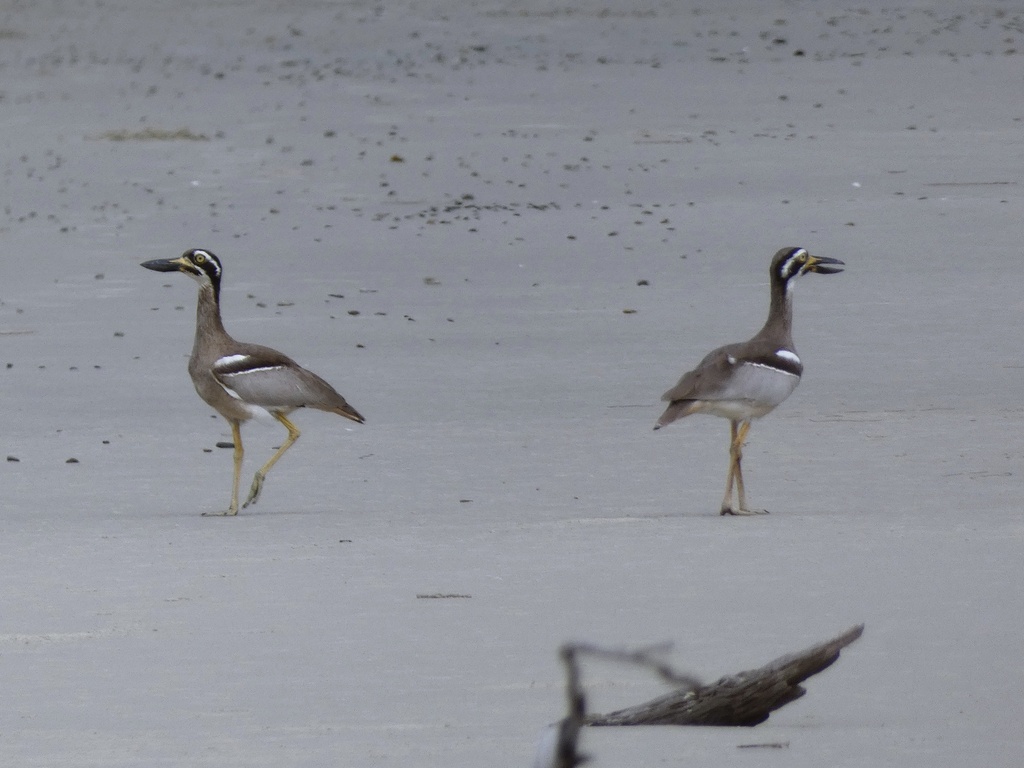
Beach Stone-curlew
Photo © Kai Squires
Photo © Kai Squires — CC BY 4.0 — Source: iNaturalist #281191643The beach stone-curlew (Esacus magnirostris) also known as beach thick-knee is a large, ground-dwelling bird that occurs in Australasia, the islands of South-east Asia. At 55 cm (22 in) and 1 kg (2.2 lb), it is one of the world's largest shorebirds. It is less strictly nocturnal than most stone-curlews, and can sometimes be seen foraging by daylight, moving slowly and deliberately, with occasional short runs. It tends to be wary and fly off into the distance ahead of the observer, employing slow, rather stiff wingbeats.. The beach stone-curlew is classified as Near Threatened on the IUCN Red List of Threatened Species. In New South Wales, it is listed as critically endangered. == Distribution == The beach stone-curlew is a resident of undisturbed open beaches, exposed reefs, mangroves, and tidal sand or mudflats over a large range, including coastal eastern Australia as far south as far eastern Victoria, the northern Australian coast and nearby islands, New Guinea, New Caledonia, Indonesia, Malaysia, and the Philippines. It is uncommon over most of its range, and rare south of Cairns. == Description == The beach stone-curlew is 54-56 cm (21-22 in) long. At a mean of 1,032 g (2.275 lb) in males and…
Ben Boyd National Park
Bribie Island National Park
Cape Range National Park
Daintree National Park
Endeavour River National Park
Fitzgerald River National Park
Gheebulum Kunungai National Park
Girringun National Park
Great Otway National Park
Nothing matches these filters.
No community photos yet. Log in to add the first one.
No community observations of this species yet.