Bearded Bellbird
Photo © William Stephens
Photo © William Stephens — CC BY 4.0 — Source: iNaturalist photo #63556952Identification
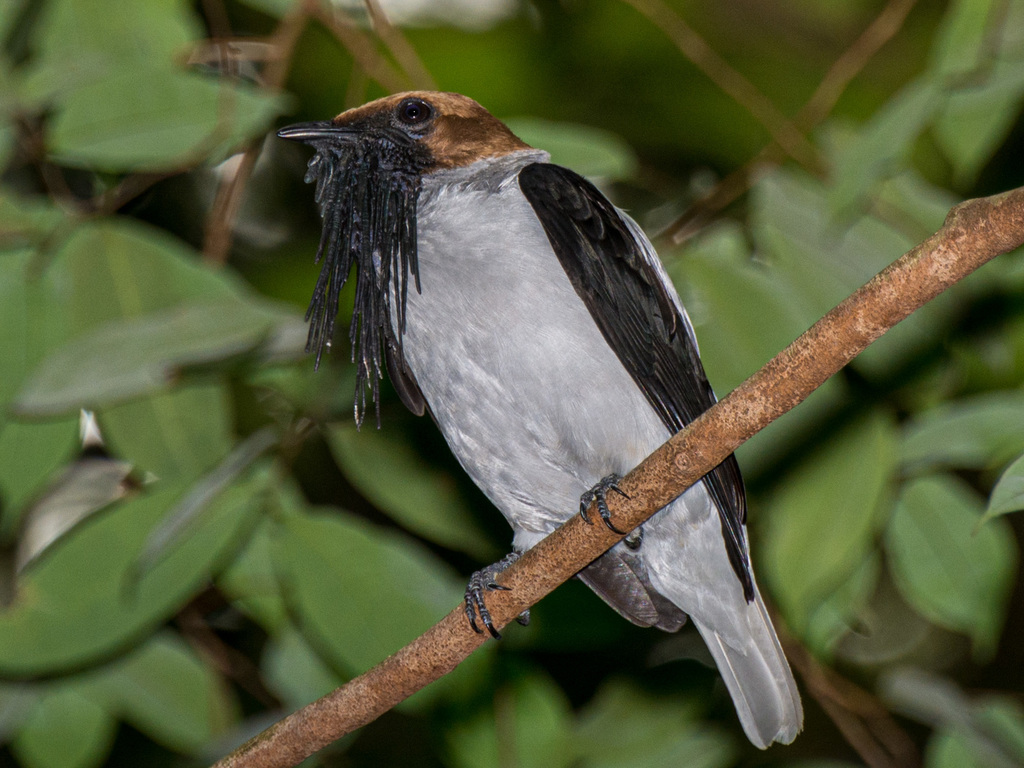
The bearded bellbird is a striking cotinga with dramatic sexual dimorphism. Males are approximately 28 cm long and unmistakable: they display white or greyish-white plumage contrasting sharply with black wings and a warm brown head. Their most distinctive feature is a "beard" of unfeathered black wattles hanging from the throat. Females are slightly smaller at around 27 cm, with olive-green upperparts, yellow underparts streaked with green, and a pure yellow vent area. They lack the male's characteristic wattles. Both sexes have dark eyes, black bills, and grey to black legs.
Range & Habitat
The bearded bellbird is native to northern South America, with two subspecies occupying distinct ranges. The nominate subspecies occurs only in northeastern Brazil, while the other subspecies is found across Trinidad, Venezuela, Colombia, Guyana, eastern Bolivia, and northern Brazil. This is a localised and uncommon bird across much of its range, though it is fairly common in Trinidad. The nominate Brazilian race is considered vulnerable due to extensive habitat loss and trapping for the cage-bird trade.
These arboreal birds inhabit humid tropical forests and woodlands. Some populations undertake altitudinal migrations, breeding at elevations up to 1,900 m and descending to lowlands during the non-breeding season.
Behaviour & Diet
Bearded bellbirds feed entirely on fruit and berries, plucking their food on the wing. They show a strong preference for plants in the families Lauraceae and Burseraceae, also taking fruits from Araliaceae and Melastomataceae. Males are famous for their extraordinarily loud vocalisations: a deep, repeated "bock" call and a metallic hammering "tonk-tonk-tonk" that sounds like rapid hammer blows on an anvil, repeated 20–30 times. Regional call variations occur across the species' range. Females remain essentially silent.
Breeding reveals interesting behavioural adaptations. The female constructs a flimsy nest of twigs and stems placed in the outer branches of isolated trees in semi-cleared areas rather than in dense forest, likely to reduce predation by monkeys, toucans, and snakes. She lays a single buff or light tan egg, which she incubates alone while the polygamous male spends his time vocalising and displaying. Young are fed regurgitated Lauraceae fruits by the female.
Best Time & Places to See It
Trinidad offers the most reliable viewing opportunities, where the species is fairly common. In Venezuela and northern South America, look during the breeding season when males are most vocal and conspicuous—April to November in Trinidad and May to September in northern Venezuela. Altitudinal migrants can be found at higher elevations during breeding season and in lowland forests outside the breeding period. The bird's loud, distinctive calls make it easier to locate than many forest species, though spotting them requires patience and knowledge of their preferred fruiting trees.
Photography Tips
Male bearded bellbirds offer dramatic photographic opportunities thanks to their striking white plumage, dark wings, and distinctive facial wattles. Position yourself near semi-cleared areas where nesting females place their flimsy nests in isolated trees—these open positions provide better lighting and visibility than dense forest. Early morning hours should reward you with vocal activity and the possibility of capturing calling males. The bird's habit of taking fruit on the wing presents a challenging but rewarding photography opportunity. Females, though less showy, display elegant coloration that photographs well in soft, diffused light. Use the bird's loud calls to locate individuals and anticipate their movements.
No community photos yet. Log in to add the first one.
No community observations of this species yet.