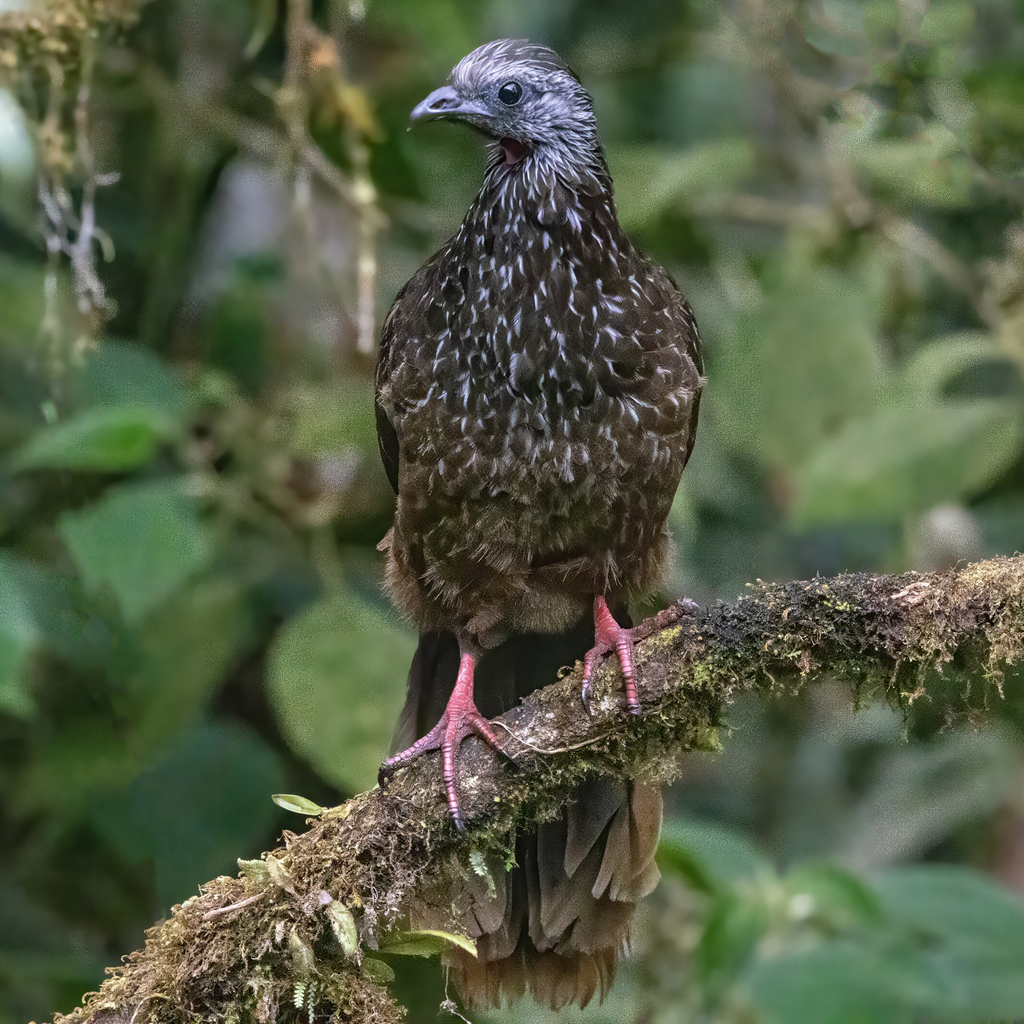
Bearded Guan
Photo © Dan Vickers
Photo © Dan Vickers — CC BY 4.0 — Source: iNaturalist #309804745Identification
The bearded guan is a compact bird roughly 55 cm in length, earning its name from a distinctive red dewlap—or "beard"—that dangles from its throat. While predominantly brown, the species displays a subtle palette of plumage details that reward careful observation. The upper parts and rear underparts are dark grayish-brown, contrasting with a silvery crown and neck feathers. White feathering edges the neck and breast, creating an elegant frame for the bird's most striking feature: the bright red legs and rufous tail complete the species' distinctive appearance.
Range & Habitat
This montane specialist is found only in the Andes of northwestern Peru and southern Ecuador, where it inhabits subtropical and tropical moist forests at elevations between 1200 and 3000 meters. The bearded guan's preference for humid, high-altitude forest environments makes it a bird of cool, misty cloud forests where moisture-laden air and lush vegetation create ideal conditions for survival. This restricted range and specific habitat preferences make it a prized discovery for dedicated birdwatchers exploring Andean forests.
Behaviour & Diet
Bearded guans are monogamous and territorial birds, with pairs remaining together through breeding season. They mate at the beginning of the rainy season, from March through July, when food availability peaks. Like other guans, the bearded guan likely feeds on the abundant fruits and berries available in cloud forests, supplemented by leaves, flowers, and insects, though specific dietary details for this species remain undocumented. Pairs produce a clutch of three eggs, with the female incubating them for approximately 24 to 28 days. Most guans reach sexual maturity at two years of age and can continue reproducing until they reach twenty years old.
Best Time & Places to See It
The breeding season from March through July offers the best opportunity to locate bearded guans, as pairs are most vocal and active during this period. Visitors should focus on humid montane forests within the specified elevation range in southern Ecuador and northwestern Peru. Patience and early-morning birding are essential, as the species inhabits dense forest vegetation. Local guides familiar with Andean cloud forests are invaluable for tracking down this elusive species, which may be more readily located by voice than by sight.
Photography Tips
Photographing bearded guans requires patience and a telephoto lens, as the species typically remains within dense montane vegetation. The bird's striking red dewlap and legs provide excellent color contrast against its brown plumage, so position yourself to capture these features in good light. Early morning sessions offer the best lighting conditions in cloud forest environments. Bring a sturdy tripod to support longer lenses in the sometimes unstable forest understory, and be prepared for the muted light typical of humid montane habitats. Respect the bird's territorial behavior and maintain a safe distance to avoid disturbing breeding pairs during the critical nesting season.
Podocarpus National Park
Zamora, Ecuador
+496 birds+6 mammals
Where the Andes descend toward the Amazon basin, Podocarpus National Park sprawls across nearly 2,800 square kilometres of the most biodiverse terrain in Ecuador's southern highlands.…
VIEW NATIONAL PARKYacuri National Park
Las Juntas, Ecuador
+166 birds+1 mammals
Where the eastern slopes of the Andes descend into Ecuador's southern frontier, Yacuri National Park unfolds across nearly 1,300 square kilometers of montane cloud forest and…
VIEW NATIONAL PARKNo community photos yet. Log in to add the first one.
No community observations of this species yet.