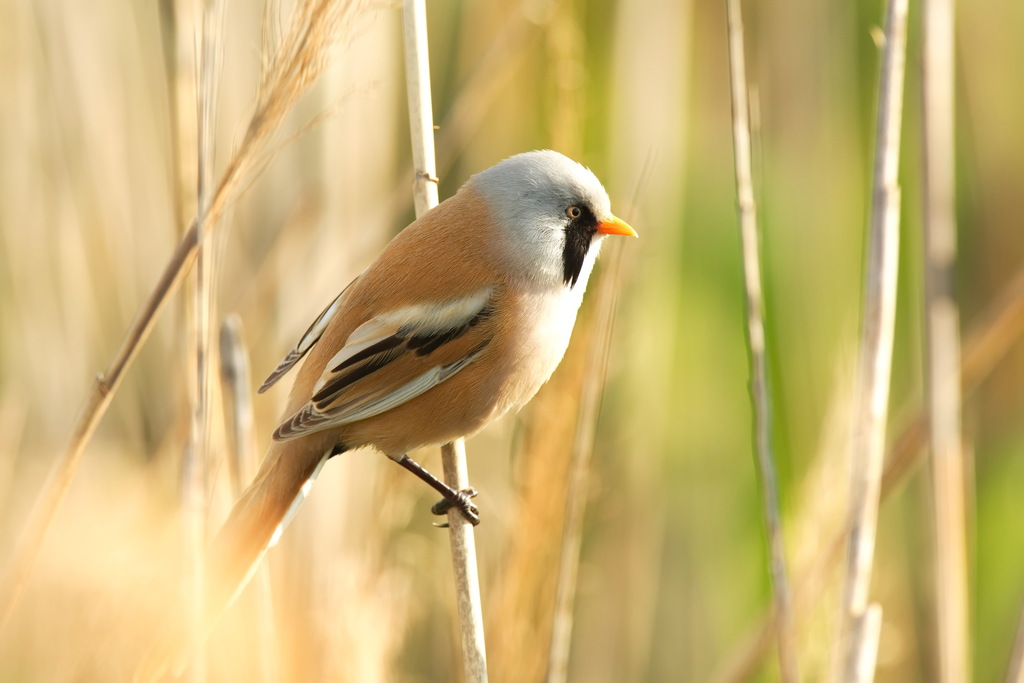
Bearded Reedling
Photo © Вячеслав Юсупов
Photo © Вячеслав Юсупов — CC BY 4.0 — Source: iNaturalist photo #78187391Identification
The Bearded Reedling is a small, distinctive passerine measuring 14.5–17 cm in length, characterized by its notably long tail and undulating flight. The plumage is predominantly orange-brown with a whitish throat and chest, contrasting black and white wing markings, and white-edged tail feathers. Sexual dimorphism is striking: males display a grey head, bold black "moustaches" (despite the common name, not a true beard), and black undertail coverts, while females are generally paler with a brownish head and lack the male's distinctive facial markings.
Range & Habitat
This species is native to temperate Europe and Asia, ranging from Spain, France, and the British Isles eastward to Manchuria. Its distribution is notably patchy due to specialized habitat requirements. During the 20th century, populations expanded northward into Scandinavia, Finland, and the Baltic region. While generally resident, some European populations undertake short-distance movements of a few hundred kilometers between breeding and wintering grounds, with occasional vagrants recorded as far as Portugal, North Africa, Israel, Kuwait, Pakistan, Japan, and Korea.
Bearded Reedlings are strict habitat specialists, requiring extensive reed beds dominated by common reed adjacent to fresh or brackish water—lakes, swamps, and rivers. They also utilize nearby tall grass-like vegetation such as bulrushes and sedges. The species shows an altitudinal range from sea level to approximately 3,050 meters, with a particular preference for floodable wetlands during breeding season.
Behaviour & Diet
Bearded Reedlings are strongly sexually dimorphic and form long-term pair bonds. They are highly productive breeders, capable of multiple breeding cycles within a single season. Their diet is seasonal: during summer they feed primarily on small invertebrates, switching to common reed seeds as their main food source in winter. Though typically observed perched or climbing among reeds, they readily hop on the ground, particularly in swampy areas and at water's edge.
Best Time & Places to See It
The species is generally resident throughout its range, making it potentially viewable year-round. Reed beds across temperate Europe and Asia offer the best opportunities, particularly in well-established wetlands with extensive common reed growth. Winter may present advantages in some regions where populations concentrate or undertake local movements, though breeding season activity in spring and summer can also be rewarding for observation.
Photography Tips
Photograph this species in reed beds during early morning or late afternoon light when males' distinctive black moustaches and grey heads are most evident. The long tail and undulating flight pattern provide dynamic photographic opportunities. A telephoto lens is essential for capturing detail while maintaining distance from this somewhat skulking bird. Winter plumage may appear duller, but the contrast between breeding males and females offers excellent comparative subjects.
Bardenas Reales
Biebrza National Park
Camargue Regional Nature Park
Caps et Marais d’Opale Regional Nature Park
Cors Fochno National Nature Reserve
Danube Delta Biosphere Reserve
De Alde Feanen National Park
De Biesbosch National Park
De Groote Peel National Park
Nothing matches these filters.
No community photos yet. Log in to add the first one.
No community observations of this species yet.