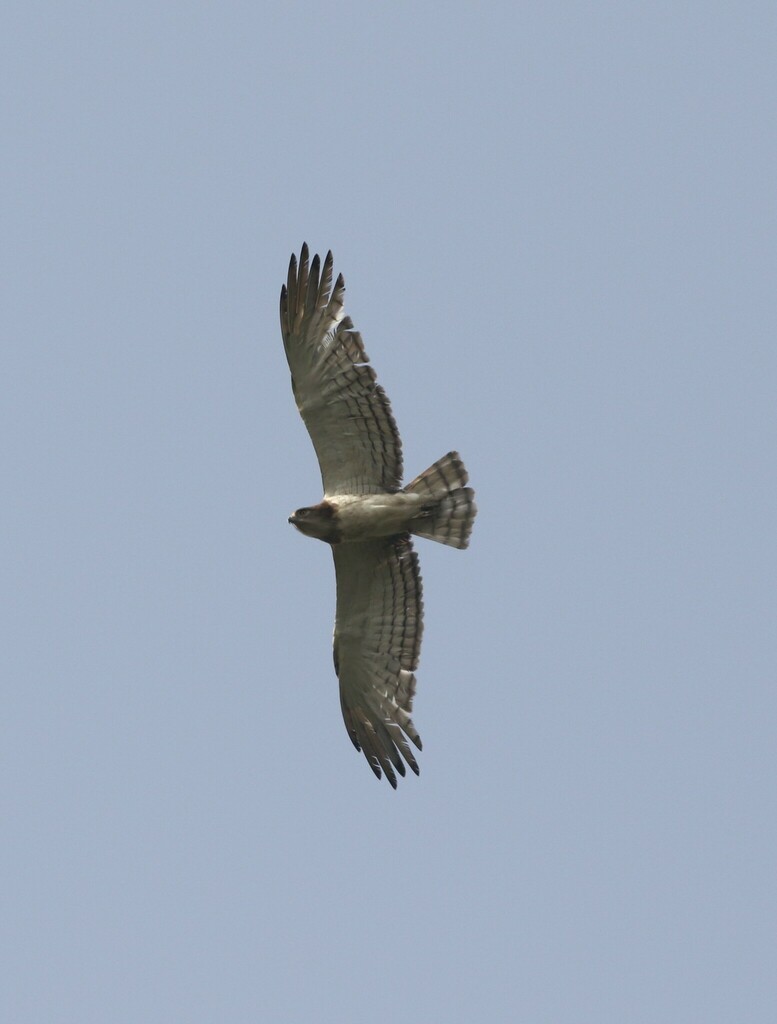
Beaudouin’s Snake Eagle
Photo © Lucy Keith-Diagne
Photo © Lucy Keith-Diagne — CC BY 4.0 — Source: iNaturalist #215497521Identification
Beaudouin's snake eagle is a large raptor with a wingspan of 170 cm, instantly recognizable by its distinctive plumage pattern. Adults display grey-brown upperparts extending across the head and chest, which contrasts sharply with white underparts heavily barred in brown and white. The bird's most striking features are its bright yellow eyes and long, pale grey unfeathered legs, combined with a black bill. Juveniles are much darker, appearing almost entirely dark-plumaged, which can make them challenging to identify in the field.
Range & Habitat
This species is endemic to the Sahel region of West Africa, where it occupies a narrow band stretching from Guinea-Bissau, Senegal, and Gambia through southern Mali and Burkina Faso, extending eastward via Niger, northern Nigeria, and Cameroon to southern Chad, the Central African Republic, and South Sudan. It has been recorded in Uganda, though its status there remains uncertain, and sightings in Kenya are unconfirmed.
Beaudouin's snake eagle favors open woodlands, wooded savanna, and cultivated areas. The species appears to be somewhat nomadic, moving southward during the dry season and northward as the rains arrive, suggesting a response to changing prey availability and habitat conditions across the Sahel.
Behaviour & Diet
This is a sit-and-wait hunter, typically observed perched prominently on telegraph poles or dead trees rather than soaring in flight. Its diet consists mainly of snakes and other small vertebrates, reflecting its role as a specialized ophiophagous predator within its ecosystem. Unfortunately, general behavior remains poorly understood due to limited field study of this elusive species.
The breeding season runs from November to March across West Africa. Pairs construct small stick nests positioned high in tree canopies, typically reaching heights up to 25 meters. Clutches consist of a single egg, with an estimated incubation period around 45 days, followed by a fledging period that may extend a further 70 days.
Best Time & Places to See It
Beaudouin's snake eagle is nowhere common and remains little studied, making sightings challenging for most travelers. The total population is estimated between 3,500 and 15,000 individuals. Your best opportunities lie in the Sahel belt, particularly in countries like Senegal, Mali, Burkina Faso, and Niger during the breeding season from November to March, when birds are more settled and visible. Visiting open woodlands and wooded savanna habitats during early morning hours offers the highest chance of locating a perched bird.
Photography Tips
Patient observation near promising habitat is essential, as these eagles spend most of their time perched rather than in flight. Look for them on dead trees or other prominent vantage points overlooking open ground. The bird's large yellow eyes and striking plumage contrast provide excellent photographic subjects when properly lit. Wide-angle shots capturing the bird's preferred perch habitat can effectively convey the species' ecological niche. Given the species' vulnerable status and low population density, document all sightings carefully—such records contribute valuable data to conservation efforts for this declining raptor.
Kidepo Valley National Park
Uganda
+478 birds+24 mammals
Where the Narus and Kidepo rivers carve through northeastern Uganda's semi-arid lowlands, a landscape of sparse acacia woodland, grassland, and riverine thickets creates one of East…
VIEW NATIONAL PARKMurchison Falls National Park
Uganda
+608 birds+33 mammals
Where the Victoria Nile compresses through a narrow gorge and explodes across a 45-meter precipice, the landscape speaks in thunder. Murchison Falls National Park sprawls across…
VIEW NATIONAL PARKLake Mburo National Park
Uganda
+505 birds+24 mammals
Rolling acacia woodland and scattered lakes define this intimate savanna preserve in southwestern Uganda, where the rift valley's geological drama shapes every water source and grassland.…
VIEW NATIONAL PARKToro-Semliki Proposed National Park
Uganda
+474 birds+5 mammals
Where the Albertine Rift's western escarpment rises above the Semliki River valley, a vast mosaic of forest, savanna and wetland converges to create one of East…
VIEW NATIONAL PARKQueen Elizabeth National Park
Uganda
+672 birds+30 mammals
Across the southwestern escarpment of Uganda, where the Western Rift Valley descends through ancient volcanic terrain, Queen Elizabeth National Park sprawls across more than 8,300 square…
VIEW NATIONAL PARKMabamba Swamp
Memere, Uganda
+464 birds+2 mammals
Across the Central Region of Uganda spreads one of Africa's most biodiverse freshwater wetlands, a sprawling nature reserve of roughly 283 square kilometres where papyrus swamps…
VIEW NATURE RESERVEZiwa Rhino and Wildlife Ranch
Nakasongola, Uganda
+359 birds+11 mammals
Where papyrus wetlands merge into sprawling savanna, Uganda's central landscape opens into one of East Africa's most vital rhino recovery zones. Ziwa Rhino and Wildlife Ranch…
VIEW WILDLIFE SANCTUARYNo community photos yet. Log in to add the first one.
No community observations of this species yet.