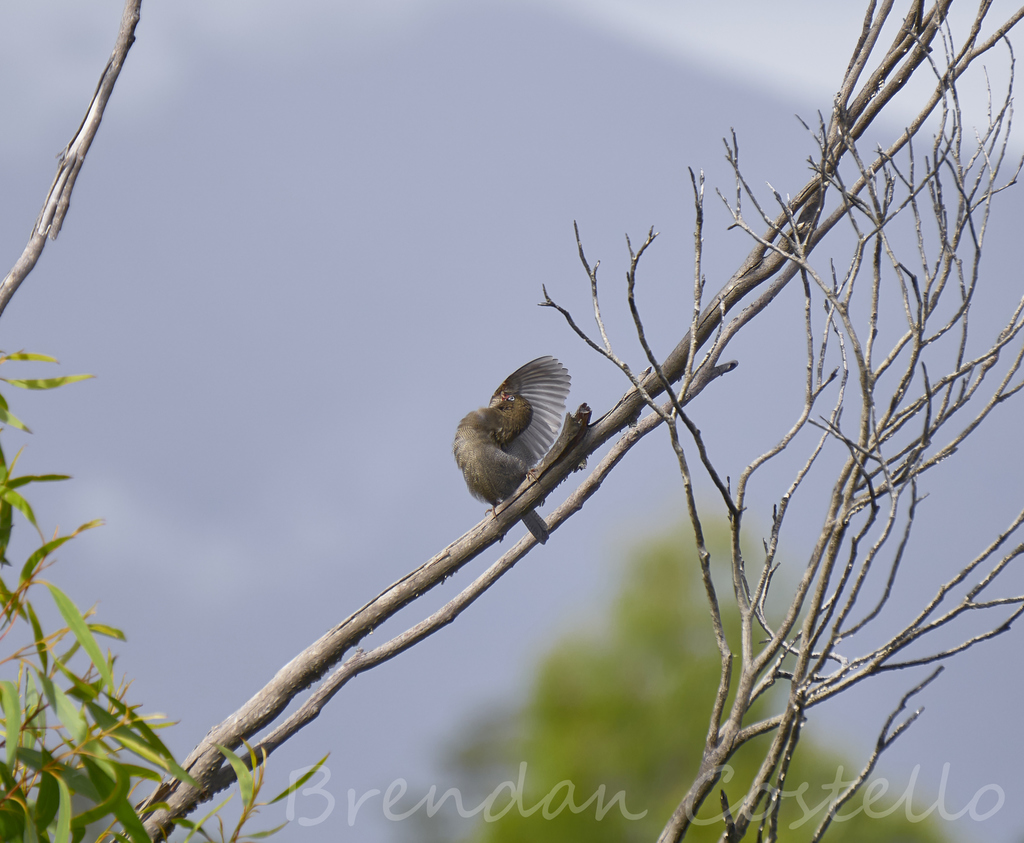
Beautiful Firetail
Photo © Brendan Costello
Photo © Brendan Costello — CC BY 4.0 — Source: iNaturalist #112483868Identification
The beautiful firetail is a small, plump estrildid finch measuring 10–13 cm in length and weighing approximately 14 g. Its most distinctive features include a deep red rump, a prominent black facial mask with pale blue eye-rings, and a thick red beak. The plumage is predominantly olive-brown, with a striking white chest finely patterned with dark lines. The legs and feet are creamy pink, while the wings and tail are short and rounded. Males are characterized by a black abdomen, whereas juveniles display less vibrant colouration, a smaller face mask, and a blackish beak. This compact finch is slightly smaller than its relative, the diamond firetail.
Range & Habitat
Endemic to southeastern Australia, the beautiful firetail's range extends from Newcastle to Kangaroo Island, with the largest populations concentrated in Tasmania and offshore islands. The species inhabits coastal heathland, forests, and shrubland, showing a strong preference for habitats near water. Research in the Victorian Central Highlands has demonstrated that it occurs almost exclusively in riparian zones within intact forest areas. As a resident species, the beautiful firetail maintains a sedentary lifestyle, rarely dispersing far from established territories.
Behaviour & Diet
The beautiful firetail primarily feeds on grass seeds and seeds from Casuarina and Melaleuca trees, occasionally supplementing this herbivorous diet with small insects and snails. The species is highly social, typically encountered in pairs or small groups of up to 20 individuals. It also frequents Banksia ericifolia heathland in coastal New South Wales.
Best Time & Places to See It
The beautiful firetail is a common resident throughout its range, making it relatively accessible to birdwatchers. The breeding season, from October to January, is an ideal time to observe the species, as birds are actively engaged in nesting and feeding behaviours. Look for them in coastal heathland and riparian habitats, particularly near water sources in Tasmania, the Victorian Central Highlands, and along the southeastern Australian coast from Newcastle to Kangaroo Island.
Photography Tips
The beautiful firetail's distinctive red rump and facial markings make it a rewarding photographic subject. Early morning visits to heathland and riparian zones offer the best lighting and bird activity. The species' preference for remaining close to ground level in dense foliage requires patience and a low approach. During breeding season (October–January), birds are more active and visible as they forage and tend to nests. Wide-angle shots capturing the bird within its heathland habitat showcase its ecological preference, while close-ups effectively highlight the striking facial mask and red beak.
Kinglake National Park
Australia
+164 birds+11 mammals
Where the volcanic plains of central Victoria rise into forested ridges, Kinglake National Park encompasses roughly 844 square kilometres of diverse habitat that represents one of…
VIEW NATIONAL PARKLower Glenelg National Park
Australia
+161 birds+12 mammals
Where the Glenelg River carves through southeastern Victoria's limestone country, Lower Glenelg National Park unfolds across nearly 800 square kilometres of river gorge, eucalypt woodland, and…
VIEW NATIONAL PARKRoyal National Park
Sydney, Australia
+296 birds+46 mammals
Where sandstone ridges plunge toward the Tasman Sea, Royal National Park unfolds across 343 square kilometres of southeastern Australian coastal wilderness. The park's defining character emerges…
VIEW NATIONAL PARKNaracoorte Caves National Park
Australia
+116 birds+12 mammals
Beneath the grassy limestone plains of southeastern South Australia lies one of the Southern Hemisphere's most significant underground landscapes. Naracoorte Caves National Park encompasses a mosaic…
VIEW NATIONAL PARKMorton National Park
Australia
+253 birds+57 mammals
Across nearly 4,800 square kilometers of New South Wales's Southern Tablelands, rugged sandstone plateaus rise above sheltered valleys where cool-climate eucalypt woodland meets grassy heath and…
VIEW NATIONAL PARKHeathcote National Park
Sydney, Australia
+119 birds+16 mammals
Sandstone ridges and eucalypt woodlands rise from the Cumberland Plain southwest of Sydney, where Heathcote National Park unfolds across 82 square kilometres of bushland shaped by…
VIEW NATIONAL PARKFlinders Chase National Park
Australia
+142 birds+14 mammals
Granite ridges and windswept mallee scrubland define this 1,630-square-kilometre expanse on Kangaroo Island, where ancient rock formations rise abruptly from coastal heathland and woodland mosaics. The…
VIEW NATIONAL PARKWilsons Promontory National Park
Australia
+210 birds+21 mammals
Where granite headlands plunge toward Bass Strait, Wilson's Promontory National Park sprawls across nearly 1,300 square kilometers of southeastern Victoria's most rugged coastal wilderness. The park's…
VIEW NATIONAL PARKBlue Mountains National Park
Australia
+220 birds+43 mammals
Dramatic sandstone cliffs rise in tiers across this mountainous plateau west of Sydney, their rust-coloured faces weathered into amphitheatres and gorges where eucalyptus forest clings to…
VIEW NATIONAL PARKKosciuszko National Park
Australia
+211 birds+52 mammals
Where the Great Dividing Range reaches its highest peaks in southeastern Australia, Kosciuszko National Park encompasses a landscape of windswept plateaus, rocky ridges, and deep river…
VIEW NATIONAL PARKBudawang National Park
Australia
+80 birds+17 mammals
Rugged sandstone ridges rise dramatically across the New South Wales Southern Tablelands, their weathered faces sculpted by millennia of wind and water into a landscape of…
VIEW NATIONAL PARKBen Boyd National Park
Eden, Australia
+255 birds+47 mammals
Where the temperate forests of the far south coast meet towering sea cliffs, Ben Boyd National Park unveils one of New South Wales' most dramatic coastal…
VIEW NATIONAL PARKGreat Otway National Park
Australia
+255 birds+42 mammals
Temperate rainforest and wet eucalyptus woodland cloak the ridges and gullies of Victoria's Great Otway National Park, where persistent moisture and mild year-round temperatures sustain a…
VIEW NATIONAL PARKCoorong National Park
Australia
+217 birds+15 mammals
Where the Murray River meets the Southern Ocean, a chain of shallow lagoons stretches across the South Australian coast, separated from the sea by a ribbon…
VIEW NATIONAL PARKCradle Mountain-Lake St Clair National Park
Australia
+72 birds+8 mammals
Where glacial valleys plunge between quartzite peaks, Tasmania's Cradle Mountain-Lake St Clair National Park unfolds as a temperate wilderness of uncommon grandeur. The park's terrain ranges…
VIEW NATIONAL PARKFreycinet National Park
Coles Bay, Australia
+115 birds+9 mammals
Granite peaks rise abruptly from the Tasmanian coast where Coles Bay opens into the Freycinet Peninsula, sculpting one of southeastern Australia's most dramatically vertical national parks.…
VIEW NATIONAL PARKTasman National Park
White Beach, Australia
+53 birds+3 mammals
Where the Tasman Peninsula's windswept coastline meets temperate rainforest, White Beach unfolds as one of Tasmania's most dramatic meeting points between land and sea. The park's…
VIEW NATIONAL PARKNo community photos yet. Log in to add the first one.
No community observations of this species yet.