
Footsteps Birdhide
Footsteps Eco-Lodge·Nyatang Faraba·The Gambia
Little Bee-eater · Yellow-crowned Gonolek+7
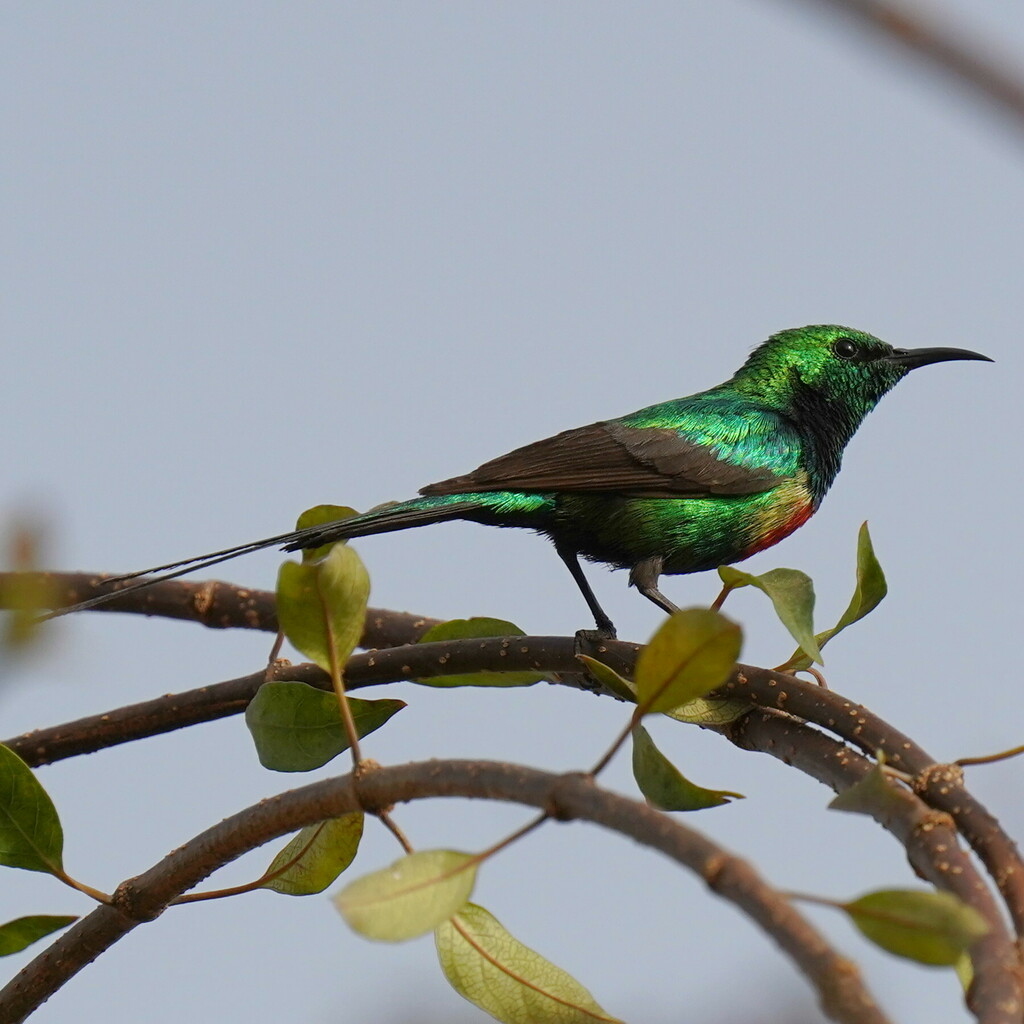
The beautiful sunbird is a tiny passerine, measuring just 10 cm (4 in) in length, though breeding males sport dramatically elongated central tail feathers that add a further 5 cm (2 in). Both sexes possess the characteristic adaptations of sunbirds: a medium-length, down-curved bill and a brush-tipped tubular tongue, perfectly designed for nectar feeding. Males are unmistakable, displaying a glossy black head contrasting with bright metallic green upperparts, a striking scarlet breast bordered with yellow, and a black belly. Females are considerably duller, appearing brown above with yellowish underparts, making them more challenging to identify in the field.
This species enjoys a broad distribution across tropical Africa, ranging from Senegal and Guinea in the west through to Sudan, South Sudan, Ethiopia, Tanzania and Kenya in the east. The beautiful sunbird occupies a variety of open habitats with scattered trees, thriving in savannah, riverside thickets, mangroves, beachsides and cultivated gardens. Its adaptability to different open woodland environments contributes to its widespread presence and stable populations across its range.
As with all sunbirds, the beautiful sunbird feeds primarily on nectar, though it supplements this diet with insects, particularly when provisioning young chicks. Despite their ability to hover like hummingbirds, these birds typically perch while feeding—a more energy-efficient approach. Their flight is notably fast and direct despite their short wings. The beautiful sunbird is a common breeder throughout sub-Saharan tropical Africa, with females constructing delicate suspended nests in trees where they lay one or two eggs. The species is a seasonal migrant within its African range.
The beautiful sunbird's seasonal migratory patterns and widespread breeding presence make it a reliable sighting across much of sub-Saharan Africa. Visitors should focus on open savannah habitats with flowering trees and shrubs, as well as gardens and riverside thickets where nectar sources are abundant. The bird's common status across its expansive range means dedicated birders have good opportunities to locate it throughout tropical African regions where suitable habitat exists.
The brilliant iridescence of the male's metallic plumage and contrasting scarlet breast make for striking photographs, particularly in good natural light that brings out the jewel-like colours. Early morning or late afternoon light is ideal for capturing the bird's metallic sheen. Patient positioning near flowering trees and gardens, where the birds perch regularly to feed, will reward photographers with opportunities for sharp, detailed images of these diminutive birds.
Nothing matches these filters.
Nothing matches these filters.
No community photos yet. Log in to add the first one.
No community observations of this species yet.
We'd love to hear from you. We'll reply as soon as possible.
Found an error? Have a suggestion? We read every message.
A compact view of how this species lives, moves and responds to its environment.
Select a card to explore the details.
Please confirm the photo rights and credit terms first.
I'm the author of this photo or hold the rights to it, and I keep full ownership. I grant Wild Atlas Guide a free, non-exclusive licence to display it on the site and in Wild Atlas Guide's own channels, including social media, always credited to me by my display name or the Instagram handle I choose to provide. I confirm it does not reveal a sensitive wildlife location or a recognisable person without their permission. I can withdraw future social use for this photo or ask for it to be removed at any time.
Please accept the photo rights and credit terms to continue.
Uploading…
We use cookies to measure traffic and improve Wild Atlas Guide. You decide. Privacy policy