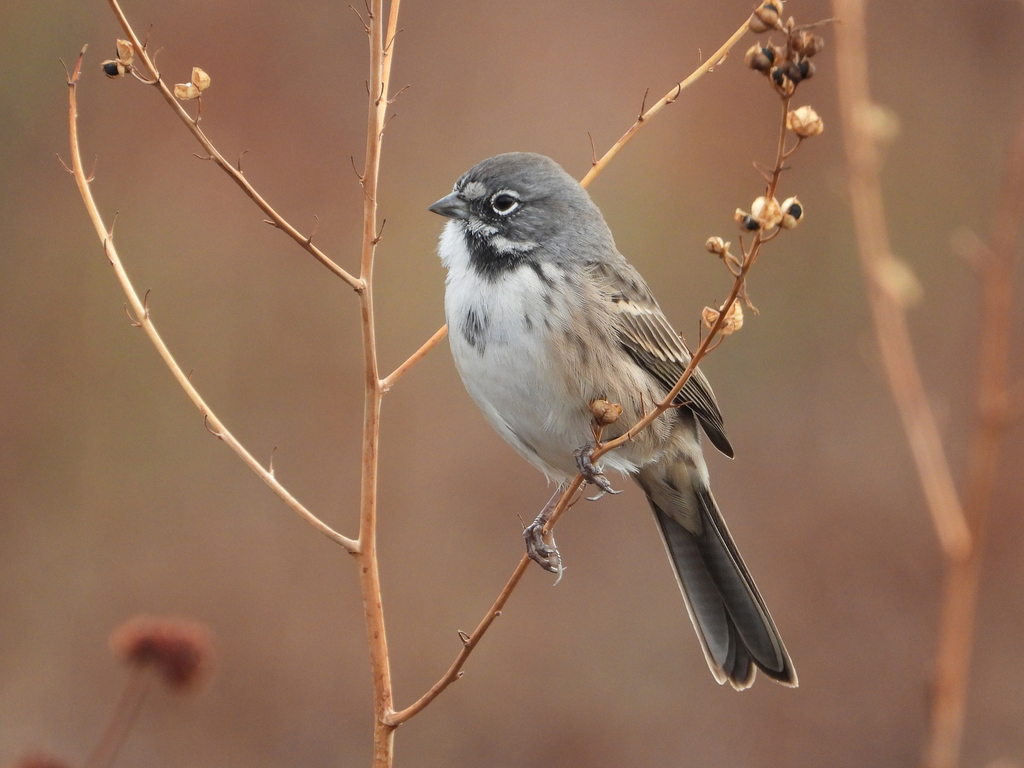
Bell’s Sparrow
Photo © James M. Maley
Photo © James M. Maley — CC BY 4.0 — Source: iNaturalist photo #251531624Identification
Bell's sparrow is a small passerine, measuring 4.7 to 5.9 inches long and weighing roughly half an ounce. Both sexes share identical plumage: a mostly dark gray head and nape, dusky black lores contrasted by a white patch above them, and a distinctive white eye-ring. A white streak runs below the ear coverts with a black stripe beneath it. The back and rump are brownish with faint streaking, while the tail is blackish-brown with white outer webs on the outermost feathers. The wings display two subtle wing bars formed by whitish to rufous tips on the median and greater coverts. The underparts are mostly white with a characteristic small black spot on the breast center; flanks show a pale brown wash with darker streaking. All individuals have a hazel-brown iris, charcoal-gray upper mandible, and pale blue-gray lower mandible. Three subspecies vary in overall tone: nominate A. b. belli is darkest; A. b. canescens is larger and paler with more distinct streaking; A. b. cinerea is the palest with minimal back streaking.
Range & Habitat
Bell's sparrow inhabits western North America from northwestern California south through the coastal ranges into Baja California, with isolated populations in central California's Sierra Nevada foothills and on San Clemente Island. The species' range extends eastward through desert regions of southern California, Nevada, Arizona, and into Sonora, Mexico, with subspecies distributions varying accordingly. The bird favors somewhat open, shrubby habitats typically dominated by sagebrush. Coastal populations occupy chaparral and sagebrush scrublands, while desert subspecies inhabit scrublands featuring sagebrush, bitterbrush, saltbush, and other semi-arid shrubs.
Behaviour & Diet
Bell's sparrow is a partial migrant; most populations remain year-round residents, though some northernmost birds migrate south after breeding, and certain desert populations make elevational or latitudinal movements. During breeding season, the species feeds on adult and larval insects, spiders, seeds, small fruits, and plant matter, switching to a primarily seed-based diet in winter. The bird forages mostly on the ground beneath or near shrubs, though it will glean from vegetation above ground, moving by hopping and walking. Breeding birds are typically seen in pairs; winter flocks may include other sparrow species.
Best Time & Places to See It
Bell's sparrow is considered quite common in some areas throughout its range. Look for it year-round in sagebrush and desert scrublands where the species is resident, particularly in coastal California chaparral, the interior valleys, and desert regions of the Southwest. During migration periods, northern populations may appear in new locations as they move to winter grounds in southeastern California, western Arizona, and northern Sonora. The bird's partial migratory nature means that seasonal visits to prime sagebrush habitat in spring and summer offer the best opportunities for observation, especially during breeding season when males are vocal.
Photography Tips
Bell's sparrow's subtle plumage demands attention to light and contrast. Photograph in early morning or late afternoon when side-lighting reveals the fine details of head markings, the black breast spot, and flank streaking. The bird's habit of foraging on the ground under shrubs can obscure views; patience and careful positioning will reward you with clear shots. Males singing from shrub tops during breeding season provide excellent photo opportunities; listen for the jumbled, buzzy song to locate singers. The small size and fine detail work make a telephoto lens essential. Shooting in harsh midday light can flatten the gray tones; overcast days or shaded canyon habitats often produce more naturalistic images with better color rendition.
Saguaro National Park
Rincon Valley, United States
+354 birds+40 mammals
Where the Sonoran Desert meets sky-island mountains, two geographically separated districts of Saguaro National Park sprawl across nearly two thousand square kilometers of Arizona's most iconic…
VIEW NATIONAL PARKPinnacles National Park
San Benito County, United States
+197 birds+33 mammals
Jagged volcanic spires thrust from chaparral-covered ridges across 222 square kilometers of central California's inner Coast Ranges, their pale stone crowns catching the afternoon light like…
VIEW NATIONAL PARKJoshua Tree National Park
Riverside County, United States
+221 birds+23 mammals
Across 5,610 square kilometers of Riverside County's high desert, a landscape of geological drama unfolds where granite monoliths pierce through bajadas of creosote scrub and Joshua…
VIEW NATIONAL PARKYosemite National Park
Mariposa County, United States
+224 birds+28 mammals
Granite cliffs soar nearly a kilometer above the valley floor in this expanse of high Sierra wilderness, where glacial U-shaped valleys sculpt a landscape of dramatic…
VIEW NATIONAL PARKSequoia National Park
Tulare County, United States
+187 birds+27 mammals
Granite peaks rising above 3,600 meters dominate the southern Sierra Nevada, where Sequoia National Park sprawls across one of North America's most vertically compressed wilderness zones.…
VIEW NATIONAL PARKKings Canyon National Park
Fresno County, United States
+186 birds+20 mammals
Where granite peaks fracture the Sierra Nevada skyline and the Kings River has carved one of North America's most dramatic canyons, a landscape of extreme relief…
VIEW NATIONAL PARKDeath Valley National Park
Inyo County, United States
+339 birds+25 mammals
Across nearly 3.5 million acres of southeastern California's Inyo County, vast salt flats meet sculpted badlands and alluvial fans in a landscape so extreme it defines…
VIEW NATIONAL PARKEl Vizcaíno
Laguna San Ignacio, Mexico
+317 birds+29 mammals
Where the Baja California peninsula thins into a tapestry of salt lagoons and coastal desert, one of Mexico's most biodiverse reserves sprawls across half a million…
VIEW BIOSPHERE RESERVEChannel Islands National Park
Santa Barbara County, United States
+330 birds+15 mammals
A chain of eight volcanic islands rises from the cold Pacific waters off the California coast, their rugged sea cliffs and windswept terrain shaped by millions…
VIEW NATIONAL PARKCabeza Prieta National Wildlife Refuge
United States
+155 birds+6 mammals
Across southwestern Arizona's harshest terrain, where the Colorado River marks the border with Mexico, lies a sanctuary shaped entirely by heat and aridity. Cabeza Prieta National…
VIEW WILDLIFE SANCTUARYHavasu National Wildlife Refuge
Lake Havasu City, United States
+291 birds+8 mammals
Where the Colorado River widens into a vast reservoir in the Sonoran Desert, Havasu National Wildlife Sanctuary protects one of the most critical wetland ecosystems in…
VIEW WILDLIFE SANCTUARYImperial National Wildlife Refuge
La Paz County, United States
+222 birds+4 mammals
Where the Colorado River carves through the Sonoran Desert in southwestern Arizona, Imperial National Wildlife Sanctuary unfolds across a landscape shaped by water and aridity. The…
VIEW WILDLIFE SANCTUARYFarallon National Wildlife Refuge
San Francisco, United States
+384 birds+16 mammals
Windswept granite peaks rising abruptly from the Pacific, the Farallon Islands form a wildlife sanctuary of extraordinary seabird abundance and ecological significance just twenty-seven miles west…
VIEW WILDLIFE SANCTUARYSalton Sea National Wildlife Refuge
Imperial County, United States
+289 birds+4 mammals
Across the floor of California's inland desert, where summer temperatures soar and rainfall is measured in tenths of inches, lies an improbable oasis of shallow water…
VIEW WILDLIFE SANCTUARYNo community photos yet. Log in to add the first one.
No community observations of this species yet.