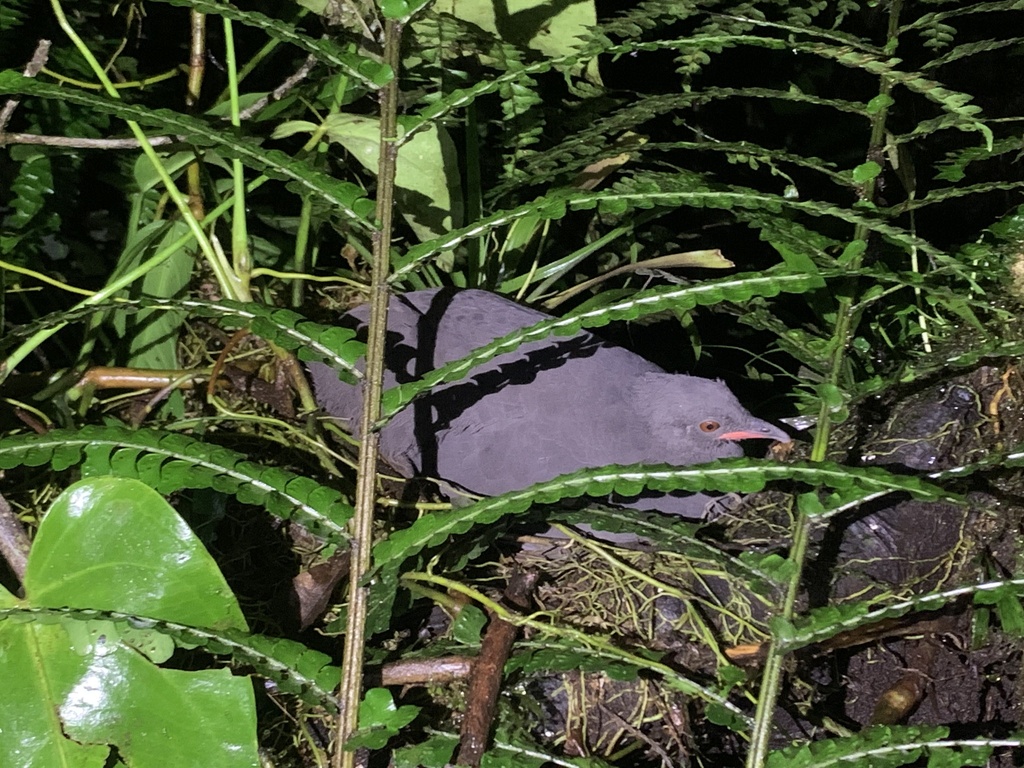
Berlepsch’s Tinamou
Photo © Ethan Borland
Photo © Ethan Borland — CC0 1.0 — Source: iNaturalist #187892727Identification
Berlepsch's tinamou is a medium-sized ground bird measuring 29.6–32 centimetres in length, with females notably heavier than males. The plumage is predominantly brownish-black to deep sooty brown, with the head and throat distinctly darker than the body and displaying a reddish tinge on the crown and nape. The bird's most distinctive features include pink legs and feet, a dark upper mandible contrasting with a pinkish lower mandible, and striking red irises. Its bill is notably longer and heavier than that of its close relative, the cinereous tinamou—a key distinguishing characteristic. Juveniles resemble adults but display cinnamon-tinged barring on their underwings and underparts.
Range & Habitat
This species inhabits the extreme northern coastal regions of Ecuador and Colombia, extending as far north as Utria National Park in the Bahia de Capica. It is a resident of lowland moist forests in subtropical to tropical zones, showing flexibility in its habitat preferences by occupying mature secondary forests and even logged areas. In Colombia, the bird typically frequents coastal lowlands and hills up to 500 metres elevation, though records document sightings as high as 900 metres.
The species has been documented at only two confirmed locations: Playa de Oro Reserva de los Tigrillos in Ecuador, approximately 20 kilometres north of Cotacachi Cayapas Ecological Reserve, and Milipe Bird Sanctuary, roughly 15 kilometres west of Maquipucuna, also in Ecuador.
Behaviour & Diet
Berlepsch's tinamou is a sedentary species, remaining within its forest territories year-round. Like other members of the Crypturellus genus, it primarily feeds on fleshy fruits gleaned from the ground, though it will also pluck fruit from lower-hanging branches. The diet is supplemented with small amounts of invertebrates, flower buds, tender leaves, seeds, and roots.
The species breeds in February in Colombia. As with all tinamou, males undertake full parental responsibility, incubating eggs from multiple females—possibly up to four—and rearing chicks until independence at 2–3 weeks of age. Nests are positioned on the ground within dense brush or between raised root buttresses, containing pale greenish oblong eggs.
Best Time & Places to See It
February offers the most likely opportunity for observing breeding birds in Colombian lowlands. The documented strongholds are Playa de Oro Reserva de los Tigrillos and Milipe Bird Sanctuary in Ecuador, both situated in the northwestern coastal region. The species inhabits lowland moist forests up to 900 metres, with preference for areas offering dense understorey vegetation and fruiting trees.
Photography Tips
The cryptic plumage and ground-dwelling habits of Berlepsch's tinamou demand patience and stealth. Early morning foraging sessions, particularly during February's breeding season, provide the best opportunities for encounters. The bird's preference for picking fruit from the ground means scanning the forest floor in areas with fruiting trees. Its reddish iris and contrasting bill colours are helpful identifying features to capture. The dense forest habitat demands fast film speeds or high ISO settings, and a telephoto lens will be essential for photographing this shy, elusive species while maintaining adequate distance.
Natural Utría National Park
Alto Baudó (Pie de Pató), Colombia
+372 birds+11 mammals
Where the Chocó's coastal mountains plunge toward the Pacific, Utría National Park preserves one of Colombia's most biodiverse and least-visited wilderness expanses. Sprawling across 1,287 square…
VIEW NATIONAL PARKNatural Farallones de Cali National Park
Buenaventura, Colombia
+733 birds+27 mammals
Where the Pacific coastal plain meets the western slopes of the Andes, Farallones de Cali National Park sprawls across nearly 3,500 square kilometers of dramatic topography…
VIEW NATIONAL PARKNatural Uramba Bahía Málaga National Park
Buenaventura, Colombia
+308 birds+15 mammals
Where the Pacific coastal rainforest descends to mangrove estuaries and rocky headlands, Uramba Bahía Málaga National Park unfolds across nearly 1,000 square kilometres of Colombia's Valle…
VIEW NATIONAL PARKNo community photos yet. Log in to add the first one.
No community observations of this species yet.