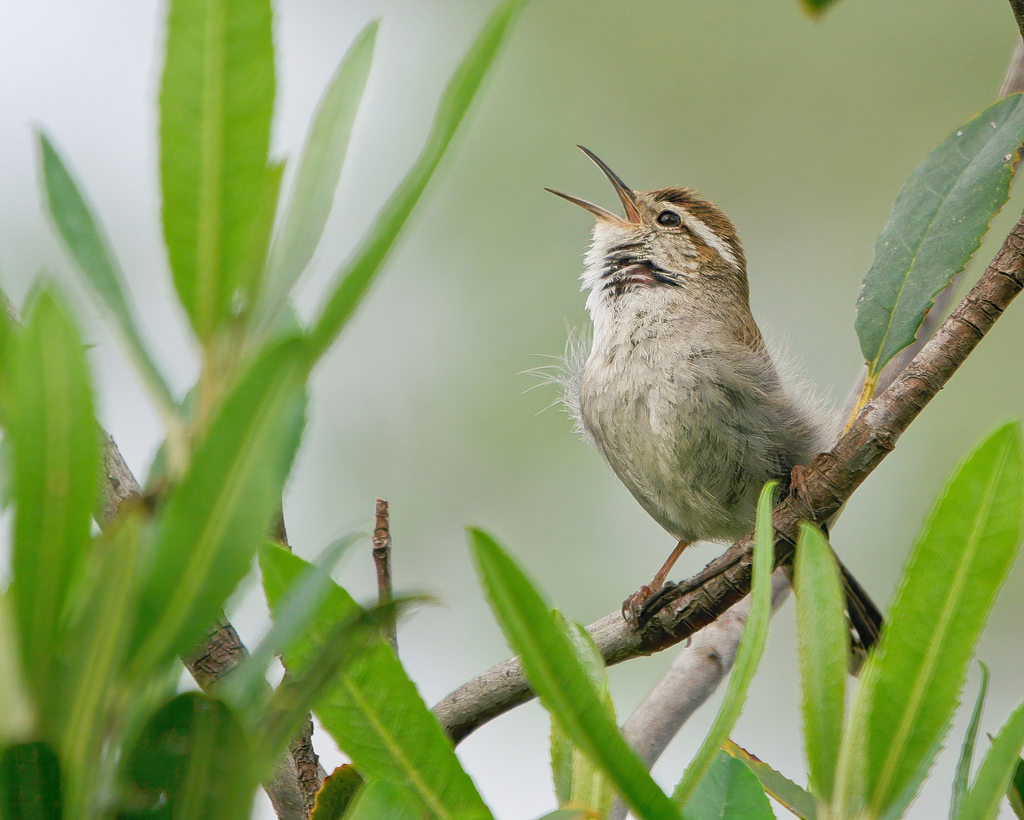
Bewick’s Wren
Photo © Bill Levine
Photo © Bill Levine — CC BY 4.0 — Source: iNaturalist photo #262276472Identification
Bewick's Wren is a small wren, approximately 14 cm (5.5 in) long, with distinctive plumage that makes it recognizable in the field. The bird is grey-brown above and white below, with a characteristic long white eyebrow stripe running above each eye. Its most striking feature is its long tail, which displays black barring and white corners—a detail made conspicuous by the bird's frequent tail movements. The beak is long, slender, and slightly curved. While superficially similar to the Carolina Wren, Bewick's Wren is smaller and more delicate. Males and females are virtually identical in appearance, though juveniles may show shorter, stockier beaks and faint speckling on the underparts.
Range & Habitat
Bewick's Wren historically ranged from southern British Columbia, Nebraska, southern Ontario, and southwestern Pennsylvania south through the eastern United States to Mexico. However, the species has undergone a dramatic range contraction and is now extremely rare east of the Mississippi River. Today, it remains relatively common along the Pacific Coast from Baja California to British Columbia, throughout much of the Mexican interior, and across the American Southwest, including Texas, Arizona, New Mexico, and Oklahoma. The species favors arid open woodlands, brush-filled hillsides, thickets, brush piles, hedgerows, and scrubby areas, often near streams. Western populations are typically non-migratory.
Behaviour & Diet
Bewick's Wrens are highly vocal birds, with males singing to establish territory and attract mates. The song is loud and melodious, typically broken into two or three parts, with individual males capable of producing up to twenty-two different variations. Remarkably, males learn their songs from neighboring males rather than from their fathers, resulting in regional song dialects. Both sexes produce short calls while foraging and emit harsh scolding calls when alarmed. The species forages primarily for insects and spiders, gleaning them from vegetation or searching on the ground.
Best Time & Places to See It
For the best chance of encountering Bewick's Wren, focus your efforts on the western portions of North America. The Pacific Coast from British Columbia to Baja California offers reliable sightings, as do the southwestern states of Texas, Arizona, New Mexico, and Oklahoma, and the interior of Mexico. Seek out open woodlands, brush-filled hillsides, and scrubby habitats, particularly those near streams or in drier upland areas. The species' vocal nature means listening for its distinctive loud, melodious song can be as effective as visual searching.
Photography Tips
Photograph Bewick's Wren in open, brushy habitats where the bird's characteristic features are visible. The white eyebrow stripe, grey-brown upperparts, and distinctive long tail with white corners are key diagnostic features to capture. The bird's frequent tail movements provide excellent opportunities for action shots. Early morning is ideal for capturing both visual detail and recording the male's varied and complex vocalizations. Use patient, stationary observation near brush piles, hedgerows, and scrubby woodland edges where the species forages, allowing the wren to move naturally into good photographic light.
Arches National Park
Bear River Migratory Bird Refuge
Big Bend National Park
Bitter Lake National Wildlife Refuge
Black Canyon of the Gunnison National Park
Bosque del Apache National Wildlife Refuge
Bryce Canyon National Park
Cabeza Prieta National Wildlife Refuge
Canyonlands National Park
Nothing matches these filters.
No community photos yet. Log in to add the first one.
No community observations of this species yet.