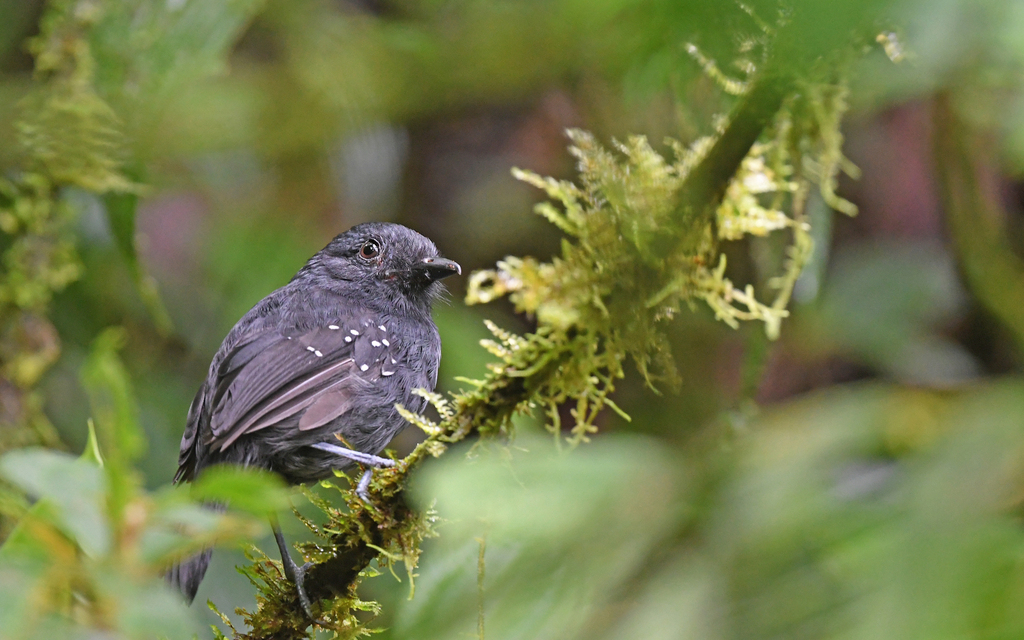
Bicolored Antvireo
Photo © Christoph Moning
Photo © Christoph Moning — CC BY 4.0 — Source: iNaturalist photo #235350779The bicolored antvireo (Dysithamnus occidentalis) is a Near Threatened insectivorous bird in subfamily Thamnophilinae of family Thamnophilidae, the "typical antbirds". It is found in Colombia, Ecuador, and Peru. == Taxonomy and systematics == The bicolored antvireo was described by the American ornithologist Frank Chapman in 1923. He considered it a subspecies of the white-shouldered antshrike (Thamnophilus aethiops) and coined the trinomial name Thamnophilus aethiops occidentalis. By the end of the twentieth century, it was widely accepted as a member of its present genus Dysithamnus . The bicolored antvireo has two subspecies, the nominate D. o. occidentalis (Chapman, 1923) and D. o. punctitectus (Chapman, 1924). Confusingly, punctitectus was originally described as a species in genus Dysithamnus while occidentalis was still in genus Thamnophilus. When occidentalis was moved to Dysithamnus and punctitectus was assigned as a subspecies, because occidentalis had been described first (even in a different genus) it became the nominate because of the principle of priority. == Description == The bicolored antvireo is about 13 to 13.5 cm (5.1 to 5.3 in) long. Adult males of the nominate subspecies D. o. occidentalis have a blackish gray head, upperparts, and tail with a mostly-hidden white patch between the scapulars. Their wings…
Antisana National Park
Quijos, Ecuador
+432 birds+21 mammals
Where the eastern Andean slopes descend into the Amazon basin, Antisana National Park sprawls across roughly 2,500 square kilometers of some of South America's most dramatic…
VIEW NATIONAL PARKNatural Farallones de Cali National Park
Buenaventura, Colombia
+733 birds+27 mammals
Where the Pacific coastal plain meets the western slopes of the Andes, Farallones de Cali National Park sprawls across nearly 3,500 square kilometers of dramatic topography…
VIEW NATIONAL PARKNo community photos yet. Log in to add the first one.
No community observations of this species yet.