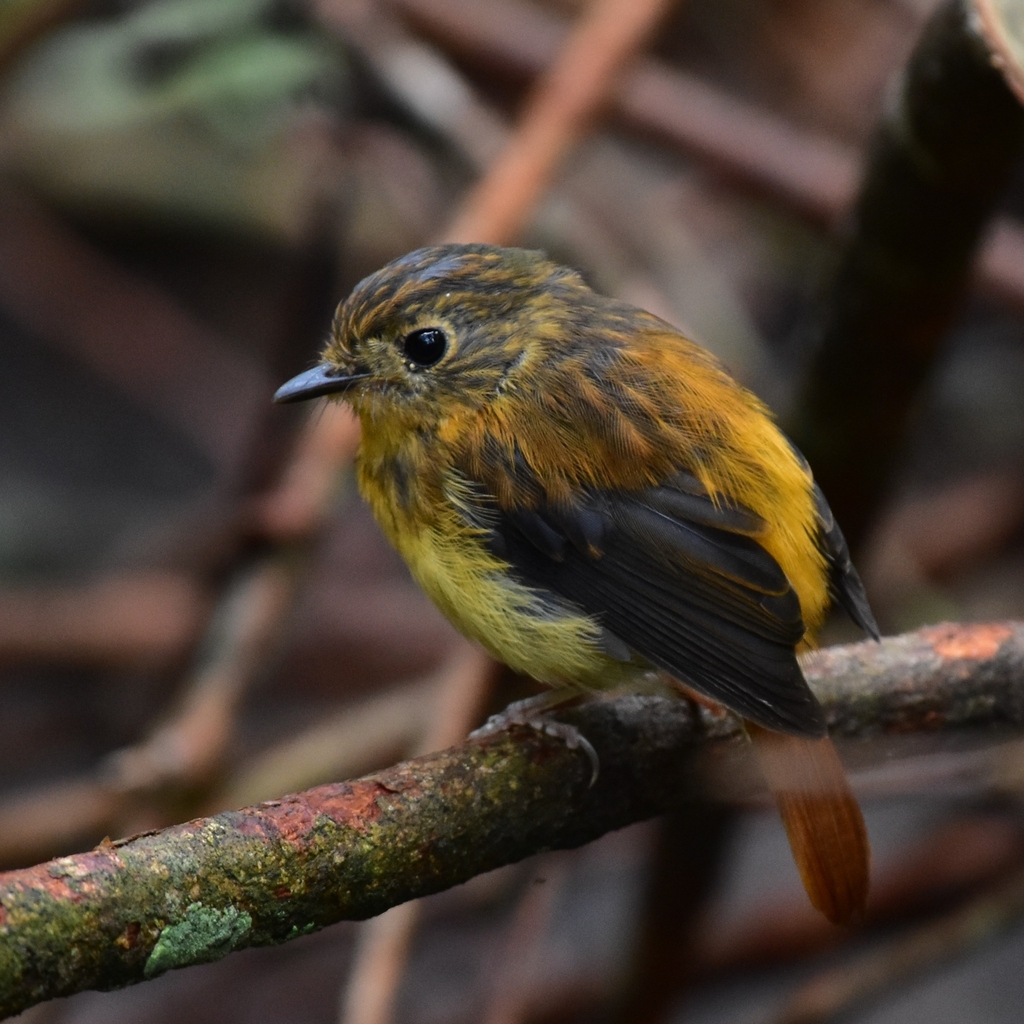
Black-and-orange Flycatcher
Photo © Renjith Jacob Mathews
Photo © Renjith Jacob Mathews — CC BY 4.0 — Source: iNaturalist #190763973The black-and-orange flycatcher (Ficedula nigrorufa) or black-and-rufous flycatcher is a species of flycatcher endemic to the central and southern Western Ghats, the Nilgiris and Palni hill ranges in southern India. It is unique among the Ficedula flycatchers in having rufous coloration on its back and prior to molecular studies was suggested to be related to the chats and thrushes. == Description == A distinctly coloured bird found mainly in the high-elevation areas of the Western Ghats, the Nilgiris, the Palnis and associated hill ranges. The male is distinctly black headed with black wings. The female has the black replaced by dark brown and has a light eye-ring. They are usually seen singly or in pairs. The young bird at around two weeks of age is brownish orange with a whitish vent and abdomen. The head has dark streaks and the wings appear bluish with a trace of brown. There is a pale ring around the eye and the orange tail appears stumpy. Eight weeks after fledging they appear almost like adults except for patches of brown feathers in the crown. == Distribution and habitat == The main population of this bird is found in the high elevation plateaus above 1,500…
Eravikulam National Park
Devikulam, India
+192 birds+7 mammals
High in the Western Ghats of Kerala, where monsoon mists cling to slopes that rise above 2,000 metres, Eravikulam National Park preserves one of South India's…
VIEW NATIONAL PARKPeriyar National Park
Mlappara, India
+232 birds+4 mammals
Dawn breaks over mist-shrouded ridges where the Western Ghats tumble toward Kerala's spice-scented lowlands. Here, ancient tropical forests envelope a glittering artificial lake, creating a mosaic…
VIEW NATIONAL PARKPampadum Shola National Park
Vattavada, India
+258 birds+14 mammals
Where misty shola forests cling to the high plateaus of the Nilgiri Mountains, ancient evergreen remnants create a world apart. This 2,316-hectare reserve protects one of…
VIEW NATIONAL PARKNo community photos yet. Log in to add the first one.
No community observations of this species yet.