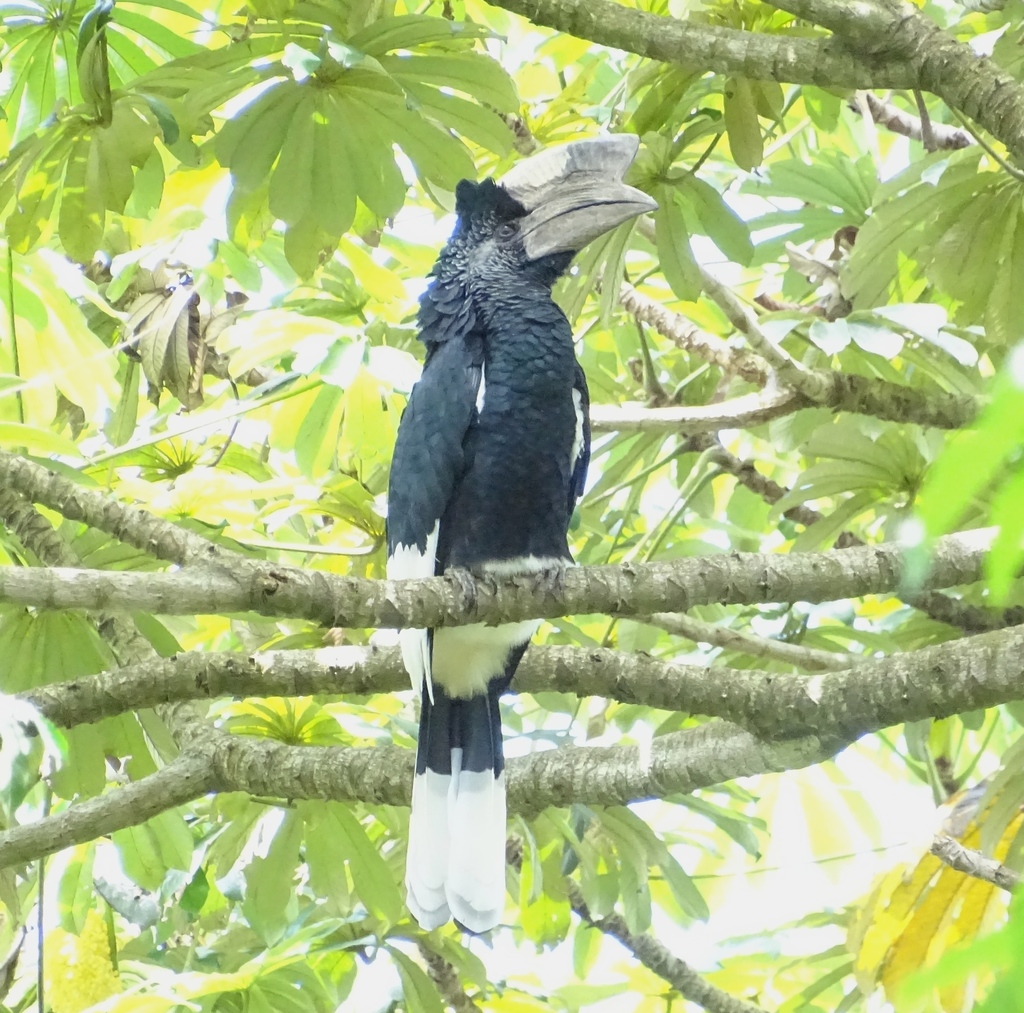
Black-and-white-casqued Hornbill
Photo © Sandra Keller
Photo © Sandra Keller — CC BY 4.0 — Source: iNaturalist #26993398Identification
The black-and-white-casqued hornbill, also known as the grey-cheeked hornbill, is a moderately large bird measuring 60 to 70 cm in length with a wingspan of 70 to 96 cm. Males typically weigh between 1 kg and 1.5 kg, while females are slightly smaller at 1 kg to 1.25 kg. This species is immediately recognizable by its striking black plumage on the upper body and wings contrasting sharply with white plumage on the lower body and wings, with black feathers scattered among the white tail feathers, particularly at the top and base.
The most distinctive feature is the oversized bill with a prominent casque (helmet-like protuberance) on top, which is notably larger and more pronounced in males. Males display a yellow-brownish bill, while females have a black bill and a significantly smaller casque. The purpose of the casque in males remains unknown, though it is thought to play a role in sexual characterization. A remarkable trait for birds is the black-and-white-casqued hornbill's very mobile eyes, which can move independently in their sockets—an uncommon ability among avian species. This hornbill can also communicate its emotional state through the feathers at the top of its head.
Range & habitat
This species is found across wooded habitats in central and western Africa, with its range extending from western Kenya to Côte d'Ivoire, with an isolated population in northern Angola. West African populations are most abundant in Ivory Coast with smaller populations in surrounding countries, while Central African populations are concentrated in Uganda, Kenya, and Cameroon, with smaller numbers in Gabon, Tanzania, and Central Africa.
The black-and-white-casqued hornbill is a tropical forest bird, preferring regions with high forest cover and rarely venturing into flat lands. Its arboreal nature makes it largely dependent on wooded habitats, where it spends most of its time in the canopy searching for food and suitable nesting sites.
Behaviour & diet
This is a monogamous species in which pairs nest together in suitable tree cavities. Females typically lay up to two eggs per breeding season. The black-and-white-casqued hornbill has an interesting relationship with hydration—it does not drink water directly but instead obtains moisture from the fruits that form the bulk of its diet.
The diet consists primarily of fruits, particularly figs, supplemented with insects and small animals including lizards and the eggs of other birds. Despite their reputation as strictly frugivorous birds, black-and-white-casqued hornbills are capable hunters of small prey. They demonstrate remarkable precision in handling food items using their beaks skillfully in conjunction with their esophagus to manipulate and consume both delicate fruits and small creatures.
Best time & places to see it
The black-and-white-casqued hornbill is widespread and still locally common throughout its range, making it relatively accessible for wildlife travellers. The species is assessed as Least Concern on the IUCN Red List, indicating stable populations. Visitors to forested regions in western and central Africa, particularly in Ivory Coast and the East African countries of Kenya and Uganda, have reasonable prospects of encountering this species in suitable wooded habitats.
Photography tips
Photographing this distinctive hornbill rewards patience and attention to canopy activity. The striking black-and-white plumage and dramatic bill and casque provide excellent photographic subjects, especially with backlighting that accentuates the contrast between dark and pale feathers. Early morning hours often provide the best light and increased foraging activity. Since these are arboreal birds, a telephoto lens is essential for capturing detailed shots from the ground. Look for feeding birds in fruiting trees, particularly fig trees, where multiple individuals may gather.
Rubondo Island National Park
Tanzania
+99 birds+8 mammals
Across the waters of Lake Victoria's northeastern arm, Rubondo Island rises as a freshwater wilderness where papyrus swamps grade into acacia woodlands and dense thickets of…
VIEW NATIONAL PARKVirunga National Park
Uganda
+418 birds+13 mammals
Where the Western Rift Valley fractures the landscape of North Kivu, Virunga National Park sprawls across terrain as geologically dramatic as it is ecologically vital. Volcanic…
VIEW NATIONAL PARKBwindi Impenetrable National Park
Kanyashogi, Uganda
+603 birds+26 mammals
Steep ridges cloaked in montane forest rise from Uganda's southwestern borderlands, where the landscape grows so dense and tangled that early explorers named it impenetrable. At…
VIEW NATIONAL PARKKidepo Valley National Park
Uganda
+478 birds+24 mammals
Where the Narus and Kidepo rivers carve through northeastern Uganda's semi-arid lowlands, a landscape of sparse acacia woodland, grassland, and riverine thickets creates one of East…
VIEW NATIONAL PARKMurchison Falls National Park
Uganda
+608 birds+33 mammals
Where the Victoria Nile compresses through a narrow gorge and explodes across a 45-meter precipice, the landscape speaks in thunder. Murchison Falls National Park sprawls across…
VIEW NATIONAL PARKLake Mburo National Park
Uganda
+505 birds+24 mammals
Rolling acacia woodland and scattered lakes define this intimate savanna preserve in southwestern Uganda, where the rift valley's geological drama shapes every water source and grassland.…
VIEW NATIONAL PARKMount Elgon National Park
Matumbei ward, Kenya
+164 birds+7 mammals
Where the volcanic slopes of Mount Elgon rise above the Trans-Nzoia landscape, a montane wilderness unfolds across multiple ecological zones, each harbouring distinct communities adapted to…
VIEW NATIONAL PARKToro-Semliki Proposed National Park
Uganda
+474 birds+5 mammals
Where the Albertine Rift's western escarpment rises above the Semliki River valley, a vast mosaic of forest, savanna and wetland converges to create one of East…
VIEW NATIONAL PARKQueen Elizabeth National Park
Uganda
+672 birds+30 mammals
Across the southwestern escarpment of Uganda, where the Western Rift Valley descends through ancient volcanic terrain, Queen Elizabeth National Park sprawls across more than 8,300 square…
VIEW NATIONAL PARKMabamba Swamp
Memere, Uganda
+464 birds+2 mammals
Across the Central Region of Uganda spreads one of Africa's most biodiverse freshwater wetlands, a sprawling nature reserve of roughly 283 square kilometres where papyrus swamps…
VIEW NATURE RESERVEZiwa Rhino and Wildlife Ranch
Nakasongola, Uganda
+359 birds+11 mammals
Where papyrus wetlands merge into sprawling savanna, Uganda's central landscape opens into one of East Africa's most vital rhino recovery zones. Ziwa Rhino and Wildlife Ranch…
VIEW WILDLIFE SANCTUARYSaiwa Swamp National Park
Sinyerere ward, Kenya
+255 birds+4 mammals
Where papyrus and sedge marshes stretch across a highland plateau in western Kenya, Saiwa Swamp National Park shelters one of East Africa's most productive freshwater wetland…
VIEW NATIONAL PARKNo community photos yet. Log in to add the first one.
No community observations of this species yet.