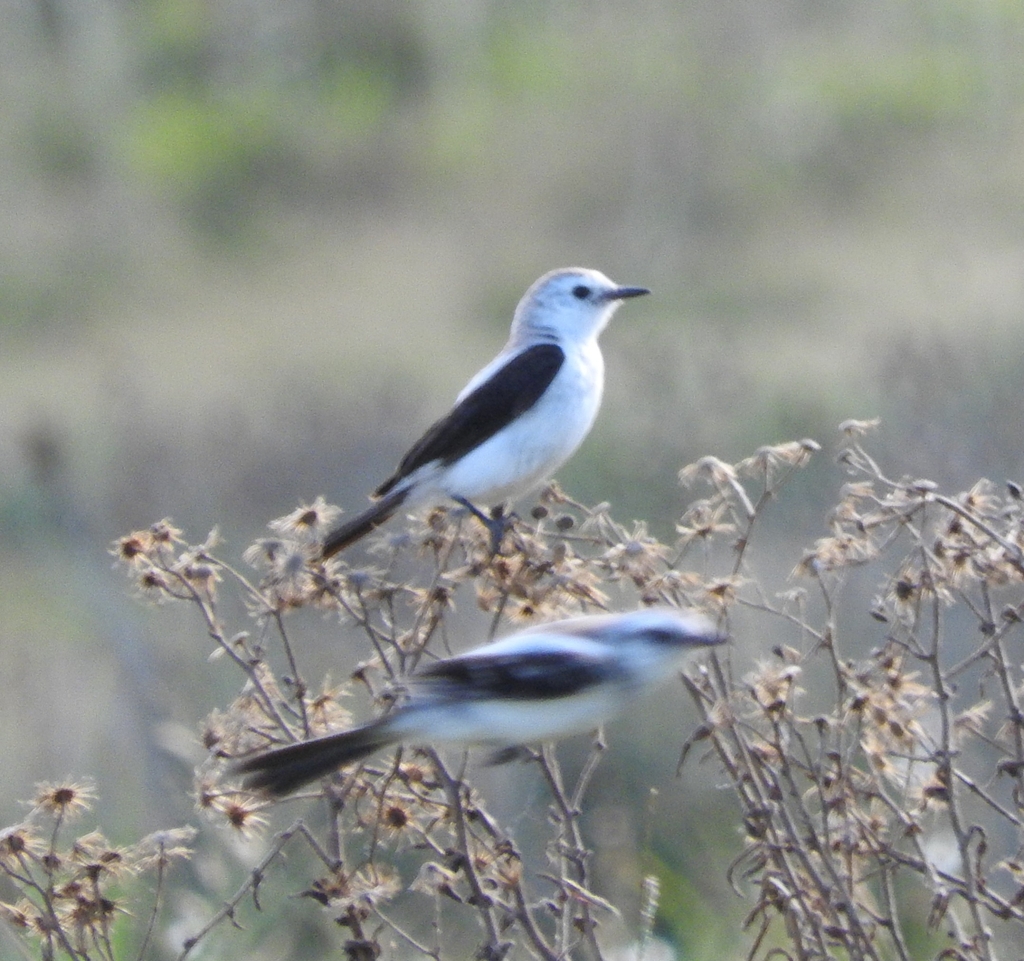
Black-and-white Monjita
Photo © Agustina Medina
Photo © Agustina Medina — CC BY 4.0 — Source: iNaturalist #169385437The black-and-white monjita (Heteroxolmis dominicana) is a species of passerine bird in the family Tyrannidae, the tyrant flycatchers. It is found in Argentina, Brazil, Uruguay and possibly Paraguay. == Taxonomy and systematics == The black-and-white monjita was formally described in 1823 as Tyrannus dominicanus. It was placed in genus Xolmis through much of the twentieth century. By the 1990s several authors had moved it to the new genus Heteroxolmis. The IOC had adopted the change by 2008. The South American Classification Committee of the American Ornithological Society (SACC) and the Clements taxonomy followed suit in 2021. However, as of December 2024 BirdLife International's Handbook of the Birds of the World retains the species as Xolmis dominicanus. Because the move of this species and several others from Xolmis resulted in species of several genera being called "monjita", the SACC is seeking a proposal to adopt new English names. The black-and-white monjita is the only species in the genus Heteroxolmis and has no subspecies. == Description == The black-and-white monjita is 20 to 20.5 cm (7.9 to 8.1 in) long. Adult males are mostly white. They have pale grayish smudging on the head and back, black wings with white outer thirds of…
Peixe National Park Lagoon
Brazil
+293 birds+4 mammals
Where the coastal plains of Rio Grande do Sul meet the Atlantic, Peixe National Park Lagoon sprawls across nearly 2,200 square kilometres of shallow waters, reed…
VIEW NATIONAL PARKSão Joaquim National Park
Brazil
+222 birds+9 mammals
Where the southern Brazilian highlands rise above the Atlantic Forest, São Joaquim National Park protects nearly 1,000 square kilometers of montane terrain that shifts between temperate…
VIEW NATIONAL PARKSerra Geral National Park
Brazil
+211 birds+2 mammals
Where basalt cliffs and sandstone escarpments rise above the subtropical forests of southern Brazil, Serra Geral National Park preserves one of the Atlantic region's most dramatic…
VIEW NATIONAL PARKNo community photos yet. Log in to add the first one.
No community observations of this species yet.