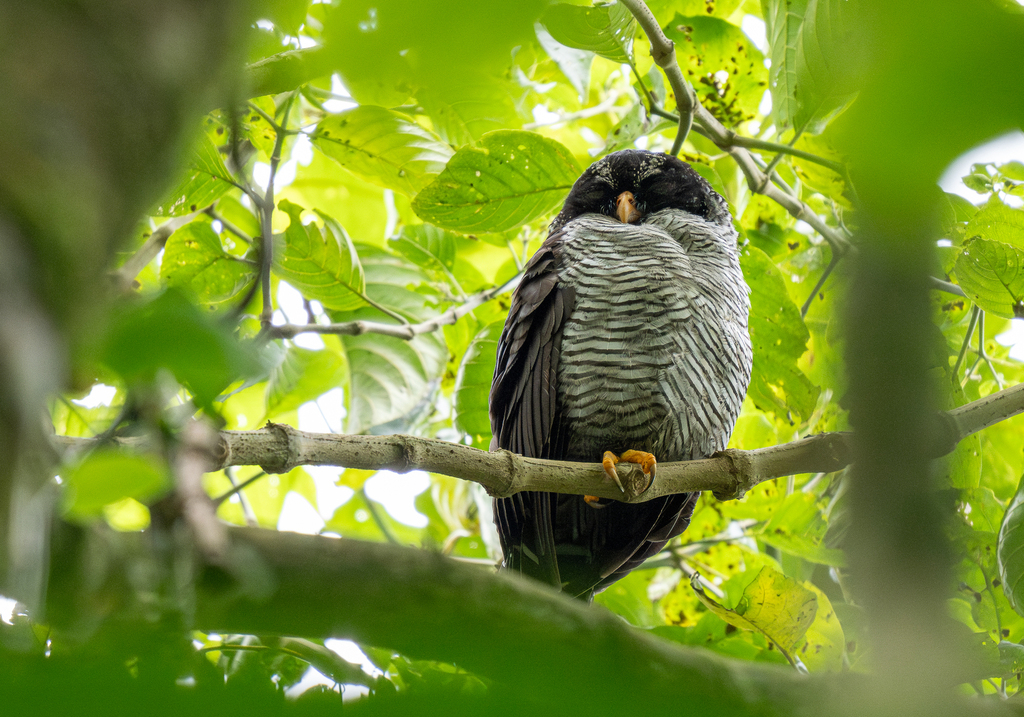
Black-and-white Owl
Photo © Forest Botial-Jarvis
Photo © Forest Botial-Jarvis — CC BY 4.0 — Source: iNaturalist photo #359665321Identification
The black-and-white owl is a medium-sized, round-headed owl measuring 35–40 cm in length and weighing 400–535 grams, with females larger than males. Its most distinctive feature is the bold black-and-white striping on the breast, belly, and vent, contrasted against sooty-black upperparts from crown to tail. A black-and-white striped collar frames the mostly black facial disc, while prominent white "eyebrows" extend from the bill to the collar. The beak is yellow-orange and the eyes are reddish-brown. Juveniles appear whitish-faced with dark brown upperparts and white-barred black underparts, while chicks are downy and white.
Range & Habitat
This neotropical owl inhabits gallery forests, rainforests, wet deciduous forests, and mangroves from central Mexico south to northwestern Peru and western Colombia, spanning 12 countries. It occurs from sea level to 2,400 meters elevation. The species shows remarkable adaptability, frequenting small ponds during hunts and nesting in tall trees such as mahogany, and notably does not shy away from human settlements. As a non-migratory resident, the black-and-white owl remains faithful to its range year-round.
Behaviour & Diet
A strictly nocturnal hunter, this owl forages primarily at canopy level, perching on elevated branches to survey its surroundings before making short, silent flights to capture prey. Its diet is primarily insectivorous, with a strong preference for scarab beetles, particularly dung beetles, supplemented by orthopterans and cicadas. However, it is a versatile predator that also takes bats (including Jamaican fruit bats) and small rodents regularly, and occasionally hunts smaller birds such as thrushes and tanagers, amphibians, and even roosting barn swallows on nearby electric lines.
The black-and-white owl's call is distinctive: a series of rapid, guttural low calls, followed by a pause and a low, airy call with a faint short hoot. Females vocalize louder than males. During breeding season in March, monogamous pairs form following the male's elaborate courtship displays of wing flaps and acrobatic flights. The female typically lays just one or two eggs in an isolated tree, often among epiphytes and orchids, incubating for at least 30 days while the male hunts and fiercely defends the nest. Chicks hatch in April, open their eyes at 14 days old, and face predation from tayras, ocelots, coatis, falcons, and hawks.
Best Time & Places to See It
Although classified as Least Concern, black-and-white owl populations are declining, with Mexico's population having dropped 50% over the last century. The species' preference for undisturbed forests and gallery systems means that protected rainforest reserves throughout its range offer the best opportunities for observation. Nocturnal activities and canopy-level foraging make sighting challenging, but listening for its distinctive calls after dark during breeding season (March onward) increases your chances significantly.
Photography Tips
Photographing this owl requires patience and specialized nocturnal equipment, as it is strictly nocturnal and forages high in the canopy. Night vision or thermal imaging technology may be necessary for documentation. If you locate a nesting pair during breeding season, maintain respectful distance—males vigorously defend their nest even from nearby humans. Early mornings or late afternoons when birds may be perched before hunting offer slightly better opportunities for natural-light photography than the depths of night.
Arenal Volcano National Park
Barra del Colorado National Wildlife Refuge
Braulio Carrillo National Park
Cahuita National Park
Caño Negro National Wildlife Refuge
Carara National Park
Cerros de Amotape National Park
Chagres National Park
Corcovado National Park
Nothing matches these filters.
No community photos yet. Log in to add the first one.
No community observations of this species yet.