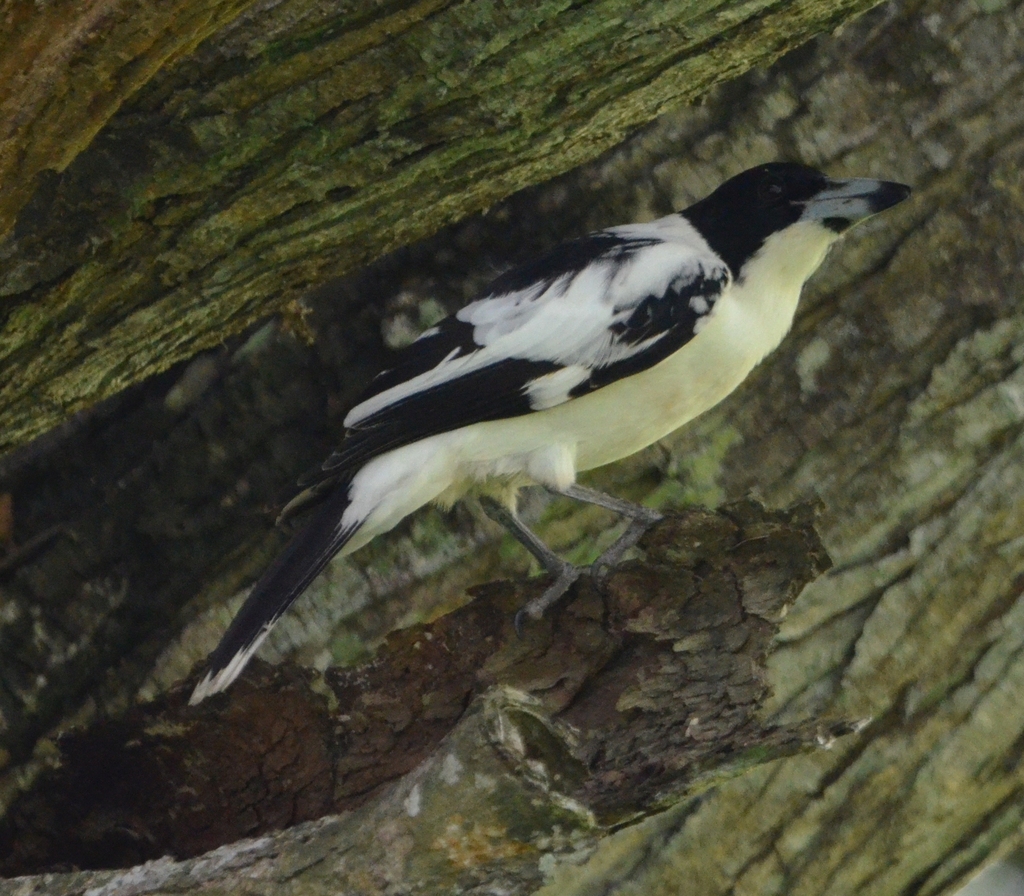
Black-backed Butcherbird
Photo © Micha Baum
Photo © Micha Baum — CC BY-SA 4.0 — Source: iNaturalist #298743450The black-backed butcherbird (Cracticus mentalis) is a species of bird in the family Artamidae. It is found in southern New Guinea and Cape York Peninsula in Queensland, Australia. == Taxonomy == The black-backed butcherbird was first described by Italian explorers and naturalists Tommaso Salvadori and Luigi D'Albertis in 1876. Although its scientific name translates as "mental noisy bird", the species epithet mentalis refers to its chin not its mind. It is one of six (or seven) members of the genus Cracticus known as butcherbirds. Within the genus, it is most closely related to the grey and silver-backed butcherbirds. The three form a monophyletic group—the subgenus Bulestes—within the genus, having diverged from ancestors of the pied butcherbird around five million years ago. An alternate common name is white-throated butcherbird to distinguish it from the pied butcherbird, which has a black throat. Gregory Mathews described the Australian population as a separate subspecies kempi in 1912, citing less white plumage on the nape and tail. However Amadon did not observe this difference. The butcherbirds, Australian magpie and currawongs were placed in the family Cracticidae in 1914 by John Albert Leach after he had studied their musculature. American ornithologists Charles Sibley and Jon Ahlquist…
Endeavour River National Park
Philadelphia, Australia
+203 birds+1 mammals
Where the Endeavour River winds through northeastern Queensland's tropical lowlands, a compact mosaic of rainforest, open woodland, and riverine corridor creates one of Australia's most ecologically…
VIEW NATIONAL PARKRinyirru National Park
Lakefield, Australia
+258 birds+7 mammals
Where the savanna grasslands of far north Queensland meet seasonal wetlands and eucalypt woodlands, Rinyirru National Park sprawls across more than 12,500 square kilometres of rugged,…
VIEW NATIONAL PARKNo community photos yet. Log in to add the first one.
No community observations of this species yet.