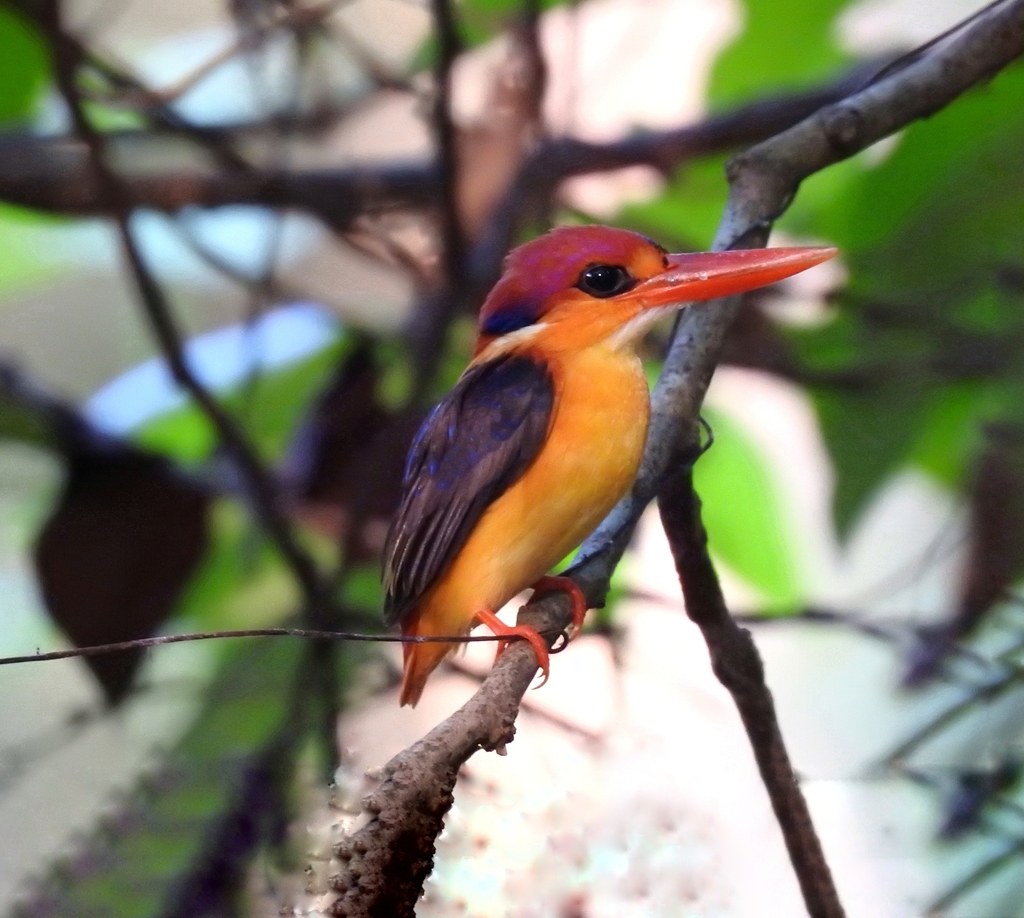
Black-backed Dwarf Kingfisher
Photo © Afsar Nayakkan
Photo © Afsar Nayakkan — CC BY 4.0 — Source: iNaturalist #86141222Identification
The black-backed dwarf kingfisher is one of the smallest kingfisher species, measuring only 12.5–14 cm in length—barely larger than a medium-sized hummingbird. Males typically weigh 14–21.5g, while females are slightly lighter at 14–16g. Despite their diminutive size, these birds are unmistakable in their range thanks to distinctive field marks: a bright red bill, yellow-orange underparts, lilac-rufous crown and rump, and a striking dark blue-black back and wings. Both sexes display blue and white patches on the side of the neck, with a white chin and throat providing contrast to the colourful plumage. A small black spot adorns the forehead of both adults. Juveniles are duller overall, with less pronounced lilac colouring, a white belly, and a pale-tipped yellowish bill. The species is also known as the three-toed kingfisher, though this name is shared with other kingfisher species.
Range & Habitat
Endemic to the Indian subcontinent and Mainland Southeast Asia, the black-backed dwarf kingfisher occupies a fragmented range. The breeding distribution spans northeastern India, Bangladesh, Myanmar, extreme southern China, Laos, Cambodia, and Thailand, with a disjunct population in the Western Ghats of western India and Sri Lanka. During the non-breeding season, some birds migrate south to the Malay Peninsula and Sumatra, making this a partial migrant. Two subspecies are recognised, with one occurring in the Andaman and Nicobar Islands.
This forest and wetland specialist typically inhabits lowland primary and secondary deciduous and evergreen forests, though it also frequents alluvial forests, mangroves, and overgrown rubber gardens. The species shows a strong preference for areas near streams and ponds, where water is readily available.
Behaviour & Diet
The black-backed dwarf kingfisher is an active forager with a surprisingly varied diet for such a small bird. It feeds on insects, spiders, worms, crabs, fish, frogs, and lizards, demonstrating the omnivorous tendencies common to many pygmy kingfishers. Rather than being strictly piscivorous like larger kingfisher species, this tiny hunter exploits the abundant small prey available in its forest and wetland habitats. The bird's vocalisation is distinctive: a high-pitched, shrill "tsriet-tsriet" call, or a softer "tjie-tjie-tjie" uttered in flight.
Best Time & Places to See It
Travellers seeking this species should focus on lowland forest areas with nearby water sources throughout its breeding range in northeastern India, Myanmar, Thailand, and Cambodia. The disjunct population in the Western Ghats of India and Sri Lanka offers an alternative destination. During the non-breeding season, the Malay Peninsula and Sumatra provide opportunities to encounter wintering birds. Visiting during the breeding season maximises chances of observation, though the bird's small size and forest habitat make it a challenging subject requiring patience and keen eyes.
Photography Tips
Photographing the black-backed dwarf kingfisher presents considerable challenges due to its tiny size and preference for dense forest habitats. A telephoto lens of at least 400–600mm focal length is essential to achieve useful frame-filling images. The bird's diminutive proportions mean it occupies little of the frame even at relatively close range, so cropping flexibility in post-processing is invaluable. Early morning light near water sources is optimal, as the bird hunts actively in these conditions and the low-angle sun accentuates its brilliant plumage colours—particularly the striking red bill and blue-black back. Patience is crucial; spend time watching likely perches along streams and ponds rather than pursuing the bird through dense vegetation, where photographic opportunities are severely limited.
Lunugamvehera National Park
Sri Lanka
+204 birds+14 mammals
Dry scrubland and shallow wetlands converge in Sri Lanka's southeastern lowlands, where Lunugamvehera National Park anchors one of the island's most ecologically vital landscapes. The park's…
VIEW NATIONAL PARKMinneriya National Park
Sri Lanka
+158 birds+9 mammals
Across the dry zone of Sri Lanka's North Central Province spreads a landscape of shallow tanks, grassland margins, and scattered dry forest—a mosaic of water and…
VIEW NATIONAL PARKMaduru Oya National Park
Sri Lanka
+74 birds+1 mammals
Granite ridges rise abruptly from the humid lowlands of Sri Lanka's Uva Province, their weathered slopes clothed in dry monsoon forest and scattered woodland where deciduous…
VIEW NATIONAL PARKKaziranga National Park
Kohora, India
+422 birds+26 mammals
Dawn breaks over the floodplains of the Brahmaputra, where tall grasslands stretch endlessly beneath monsoon-heavy skies. This sprawling wilderness of northeastern Assam is a mosaic of…
VIEW NATIONAL PARKTaman Negara National Park
Kampong Samas, Malaysia
+393 birds+48 mammals
Where ancient rainforest meets limestone peaks, one of Southeast Asia's oldest protected wilderness preserves sprawls across 4,343 square kilometers of primordial landscape. Dipterocarp giants tower overhead,…
VIEW NATIONAL PARKGunung Mulu National Park
Long Seridan, Malaysia
+280 birds+39 mammals
Where granite monoliths pierce the rainforest canopy of Sarawak, an ancient limestone karst landscape reveals one of Southeast Asia's most biodiverse strongholds. Soaring peaks cloaked in…
VIEW NATIONAL PARKWay Kambas National Park
Lampung Timur, Indonesia
+237 birds+20 mammals
Across the low swamplands of eastern Lampung, where freshwater wetlands merge into tidal mangrove forests along the Sunda Strait, sprawls one of Sumatra's most vital sanctuaries.…
VIEW NATIONAL PARKNo community photos yet. Log in to add the first one.
No community observations of this species yet.