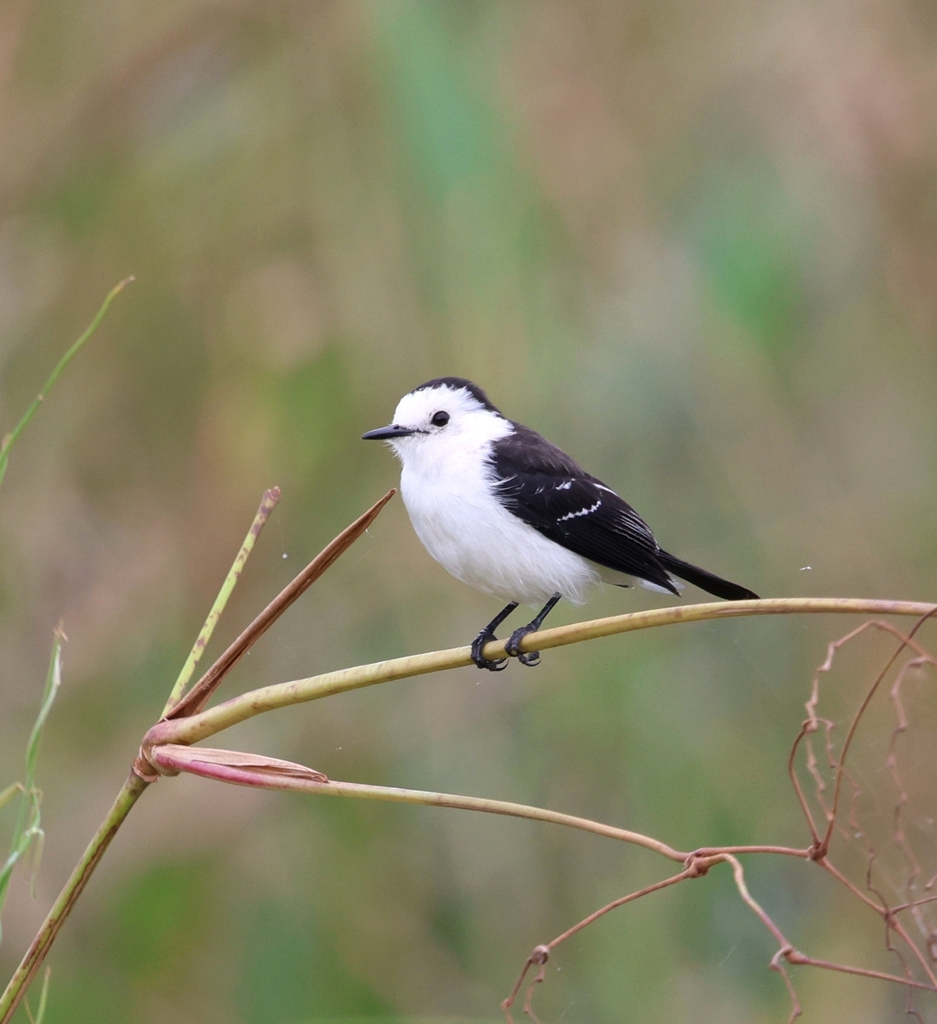
Black-backed Water Tyrant
Photo © Miguel
Photo © Miguel — CC BY-SA 4.0 — Source: iNaturalist photo #562427641Identification
The black-backed water tyrant is a medium-sized flycatcher measuring 13 to 14 cm in length. Both sexes share identical plumage, making identification straightforward. Adults are striking in their contrasting coloration: mostly white underparts and face offset by a black hindcrown and nape, a black back marked by a thin white band across the rump, and black wings bearing two thin white wing bars. The black tail displays variable white tips and edges on its feathers. Look for the bird's dark iris, black bill, and black legs and feet to confirm identification in the field.
Range & Habitat
This species is found across a vast region of South America, occurring in Argentina, Bolivia, Brazil, Paraguay, Peru, and Uruguay. Its range extends along eastern Peru southward through eastern Bolivia and western Paraguay to western Uruguay and Argentina, reaching as far south as Buenos Aires Province. In Brazil, its distribution is roughly bounded by west-central Amazonas, Amapá, east-central Bahia, western São Paulo State, and Mato Grosso do Sul.
The black-backed water tyrant favors marshes and shrubby areas bordering watercourses and oxbow lakes, thriving in wetland habitats from sea level to approximately 1,000 meters elevation. These birds are partial migrants, remaining in breeding areas year-round while some individuals move west and north into western Brazil, northern Bolivia, and eastern Peru during non-breeding seasons.
Behaviour & Diet
These birds are insectivores that typically forage near or on the ground and among floating and emergent vegetation, often cocking and fanning their tail while hunting. During breeding season—spanning October to February in Argentina—males perform striking aerial courtship displays. The species builds distinctive ball-shaped nests with side openings near the top, constructed from small twigs and stems lined with feathers and plant down, positioned low to the ground or low over water. Clutches contain two to three eggs, with an incubation period of 12 to 14 days and fledging occurring 10 to 15 days after hatching.
The black-backed water tyrant produces a distinctive "high, dry, very short wic" call. Nests have been recorded as targets for parasitism by shiny cowbirds.
Best Time & Places to See It
The breeding season from October to February in Argentina offers excellent opportunities for observation and photography. The species is considered uncommon to locally fairly common throughout its range and occurs in several protected areas. Wetland habitats—particularly marshes and areas bordering oxbow lakes and watercourses—are the most promising locations. Given its wide distribution across multiple countries, travelers exploring South American wetlands, especially in Paraguay, Argentina, and eastern Bolivia, have reasonable chances of encountering this species.
Photography Tips
The black-backed water tyrant's striking black-and-white plumage provides excellent contrast for photography. Focus on capturing the bird while it forages in its characteristic posture—near water level among vegetation—as this is when it's most active and the tail-cocking behavior is most apparent. The high-elevation limit of 1,000 meters suggests accessible shooting locations without extreme altitude challenges. Early morning light in wetland habitats will best showcase the bird's contrasting plumage against water and marsh vegetation.
Ilha Grande National Park
Brazil
+233 birds
Across the subtropical plateaus and Atlantic forest remnants of southern Brazil, a vast protected landscape spanning nearly 4,600 square kilometers safeguards one of the continent's most…
VIEW NATIONAL PARKChapada dos Guimarães National Park
Brazil
+450 birds+1 mammals
Where weathered sandstone plateaus rise above the cerrado grasslands of central Brazil, Chapada dos Guimarães National Park protects 624 square kilometres of ecological transition zone that…
VIEW NATIONAL PARKChapada dos Veadeiros National Park
Brazil
+324 birds+6 mammals
Where granite plateaus rise above the cerrado savanna in central Brazil, Chapada dos Veadeiros National Park unfolds across 6,665 square kilometres of some of the world's…
VIEW NATIONAL PARKPantanal Matogrossense National Park
Brazil
+322 birds+17 mammals
Where the flooded forests of central Brazil meet vast seasonally inundated grasslands, Pantanal Matogrossense National Park sprawls across nearly 2,900 square kilometers of one of the…
VIEW NATIONAL PARKChapada Diamantina National Park
Brazil
+346 birds+5 mammals
Where granite peaks and sandstone cliffs rise abruptly from the Brazilian interior, Chapada Diamantina National Park sprawls across 4,215 square kilometers of some of Brazil's most…
VIEW NATIONAL PARKSerra do Divisor National Park
Brazil
+448 birds+10 mammals
Where the western Amazon meets the Andes foothills, Serra do Divisor National Park sprawls across one of South America's most biodiverse and least accessible frontiers. Spanning…
VIEW NATIONAL PARKManu National Park
Manu, Peru
+892 birds+26 mammals
Across the eastern slopes of the Peruvian Andes, tropical rainforest descends into the Amazon basin with a complexity that few terrestrial ecosystems match. Manu National Park…
VIEW NATIONAL PARKBahuaja Sonene National Park
San Pedro de Putina Punco, Peru
+602 birds+8 mammals
Where the Madre de Dios and Heath rivers converge in southeastern Peru rises one of South America's most biodiverse wilderness regions: a vast protected realm of…
VIEW NATIONAL PARKEl Palmar National Park
Distrito Sexto, Argentina
+244 birds+14 mammals
Across the Paraná River floodplain in northeastern Argentina, palms rise from wetland and grassland in a landscape shaped by water and time. El Palmar National Park…
VIEW NATIONAL PARKRío Pilcomayo National Park
Argentina
+271 birds+13 mammals
Where the Río Pilcomayo cuts through northeastern Argentina's subtropical lowlands, a sprawling mosaic of wetlands, grasslands, and seasonally flooded forests creates one of South America's most…
VIEW NATIONAL PARKEl Rey National Park
Municipio de Las Lajitas, Argentina
+317 birds+4 mammals
Where the eastern slopes of the Andes descend into northwestern Argentina's subtropical transition zone, El Rey National Park unfolds across 841 square kilometers of dramatically varied…
VIEW NATIONAL PARKParque Provincial Pampa del Indio
Laguna Limpia, Argentina
+231 birds+4 mammals
Across the flat horizons of Chaco Province, where the Paraná River system spills into vast wetlands and grasslands, Parque Provincial Pampa del Indio protects one of…
VIEW NATURE RESERVEChaco National Park
Municipio de Presidencia de la Plaza, Argentina
+258 birds+7 mammals
Across the humid subtropical lowlands of northeastern Argentina, where the Paraná River basin feeds vast seasonal wetlands and gallery forests, Chaco National Park protects one of…
VIEW NATIONAL PARKNo community photos yet. Log in to add the first one.
No community observations of this species yet.