Identification
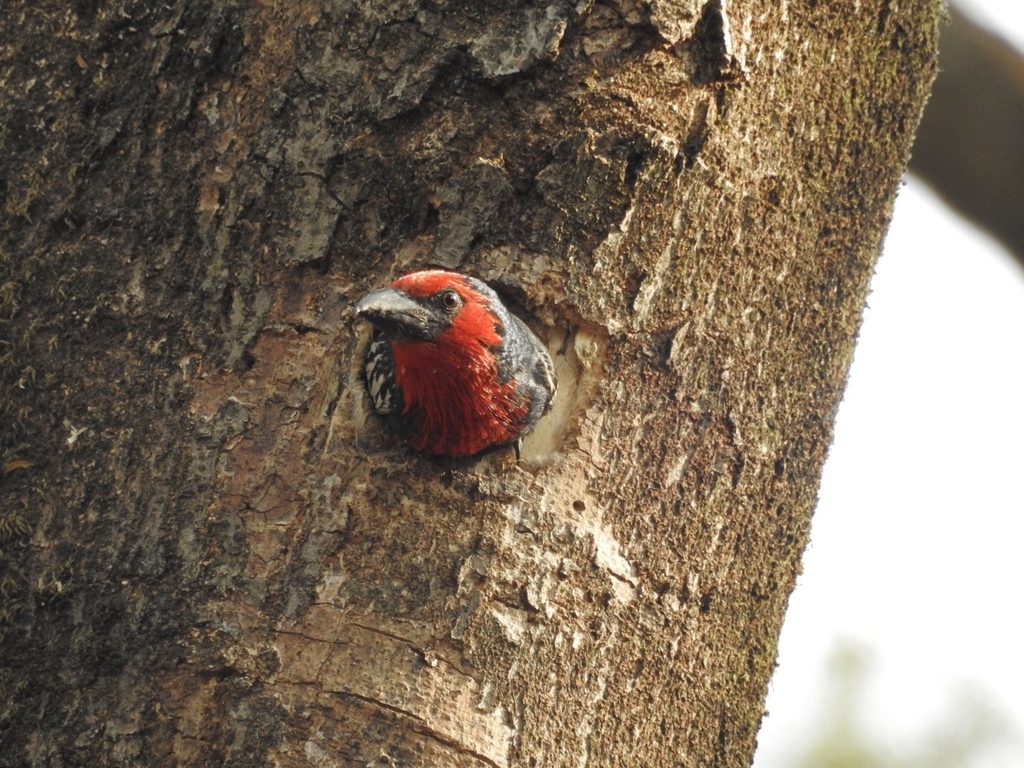
The Black-billed Barbet is a striking medium-sized bird immediately recognisable by its bold colouration. Both males and females display glossy blue-black plumage across most of the body, with slightly browner tones on the wings and belly. The most eye-catching feature is the brilliant red or red-orange face, throat, and upper chest that contrasts dramatically with the dark back. Narrow yellow to white lines streak the upperwings, adding subtle detail to the overall appearance. The bird sports a strong, black beak, grey featherless facial skin, and reddish-brown eyes. Legs and feet are blackish-grey. With a wingspan of 7.9–9.4 centimetres and a tail length of 4.5–5.4 centimetres, it is compact and stocky. There is no noticeable sexual dimorphism between males and females, though young birds display duller plumage than adults, making them somewhat harder to identify at first glance.
Range & Habitat
This species boasts an extremely large range across the Afrotropical realm, occurring in a broad swathe of central and eastern Africa. Its distribution spans Cameroon, the northeastern Democratic Republic of the Congo, Eritrea, eastern Sudan through to western Ethiopia, western Kenya, northern Tanzania, and Uganda. The Black-billed Barbet is an adaptable species, thriving at altitudes between 900 and 2,200 metres above sea level in diverse habitats. You may encounter it in open forests and forest edges, woodland vegetation, savannah, and scrubland, as well as in gardens and cultivated areas that support fruit-bearing trees.
Behaviour & Diet
Black-billed Barbets are typically social birds, living in pairs or small groups of up to seven individuals. They are primarily frugivorous, with their diet consisting mainly of fruits such as figs, guavas, papaya, and various berries. However, they also supplement their diet with insects including beetles, ants, and termites, demonstrating their dietary flexibility. Their vocalisations are distinctive and relatively low-key, comprising soft growling sounds interspersed with a series of two-syllabled "koop-pup" phrases that carry through their woodland and garden habitats.
Best Time & Places to See It
The Black-billed Barbet's wide distribution across central and eastern Africa offers numerous opportunities for observation. Look for it in fruit-bearing gardens and cultivated areas, which can be particularly productive locations. The species' presence in open forests, forest edges, and woodland from 900 to 2,200 metres elevation means that varied habitats throughout its range are worth exploring. Their habit of living in small groups and frequenting gardens makes them relatively accessible compared to more elusive forest species.
Photography Tips
The Black-billed Barbet's striking red-and-black plumage makes it a rewarding photographic subject. The contrast between the brilliant red face and throat and the glossy blue-black body creates compelling compositions. Look for birds feeding in fruit trees during early morning or late afternoon when light conditions are optimal. The yellow-white wing stripes and reddish-brown eyes provide fine detail worth capturing with good resolution. Since these barbets often occur in pairs or small groups, patient observation near fruiting trees—particularly figs and guavas—will reward you with multiple photo opportunities.
Serengeti National Park
Tanzania
+558 birds+57 mammals
Across Tanzania's northern plateau, where volcanic soils meet acacia woodland and open grassland, unfolds one of Earth's most dynamic ecosystems. The Serengeti National Park sprawls across…
VIEW NATIONAL PARKBwindi Impenetrable National Park
Kanyashogi, Uganda
+603 birds+26 mammals
Steep ridges cloaked in montane forest rise from Uganda's southwestern borderlands, where the landscape grows so dense and tangled that early explorers named it impenetrable. At…
VIEW NATIONAL PARKKidepo Valley National Park
Uganda
+478 birds+24 mammals
Where the Narus and Kidepo rivers carve through northeastern Uganda's semi-arid lowlands, a landscape of sparse acacia woodland, grassland, and riverine thickets creates one of East…
VIEW NATIONAL PARKMurchison Falls National Park
Uganda
+608 birds+33 mammals
Where the Victoria Nile compresses through a narrow gorge and explodes across a 45-meter precipice, the landscape speaks in thunder. Murchison Falls National Park sprawls across…
VIEW NATIONAL PARKLake Mburo National Park
Uganda
+505 birds+24 mammals
Rolling acacia woodland and scattered lakes define this intimate savanna preserve in southwestern Uganda, where the rift valley's geological drama shapes every water source and grassland.…
VIEW NATIONAL PARKToro-Semliki Proposed National Park
Uganda
+474 birds+5 mammals
Where the Albertine Rift's western escarpment rises above the Semliki River valley, a vast mosaic of forest, savanna and wetland converges to create one of East…
VIEW NATIONAL PARKQueen Elizabeth National Park
Uganda
+672 birds+30 mammals
Across the southwestern escarpment of Uganda, where the Western Rift Valley descends through ancient volcanic terrain, Queen Elizabeth National Park sprawls across more than 8,300 square…
VIEW NATIONAL PARKZiwa Rhino and Wildlife Ranch
Nakasongola, Uganda
+359 birds+11 mammals
Where papyrus wetlands merge into sprawling savanna, Uganda's central landscape opens into one of East Africa's most vital rhino recovery zones. Ziwa Rhino and Wildlife Ranch…
VIEW WILDLIFE SANCTUARYAbijata-Shalla Lakes National Park
Ethiopia
+438 birds+7 mammals
Two crater lakes of contrasting chemistry define this remote corner of Ethiopia's Rift Valley, where soda lakes and freshwater basins create a mosaic of distinct aquatic…
VIEW NATIONAL PARKBale Mountains National Park
Ethiopia
+397 birds+20 mammals
Where the Ethiopian highlands rise above 4,000 metres, the Bale Mountains create a landscape of stunning ecological extremes—from afroalpine grasslands swept by wind and mist to…
VIEW NATIONAL PARKAwash National Park
Didiga, Ethiopia
+473 birds+23 mammals
Where the Ethiopian Rift Valley carves through volcanic plateaus, a ribbon of riverine forest winds through acacia scrubland and grassland, creating a mosaic of habitats that…
VIEW NATURAL PARKSimien Mountains National Park
Debark, Ethiopia
+120 birds+9 mammals
Where granite escarpments plunge thousands of metres into misty valleys, the Ethiopian highlands reveal a landscape of almost mythical drama. These volcanic plateaus, carved by ancient…
VIEW NATIONAL PARKNech Sar National Park
Arba Minch, Ethiopia
+191 birds+10 mammals
Where the East African Rift Valley plateaus drop dramatically toward the shore of Lake Abaya, a mosaic of habitats unfolds across sun-scorched savanna and acacia woodland.…
VIEW NATIONAL PARKYabelo Wildlife Sanctuary
Bedewera, Ethiopia
+359 birds+5 mammals
Where acacia woodlands meet volcanic plateaus in southern Ethiopia, a landscape of austere beauty unfolds across nearly 2,500 square kilometers. Yabelo Wildlife Sanctuary sprawls across semi-arid…
VIEW WILDLIFE SANCTUARYRuma National Park
Suba, Kenya
+250 birds+8 mammals
Where the Winam Gulf narrows toward the Kenyan mainland, Ruma National Park rises as a sanctuary of evergreen woodland set within the humid tropics of Homa…
VIEW NATIONAL PARKNo community photos yet. Log in to add the first one.
No community observations of this species yet.