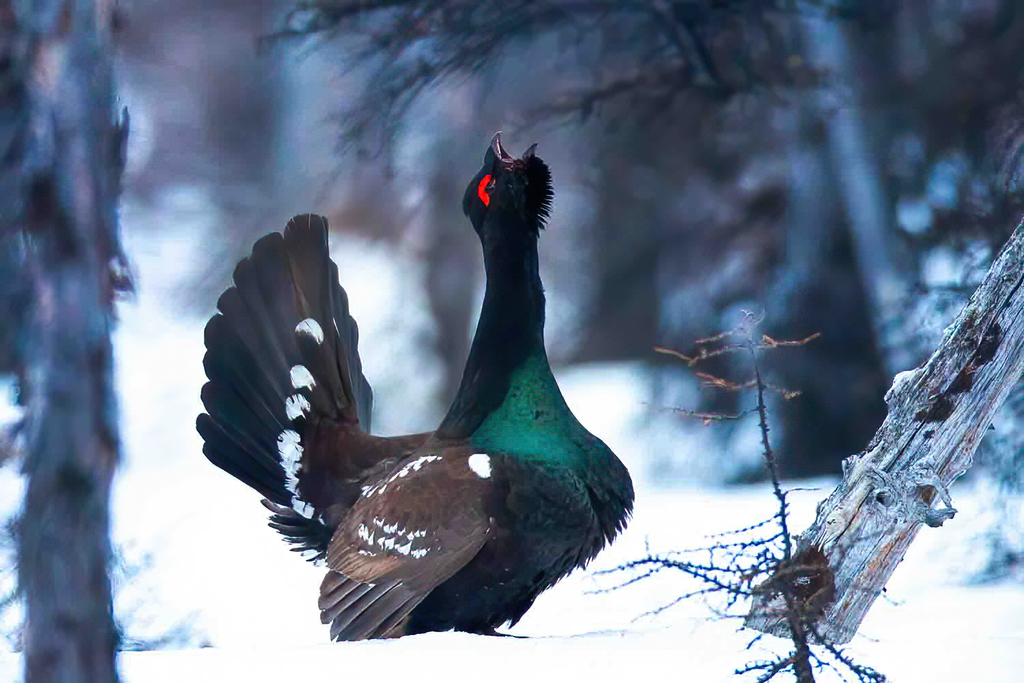
Black-billed Capercaillie
Photo © egorbirder
Photo © egorbirder — CC BY 4.0 — Source: iNaturalist photo #195507291The black-billed capercaillie (Tetrao urogalloides) is a large grouse species closely related to the more widespread western capercaillie. It is a sedentary species that breeds in the larch taiga forests of eastern Siberia as well as parts of northern Mongolia and China. In the far west of its distribution, the black-billed capercaillie has been known to hybridize with the western capercaillie. Compared to its western cousin, the black-billed capercaillie is also more adaptable to open habitat, given the larch forests it lives in are usually less dense than other taiga communities. Thus, they tend to avoid thick coniferous forests. They are primarily herbivorous, feeding on twigs, buds, leaves, shoots, and berries of various plants. However, their diet in the warmer months includes some insects like caterpillars, larvae, ants and midges. This species is also known as the eastern capercaillie, Siberian capercaillie, spotted capercaillie or (in Russian) "stone capercaillie". == Description == A male black-billed capercaillie has an average length of about 89–97 cm (35–38 in) and weighs 3.4–4.6 kg (7.5–10.1 lb), with females measuring around 69–75 cm (27–30 in) and weighing 1.7–2.2 kg (3.7–4.9 lb). Their wingspan stretches approximately 75–115 cm (30–45 in) long. Compared to the western capercaillie, it…
Khangai Nuruu National Park
Erdenetsogt, Mongolia
+136 birds+7 mammals
Where granite ridges pierce Mongolia's central steppe, alpine meadows give way to dense coniferous forests that climb toward windswept summits. Khangai Nuruu sweeps across 1.2 million…
VIEW NATIONAL PARKGorkhi-Terelj National Park
Ulaanbaatar, Mongolia
+137 birds+5 mammals
Where granite monoliths rise abruptly from rolling steppe grasslands, Gorkhi-Terelj National Park unfolds across the landscape north of Ulaanbaatar, a sanctuary where forest and alpine meadow…
VIEW NATIONAL PARKKhoridol Saridag National Park
Khatgal, Mongolia
+164 birds+6 mammals
Where granite peaks thrust skyward across Mongolia's remote southeastern reaches, a landscape of raw geological drama unfolds. Deep river gorges carved through ancient stone create a…
VIEW NATIONAL PARKNo community photos yet. Log in to add the first one.
No community observations of this species yet.