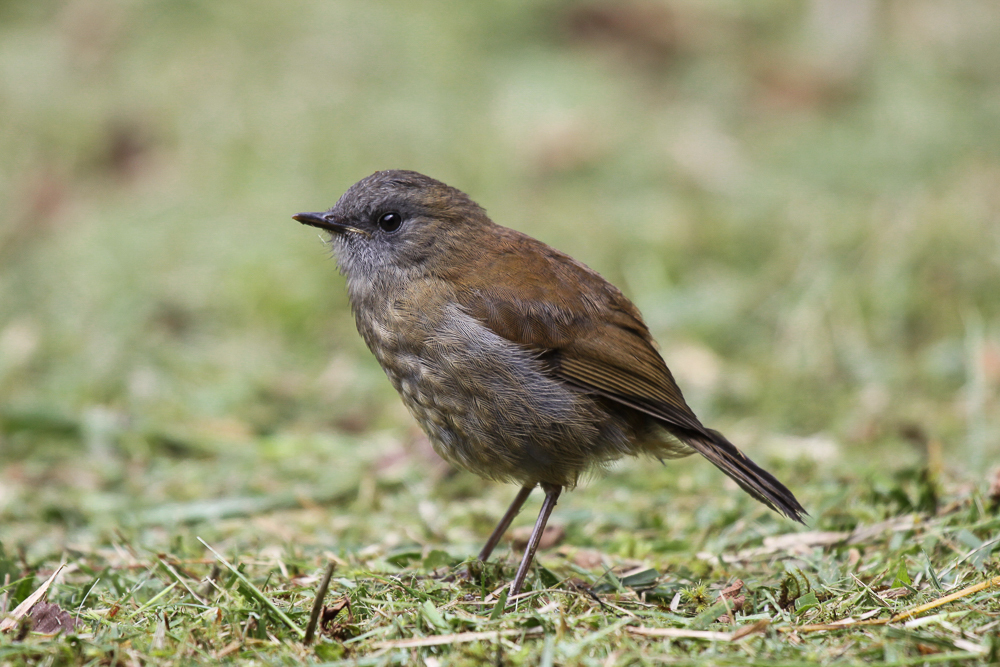
Black-billed Nightingale-Thrush
CC BY 4.0
CC BY 4.0 — Source: iNaturalist photo #30127038The black-billed nightingale-thrush (Catharus gracilirostris) is a species of bird in the family Turdidae, the thrushes and allies. It is found in Costa Rica and Panama. == Taxonomy and systematics == The black-billed nightingale-thrush was originally described in 1865 with its current binomial Catharus gracilirostris. The black-billed nightingale's further taxonomy is unsettled. The IOC, AviList, and BirdLife International's Handbook of the Birds of the World assign it three subspecies: the nominate C. g. gracilirostris (Salvin, 1865), C. g. accentor (Bangs, 1902), and C. g. bensoni (Griscom, 1924). The Clements taxonomy recognizes two by including bensoni within accentor. This article follows the three-subspecies model. == Description == The black-billed nightingale-thrush is about 15 cm (5.9 in) long and weighs about 20 g (0.71 oz) The sexes have the same plumage. Adults of the nominate subspecies have a slate-gray forecrown, an olive-brown crown, and a slate-gray face. Their upperparts, wings, and the upper side of their tail are olive-brown. Their throat is whitish, the middle of their lower belly light gray to whitish, and the rest of their underparts slate-gray with an olivaceous band across the breast. They have a dark brown iris, a black bill, and dark gray legs and feet.…
Chirripó National Park
Rivas, Costa Rica
+274 birds+6 mammals
Where the volcanic spine of Costa Rica's Central Cordillera reaches its apex, Chirripó National Park encompasses a landscape that shifts dramatically with elevation, from montane cloud…
VIEW NATIONAL PARKBraulio Carrillo National Park
Las Horquetas, Costa Rica
+547 birds+18 mammals
Where the Caribbean slope descends from the central volcanic cordillera toward the humid lowlands of Heredia, Braulio Carrillo National Park preserves one of Costa Rica's most…
VIEW NATIONAL PARKVolcán Poás National Park
Toro Amarillo, Costa Rica
+237 birds+4 mammals
Where volcanic slopes rise sharply from the Central Valley floor, Volcán Poás National Park protects one of Costa Rica's most active and accessible volcanic systems. The…
VIEW NATIONAL PARKBaru Volcano National Park
Cerro Punta, Panama
+402 birds+6 mammals
Where the land rises sharply toward the Caribbean's western spine, Baru Volcano National Park sprawls across roughly 220 square kilometres of southwestern Panama, anchored by the…
VIEW NATIONAL PARKParque Internacional la Amistad
Teribe, Panama
+325 birds+11 mammals
Where the continental divide rises between the Caribbean and Pacific watersheds, a wilderness of extraordinary biological richness unfolds across the Talamanca Range and into lowland rainforest—a…
VIEW NATIONAL PARKLos Quetzales National Park
Copey, Costa Rica
+232 birds+3 mammals
Cloud forest sweeps across the upper slopes of the Central Valley watershed, where elevation and persistent moisture forge an ecosystem unlike any other in Costa Rica.…
VIEW NATIONAL PARKTapantí Macizo de la Muerte National Park
Orosi, Costa Rica
+503 birds+18 mammals
Where montane cloud forest rises steeply from the Orosi Valley, Tapantí Macizo de la Muerte National Park enfolds a landscape of perpetual moisture and emerald complexity.…
VIEW NATIONAL PARKLa Amistad International Park
Crorina, Costa Rica
+532 birds+20 mammals
Where the Caribbean slopes of Costa Rica's Talamanca Mountains rise steeply inland from Limón, the boundary between two nations dissolves into an unbroken expanse of rainforest.…
VIEW NATIONAL PARKNo community photos yet. Log in to add the first one.
No community observations of this species yet.