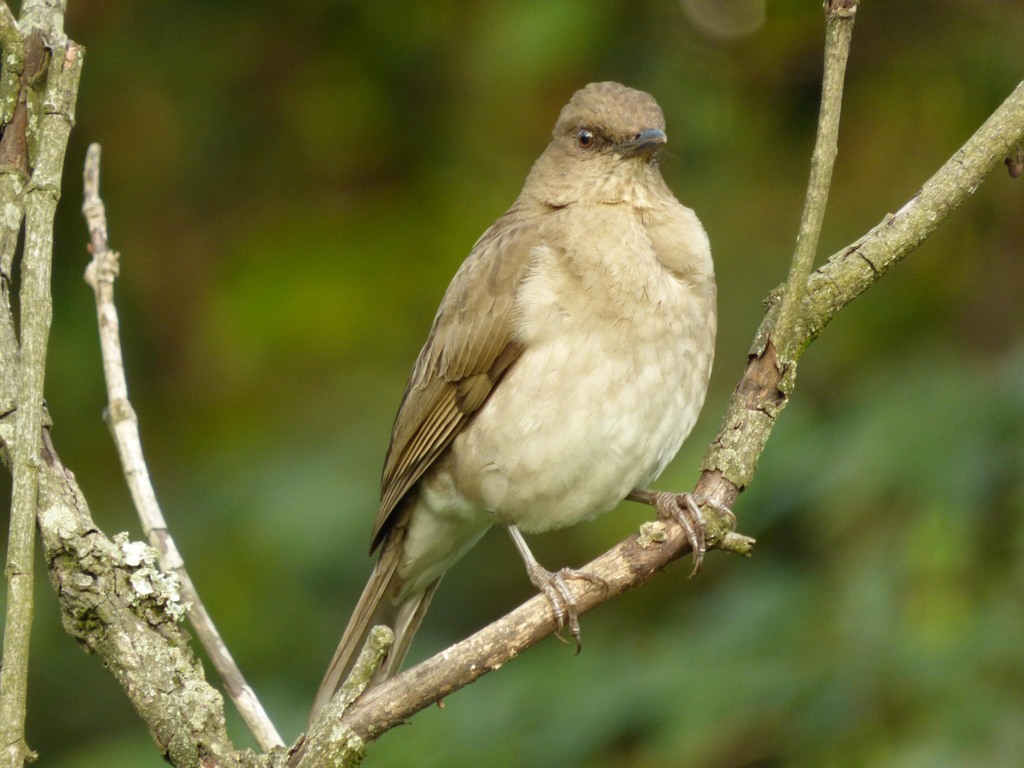
Black-billed Thrush
Photo © Luis G Restrepo
Photo © Luis G Restrepo — CC BY 4.0 — Source: iNaturalist photo #477896263Identification
The Black-billed Thrush is a medium-sized thrush measuring 18.5 to 24 cm in length, with a weight range of 48 to 81 grams. Both sexes share identical plumage, making field identification straightforward. The nominate subspecies displays olive-brown upperparts and head with a slightly darker face, contrasting with an off-white throat marked by dark streaks. The breast and flanks are paler olive-brown, while the belly and undertail coverts are whitish. This species is aptly named for its black bill, which pairs with a black iris and dark gray-brown to blackish legs and feet. Geographical variation exists across subspecies: T. i. goodfellowi shows warmer, darker olive-brown tones, while T. i. debilis presents more white on the throat and upper breast with weaker throat streaks and grayer flanks.
Range & Habitat
The Black-billed Thrush occurs across northern South America, with a disjunct distribution spanning Bolivia, Brazil, Colombia, Ecuador, Peru, and Venezuela. The nominate subspecies inhabits Colombia's Central and Eastern Andes, while T. i. goodfellowi is restricted to the Cauca River valley and the western slope of the Western Andes. Subspecies T. i. debilis has the most extensive range, stretching from the Venezuelan Andes through eastern Colombia and Ecuador, down through eastern Peru into northern Bolivia, and across much of Amazonian Brazil, primarily following major river corridors.
This adaptable species favors semi-open to open landscapes, including forest edges and clearings, gallery forest in savanna, secondary forest, shade coffee plantations, early succession areas, brushy pastures, and human-modified spaces such as parks and gardens. Elevational range varies by region: up to 1,600 m in Venezuela, 2,600 m in Colombia, 1,200 m in Ecuador and Peru, and 2,000 m in Brazil.
Behaviour & Diet
The Black-billed Thrush is believed to be sedentary year-round, with no evidence of significant migration. It forages singly or in pairs, rarely joining mixed-species feeding flocks. Its diet comprises berries, seeds, insects, and other invertebrates including worms, gleaned from trees, shrubs, and sheltered ground areas.
Breeding occurs seasonally, spanning December to August in Colombia (varying regionally), at least November to February in Ecuador, and including January in Peru. The species constructs a cup-shaped nest from moss and mud lined with fine fibers, placed in bushes, on stumps, or in tree forks, typically below 5 meters. Clutches contain two or three greenish-blue eggs heavily marked with brown. Incubation lasts approximately 13 to 16 days, with fledging occurring 14 to 17 days after hatching; both parents provision the young.
Best Time & Places to See It
The Black-billed Thrush's abundance varies geographically, ranging from uncommon to locally fairly common in Venezuela, common in Colombia, fairly common in Ecuador and Peru, and common to frequent in Brazil. During breeding season—which extends from December through August in parts of Colombia and November through February in Ecuador—the species is most actively vocal and visible, making these periods ideal for observation.
Forest edges, gallery forests in savanna, secondary forest, and coffee plantations offer excellent viewing opportunities. The species adapts well to disturbed habitats and parks, making it accessible to travellers in areas from lowland riparian zones to montane regions up to 2,600 meters, depending on locality.
Photography Tips
The Black-billed Thrush's preference for semi-open habitats and forest edges provides good photographic opportunities compared to canopy-restricted species. Early morning and late afternoon light works well for capturing the subtle olive-brown tones and contrasting pale throat markings. The species' habit of foraging in pairs and low vegetation makes it relatively approachable, though patience is necessary.
Focus on capturing diagnostic features: the distinctive black bill, black iris, and the characteristic off-white throat with dark streaking. When photographing in coffee plantations and disturbed areas, include habitat context to illustrate the species' adaptability. The call—a pleasant, musical caroling with relaxed phrases—may help locate individuals, allowing photographers to position themselves strategically along forest edges and clearings where the bird naturally forages.
Yasuní National Park
Aguarico, Ecuador
+601 birds+43 mammals
Where the western Amazon basin converges with Ecuador's Orellana Province, lowland rainforest reaches toward the horizon in an unbroken canopy of staggering botanical density. Yasuní National…
VIEW NATIONAL PARKSangay National Park
Cebadas, Ecuador
+320 birds+10 mammals
High in Ecuador's Andean spine, where the Western Cordillera rises to touch perpetual snow, a landscape of volcanic drama and ecological intensity unfolds across Sangay National…
VIEW NATIONAL PARKPodocarpus National Park
Zamora, Ecuador
+496 birds+6 mammals
Where the Andes descend toward the Amazon basin, Podocarpus National Park sprawls across nearly 2,800 square kilometres of the most biodiverse terrain in Ecuador's southern highlands.…
VIEW NATIONAL PARKSumaco Napo-Galeras National Park
Loreto, Ecuador
+563 birds+4 mammals
Where Ecuador's Amazon transitions into cloud forest, a massive shield volcano rises from the emerald lowlands of Orellana Province, anchoring one of the continent's most biodiverse…
VIEW NATIONAL PARKAntisana National Park
Quijos, Ecuador
+432 birds+21 mammals
Where the eastern Andean slopes descend into the Amazon basin, Antisana National Park sprawls across roughly 2,500 square kilometers of some of South America's most dramatic…
VIEW NATIONAL PARKNatural Sierra de Chiribiquete National Park
Solano, Colombia
+359 birds+27 mammals
Massive table-top mountains rise abruptly from the lowland rainforest of southeastern Colombia, their sheer sandstone cliffs and isolated summits creating some of the most dramatic topography…
VIEW NATIONAL PARKNatural Utría National Park
Alto Baudó (Pie de Pató), Colombia
+372 birds+11 mammals
Where the Chocó's coastal mountains plunge toward the Pacific, Utría National Park preserves one of Colombia's most biodiverse and least-visited wilderness expanses. Sprawling across 1,287 square…
VIEW NATIONAL PARKNatural Munchique National Park
El Tambo, Colombia
+194 birds
Where the Western Cordillera rises steeply from the Pacific plains of southwestern Colombia, Natural Munchique National Park sprawls across 1,078 square kilometers of montane forest that…
VIEW NATIONAL PARKNatural la Paya National Park
Puerto Leguízamo, Colombia
+262 birds+4 mammals
Where the Amazon's western reaches fold into the Andes foothills, La Paya National Park sprawls across more than 8,500 square kilometers of pristine Amazonian rainforest in…
VIEW NATIONAL PARKNatural Serranía de los Yariguíes National Park
El Carmen de Chucurí, Colombia
+320 birds+3 mammals
Where the northern cordilleras of Colombia rise toward cloud forest, the Serranía de los Yariguíes unfolds across nearly 1,820 square kilometers of some of the most…
VIEW NATIONAL PARKNatural Farallones de Cali National Park
Buenaventura, Colombia
+733 birds+27 mammals
Where the Pacific coastal plain meets the western slopes of the Andes, Farallones de Cali National Park sprawls across nearly 3,500 square kilometers of dramatic topography…
VIEW NATIONAL PARKNatural el Cocuy National Park
Güicán, Colombia
+313 birds+3 mammals
Where the Andes rise to their highest peaks in Colombia's eastern cordillera, El Cocuy National Park sprawls across more than 6,600 square kilometers of some of…
VIEW NATIONAL PARKPuracé National Natural Park
Puracé, Colombia
+327 birds+2 mammals
Where the Andes thrust upward across southwestern Colombia, Puracé National Natural Park spans nearly 2,631 square kilometers of some of South America's most dramatic montane terrain.…
VIEW NATIONAL PARKGuácharos Cave National Natural Park
Acevedo, Colombia
+359 birds
High in the Andean foothills of southern Huila, where mist-laden slopes rise above 1,600 metres, lies a landscape carved by underground rivers and crowned by karst…
VIEW NATIONAL PARKNatural Uramba Bahía Málaga National Park
Buenaventura, Colombia
+308 birds+15 mammals
Where the Pacific coastal rainforest descends to mangrove estuaries and rocky headlands, Uramba Bahía Málaga National Park unfolds across nearly 1,000 square kilometres of Colombia's Valle…
VIEW NATIONAL PARKNatural Sumapaz National Park
Cubarral, Colombia
+368 birds+1 mammals
Where the Andes descend toward the Amazon basin, the high páramo grasslands of Sumapaz National Park sprawl across more than five thousand square kilometers of Meta…
VIEW NATIONAL PARKEl Tamá National Park
Toledo, Colombia
+435 birds
Where the Andes descend toward the Caribbean coastal lowlands of northern Colombia, El Tamá National Park sprawls across nearly 3,800 square kilometres of montane forest, cloud…
VIEW NATIONAL PARKNatural Sierra de la Macarena National Park
Vista Hermosa, Colombia
+566 birds+15 mammals
Across nearly 20,000 square kilometres of Colombia's Meta Department, the terrain rises from lowland savanna into Andean foothills through a mosaic of gallery forests, palm-fringed wetlands,…
VIEW NATIONAL PARKAmacayacu National Park
Leticia, Colombia
+567 birds+25 mammals
Where the Rio Amazonas curves through the tri-border region where Colombia, Peru, and Brazil converge, Amacayacu National Park sprawls across more than 5,250 square kilometres of…
VIEW NATIONAL PARKNatural Nevado del Huila National Park
Planadas, Colombia
+117 birds
Where the Colombian Andes rise above 5,000 metres, tropical cloud forest yields to páramo and glaciated peaks, and the Planadas region of Tolima contains one of…
VIEW NATIONAL PARKViruá National Park
Brazil
+389 birds+6 mammals
Across the northern frontier of Roraima, where the forest canopy rises from ancient Amazonian lowlands, Viruá National Park protects nearly 3,700 square kilometres of terra firme…
VIEW NATIONAL PARKChapada dos Guimarães National Park
Brazil
+450 birds+1 mammals
Where weathered sandstone plateaus rise above the cerrado grasslands of central Brazil, Chapada dos Guimarães National Park protects 624 square kilometres of ecological transition zone that…
VIEW NATIONAL PARKAnavilhanas National Park
Brazil
+468 birds+8 mammals
Across the Rio Negro in central Amazonas, an archipelago of over a thousand islands rises from the world's largest rainforest river system, creating a labyrinth of…
VIEW NATIONAL PARKSerra do Divisor National Park
Brazil
+448 birds+10 mammals
Where the western Amazon meets the Andes foothills, Serra do Divisor National Park sprawls across one of South America's most biodiverse and least accessible frontiers. Spanning…
VIEW NATIONAL PARKOtishi National Park
Río Tambo, Peru
+108 birds
Where the Andes descend toward the Amazon basin, vast cloud forests cloak the ridges and valleys of Peru's Río Tambo watershed, and this is where Otishi…
VIEW NATIONAL PARKYanachaga–chemillén National Park
Palcazu, Peru
+639 birds+6 mammals
Where the eastern slopes of Peru's central cordillera plunge into cloud forest, Yanachaga–Chemillén National Park protects nearly three thousand square kilometres of montane wilderness that few…
VIEW NATIONAL PARKManu National Park
Manu, Peru
+892 birds+26 mammals
Across the eastern slopes of the Peruvian Andes, tropical rainforest descends into the Amazon basin with a complexity that few terrestrial ecosystems match. Manu National Park…
VIEW NATIONAL PARKBahuaja Sonene National Park
San Pedro de Putina Punco, Peru
+602 birds+8 mammals
Where the Madre de Dios and Heath rivers converge in southeastern Peru rises one of South America's most biodiverse wilderness regions: a vast protected realm of…
VIEW NATIONAL PARKTingo Maria National Park
Mariano Dámaso Beraún, Peru
+423 birds
Where the eastern slopes of the Peruvian Andes descend toward the Amazon basin, the landscape fractures into a maze of limestone ridges, humid gorges, and cloud-wrapped…
VIEW NATIONAL PARKCordillera Azul National Park
Pampa Hermosa, Peru
+322 birds+1 mammals
Where the eastern Andes descend into the western Amazon basin, Cordillera Azul National Park sprawls across nearly 38,000 square kilometres of some of Peru's most pristine…
VIEW NATIONAL PARKNo community photos yet. Log in to add the first one.
No community observations of this species yet.