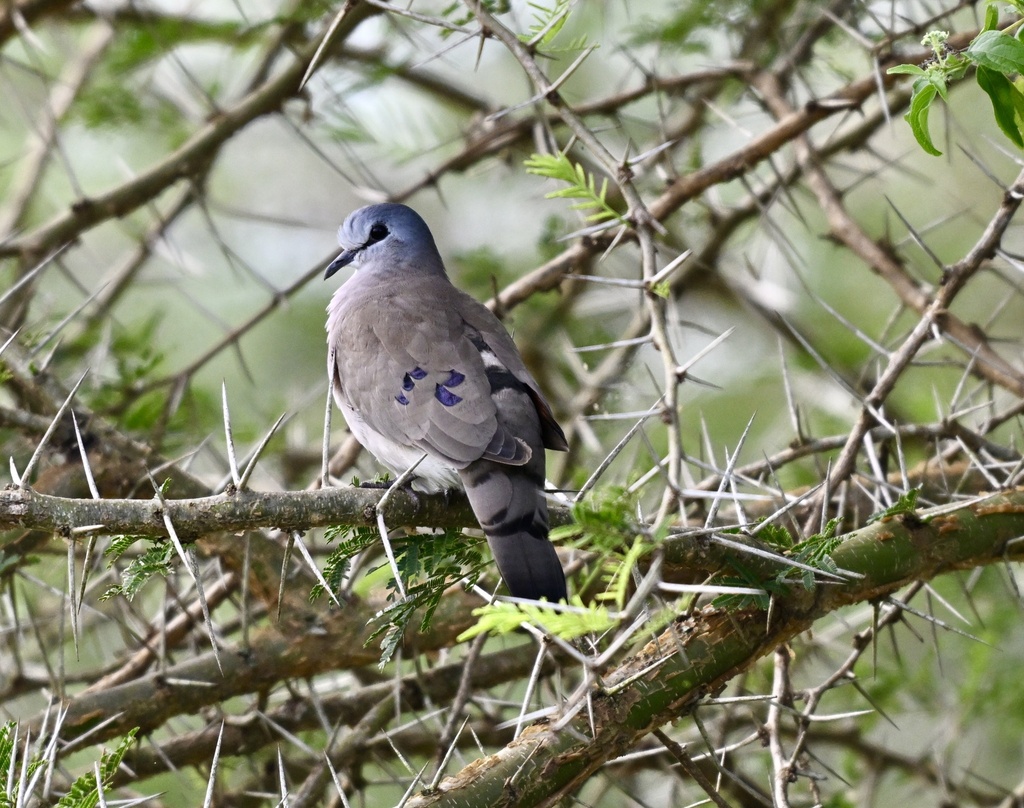
Black-billed Wood Dove
Photo © Lukas Zangl
Photo © Lukas Zangl — CC BY 4.0 — Source: iNaturalist #304438273Identification
The Black-billed Wood Dove is a small, plump pigeon measuring typically 20 cm in length. Its most distinctive feature is its black bill, which sets it apart from related species. The bird's plumage is soft and subtle: the back, hindneck, wings and tail are pale grey-brown, while the folded wings display striking dark metallic patches. Two blackish bands run across the back, providing useful field marks. The head is particularly diagnostic, with a bluish-grey forehead, crown and nape that fade to whitish on the face, contrasting with warm pinkish underparts that become whiter towards the belly. In flight, look for chestnut coloring in the underwing. Immature birds are considerably duller than adults, with scaly plumage below and lacking the distinctive wing spots found on mature birds. The sexes are similar in appearance.
Range & Habitat
This dove is a widespread resident breeding bird distributed across a belt in Africa just south of the Sahara Desert. It is abundant throughout its range in near-desert, scrub and savannah habitats, making it a characteristic bird of these arid and semi-arid environments. The species shows a preference for open and sparsely vegetated landscapes where it can forage easily on the ground.
Behaviour & Diet
Black-billed Wood Doves are quite terrestrial, spending much of their time foraging on the ground where they feed on grass seeds and other small seeds. They are not particularly gregarious in their daily habits, but they do form large congregations at waterholes, where they gather to drink. Their distinctive call is a persistent fluted coo-coo-cu-coo, which can often be heard across open country. The birds are swift and agile in flight, displaying the quick, regular wingbeats characteristic of pigeons, interspersed with occasional sharp flicks of the wings. They tend to stay quite low in their flight patterns, rarely climbing to great heights.
During breeding season, Black-billed Wood Doves build stick nests in trees, often selecting acacias as nest sites. They lay two cream-colored eggs per clutch.
Best Time & Places to See It
These doves are year-round residents throughout their African range, making them available for viewing at any time of year. Your best opportunities come at waterholes during the dry season, when birds congregate in large numbers to drink. Early mornings are particularly productive for birdwatching, as the doves are most active during cooler parts of the day in their arid habitat. Look for them in open savannah and scrubland areas where vegetation is sparse enough to allow easy ground foraging.
Photography Tips
The Black-billed Wood Dove's small size and ground-foraging habits require patience and careful approach. Position yourself near waterholes before dawn, as this is when birds are most likely to visit and light is favorable for photography. Use a telephoto lens to maintain distance and avoid flushing the birds. The subtle plumage colors—pale greys, pinks and blues—photograph best in soft, diffused light. The chestnut underwing visible in flight and the dark metallic wing patches are key diagnostic features worth capturing. Keep your shutter speed high enough to freeze their quick, direct flight if you attempt in-flight shots.
Bwindi Impenetrable National Park
Kanyashogi, Uganda
+603 birds+26 mammals
Steep ridges cloaked in montane forest rise from Uganda's southwestern borderlands, where the landscape grows so dense and tangled that early explorers named it impenetrable. At…
VIEW NATIONAL PARKKidepo Valley National Park
Uganda
+478 birds+24 mammals
Where the Narus and Kidepo rivers carve through northeastern Uganda's semi-arid lowlands, a landscape of sparse acacia woodland, grassland, and riverine thickets creates one of East…
VIEW NATIONAL PARKMurchison Falls National Park
Uganda
+608 birds+33 mammals
Where the Victoria Nile compresses through a narrow gorge and explodes across a 45-meter precipice, the landscape speaks in thunder. Murchison Falls National Park sprawls across…
VIEW NATIONAL PARKLake Mburo National Park
Uganda
+505 birds+24 mammals
Rolling acacia woodland and scattered lakes define this intimate savanna preserve in southwestern Uganda, where the rift valley's geological drama shapes every water source and grassland.…
VIEW NATIONAL PARKToro-Semliki Proposed National Park
Uganda
+474 birds+5 mammals
Where the Albertine Rift's western escarpment rises above the Semliki River valley, a vast mosaic of forest, savanna and wetland converges to create one of East…
VIEW NATIONAL PARKQueen Elizabeth National Park
Uganda
+672 birds+30 mammals
Across the southwestern escarpment of Uganda, where the Western Rift Valley descends through ancient volcanic terrain, Queen Elizabeth National Park sprawls across more than 8,300 square…
VIEW NATIONAL PARKNo community photos yet. Log in to add the first one.
No community observations of this species yet.