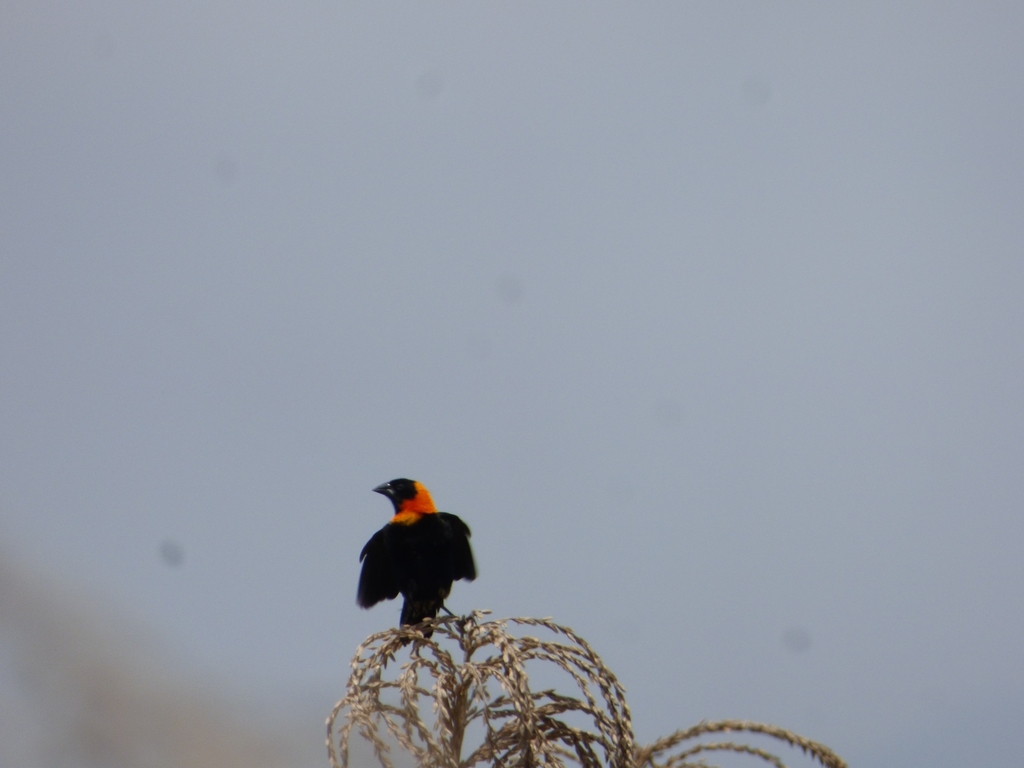
Black Bishop
Photo © Oscar Hopgood
Photo © Oscar Hopgood — CC BY 4.0 — Source: iNaturalist #305262286Identification
The black bishop is a large weaver at 14 to 16 cm in length, with a distinctive appearance that varies markedly between seasons and sexes. Breeding males are unmistakable: predominantly black on the wings, tail, chest, cheeks and forehead, with striking orange or orange-red on the neck, back of the head, and breast band. The upper back is yellow or orange-yellow depending on subspecies, while the conical black bill and brown tarsus are characteristic of the weaver family. Under tail-coverts are pale buff with black streaks.
Females and non-breeding males are considerably duller and more challenging to identify. Females are dark overall with boldly spotted under tail-coverts, dark spots on a buff breast, and black wing linings. Non-breeding males retain black on the back, wings and rump but show yellowish supercilia and chin, with tawny buff sides to the face and breast. Juveniles resemble females but have smaller breast spots. The species is vocal, with calls comprising various subdued twittering sounds and harsher calls including "see-zee see-zee" and "hishaah" phrases.
Range & Habitat
The black bishop is native to sub-Saharan Africa, with three recognized subspecies distributed across distinct regions. The northern black bishop (ansorgei) inhabits Cameroon, the Central African Republic, Republic of the Congo, Democratic Republic of the Congo, South Sudan, Ethiopia, Uganda, and Kenya, with a stronghold around the Lake Victoria basin and Kakamega. The nominate Angola black bishop (gierowii) is found in Angola and the Democratic Republic of the Congo, while the southern black bishop (friederichseni) inhabits Kenya and Tanzania, particularly around Babati and sporadically to Lake Manyara and Serengeti National Park.
Across its range, the species favors grasslands, shrublands, and wetlands, making it a bird of open and semi-open habitats rather than dense forest.
Behaviour & Diet
The black bishop is not a highly gregarious species, though it may occasionally be found in small flocks. During the breeding season, males are territorial and likely polygynous, with each male defending his territory against rivals. The species is not particularly social, especially during the nesting period when males are focused on territorial defense.
Best Time & Places to See It
The best opportunities to see black bishops come during the breeding season when males are most conspicuous in their brilliant plumage, actively defending territories. The Lake Victoria basin and Kakamega in Kenya are excellent locations for the northern subspecies, while Serengeti National Park and the area around Lake Manyara in Tanzania offer chances to encounter the southern subspecies. Wetlands and grassland habitats should be prioritized when searching for this species.
Photography Tips
Photographing breeding males is rewarding due to their vibrant orange and black coloration, which contrasts sharply against grassland and wetland backdrops. Males are most visible and active during breeding season when defending territories. Early morning visits to grassland and wetland habitats will maximize sighting chances. Be aware that females and non-breeding males are considerably duller and more cryptic; patience and careful observation of movement in grassland and shrubland edges will be necessary to locate them.
Serengeti National Park
Tanzania
+558 birds+57 mammals
Across Tanzania's northern plateau, where volcanic soils meet acacia woodland and open grassland, unfolds one of Earth's most dynamic ecosystems. The Serengeti National Park sprawls across…
VIEW NATIONAL PARKArusha National Park
Tanzania
+555 birds+16 mammals
Where the slopes of Mount Mawenzi rise above the Arusha region, a compact yet ecologically rich national park unfolds across montane forest, moorland, and alpine zones.…
VIEW NATIONAL PARKVirunga National Park
Uganda
+418 birds+13 mammals
Where the Western Rift Valley fractures the landscape of North Kivu, Virunga National Park sprawls across terrain as geologically dramatic as it is ecologically vital. Volcanic…
VIEW NATIONAL PARKBwindi Impenetrable National Park
Kanyashogi, Uganda
+603 birds+26 mammals
Steep ridges cloaked in montane forest rise from Uganda's southwestern borderlands, where the landscape grows so dense and tangled that early explorers named it impenetrable. At…
VIEW NATIONAL PARKKidepo Valley National Park
Uganda
+478 birds+24 mammals
Where the Narus and Kidepo rivers carve through northeastern Uganda's semi-arid lowlands, a landscape of sparse acacia woodland, grassland, and riverine thickets creates one of East…
VIEW NATIONAL PARKMurchison Falls National Park
Uganda
+608 birds+33 mammals
Where the Victoria Nile compresses through a narrow gorge and explodes across a 45-meter precipice, the landscape speaks in thunder. Murchison Falls National Park sprawls across…
VIEW NATIONAL PARKLake Mburo National Park
Uganda
+505 birds+24 mammals
Rolling acacia woodland and scattered lakes define this intimate savanna preserve in southwestern Uganda, where the rift valley's geological drama shapes every water source and grassland.…
VIEW NATIONAL PARKTarangire National Park
Tanzania
+527 birds+50 mammals
Acacia woodland and grassland sweep across the Manyara Region where the Tarangire River carves through low hills and volcanic soils, creating one of East Africa's most…
VIEW NATIONAL PARKNgorongoro Conservation Area
Tanzania
+626 birds+55 mammals
Volcanic calderas and open grassland dominate this high plateau in northern Tanzania, where the landscape rises above 2,000 metres and ancient geological forces have shaped both…
VIEW WILDLIFE MANAGEMENT AREAToro-Semliki Proposed National Park
Uganda
+474 birds+5 mammals
Where the Albertine Rift's western escarpment rises above the Semliki River valley, a vast mosaic of forest, savanna and wetland converges to create one of East…
VIEW NATIONAL PARKQueen Elizabeth National Park
Uganda
+672 birds+30 mammals
Across the southwestern escarpment of Uganda, where the Western Rift Valley descends through ancient volcanic terrain, Queen Elizabeth National Park sprawls across more than 8,300 square…
VIEW NATIONAL PARKMabamba Swamp
Memere, Uganda
+464 birds+2 mammals
Across the Central Region of Uganda spreads one of Africa's most biodiverse freshwater wetlands, a sprawling nature reserve of roughly 283 square kilometres where papyrus swamps…
VIEW NATURE RESERVEMeru National Park
Igembe Central, Kenya
+408 birds+38 mammals
Granite outcrops and acacia woodland rise across the northern reaches of Meru, where semi-arid savanna transitions into drier scrubland under the fierce equatorial sun. The park's…
VIEW NATIONAL PARKRuma National Park
Suba, Kenya
+250 birds+8 mammals
Where the Winam Gulf narrows toward the Kenyan mainland, Ruma National Park rises as a sanctuary of evergreen woodland set within the humid tropics of Homa…
VIEW NATIONAL PARKNo community photos yet. Log in to add the first one.
No community observations of this species yet.