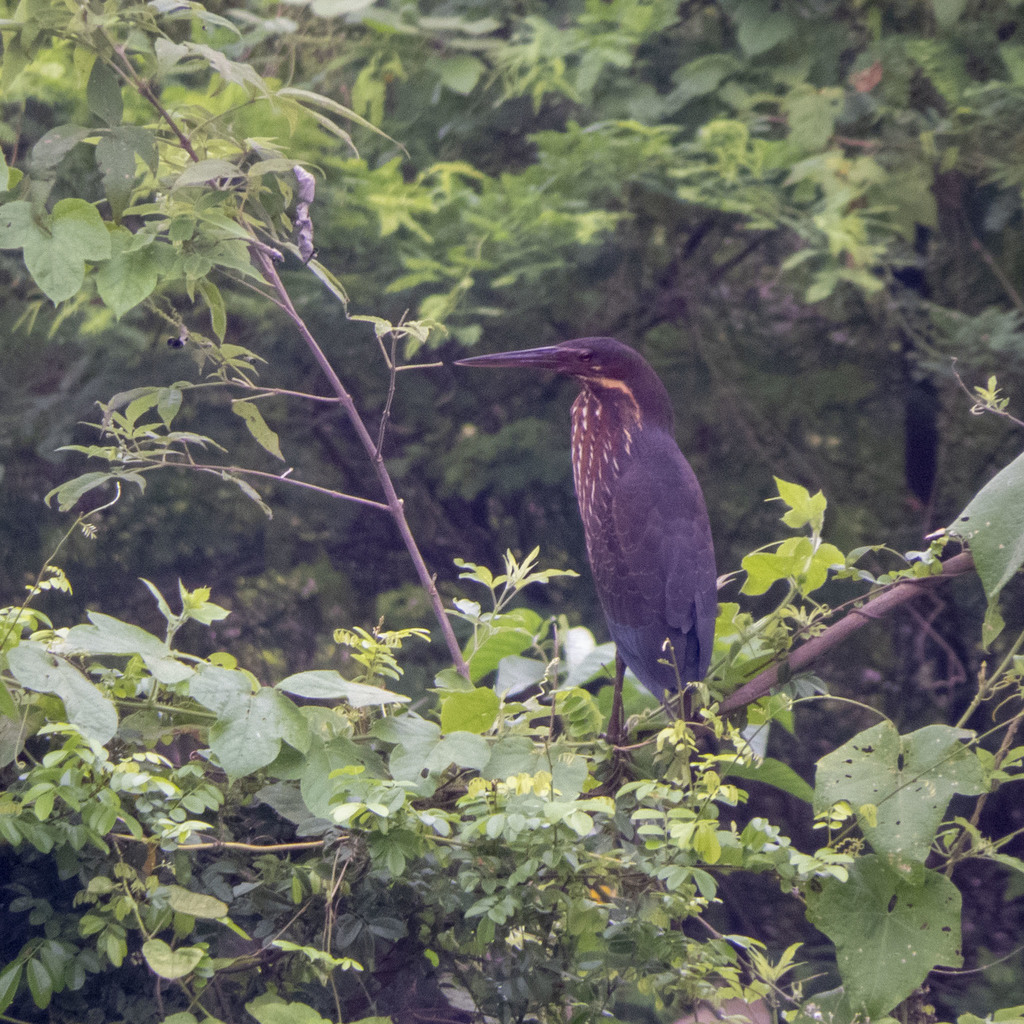
Black Bittern
Photo © Paulmathi Vinod
Photo © Paulmathi Vinod — CC BY 4.0 — Source: iNaturalist #92214541Identification
The black bittern is a medium-sized bittern measuring 54–66 cm in length. Males are distinctive with black upperparts contrasted by buff-coloured neck sides heavily streaked with brown, while females are dark brown rather than black. Juveniles resemble females but are noticeably paler. The species has a dark bill and can be challenging to observe due to their secretive, skulking lifestyle in reed beds. However, when they take to the air—which they do fairly frequently—their all-black upperparts make them unmistakable in flight.
Range & Habitat
This Old World bittern breeds across tropical Asia, with its range extending from Pakistan, India, Bangladesh, and Sri Lanka eastward through China and Indonesia to Australia. The species is primarily resident throughout most of its range, though some populations in northern areas undertake short-distance migrations. Three subspecies are recognised, distributed across different regions from the Indian subcontinent through Southeast Asia to the Solomon Islands and Australia.
Black bitterns favour reed beds as their preferred habitat, where their cryptic plumage and secretive behaviour provide excellent camouflage among the dense vegetation. This specialisation makes them birds of wetland environments where reed beds are well-established.
Behaviour & Diet
Black bitterns are crepuscular and nocturnal feeders, remaining active primarily at dusk and dawn when they venture out to hunt. They feed on a varied diet of frogs, fish up to 15 centimetres in length, crustaceans, and insects. Their nocturnal habits, combined with their reed-bed habitat preference, contribute to their elusive nature and limited visibility to observers.
During breeding season, pairs establish territories in reed beds, constructing nests on platforms of reeds in shrubs or occasionally in trees. Females typically lay three to five eggs, and the resulting chicks are covered with white down marked with brown patches. Young birds first leave the nest when approximately 15 days old.
Best Time & Places to See It
Black bitterns are most active and most likely to be observed during dawn and dusk hours when they feed. While they remain skulking and difficult to see in their reed-bed habitat during daylight hours, observers patient enough to watch reed beds during these crepuscular periods may be rewarded with sightings. Their tendency to fly fairly frequently offers the best opportunity for identification, particularly when their distinctive black upperparts are visible against the sky.
Photography Tips
Photographing black bitterns presents a genuine challenge given their nocturnal and crepuscular habits and reed-bed habitat. Early morning and late evening sessions at suitable wetland locations offer the best opportunities to capture these birds. Since they are most active in flight during low-light conditions, a camera capable of performing well at higher ISO settings will be advantageous. Patience is essential; observing reed beds quietly during dawn and dusk increases the likelihood of witnessing the bird's distinctive flight silhouette against the sky, when the all-black upperparts are most evident and photogenic.
Khao Yai National Park
Prachantakham District, Thailand
+377 birds+46 mammals
Evergreen dipterocarp forest blankets the rolling terrain of this national park in eastern Thailand, where limestone hills rise abruptly from the forest floor and seasonal streams…
VIEW NATIONAL PARKDaintree National Park
Dedin, Australia
+362 birds+37 mammals
Daintree National Park is one of the world’s oldest and most biologically diverse tropical rainforests, protecting an extraordinary landscape where ancient forests meet the Great Barrier…
VIEW NATIONAL PARKKeoladeo National Park
Shreenagar Rural, India
+326 birds+14 mammals
Where shallow wetlands shimmer beneath vast Rajasthani skies, one of Asia's finest bird sanctuaries pulses with extraordinary life. This former maharaja's hunting reserve, now spanning 29…
VIEW NATIONAL PARKNo community photos yet. Log in to add the first one.
No community observations of this species yet.