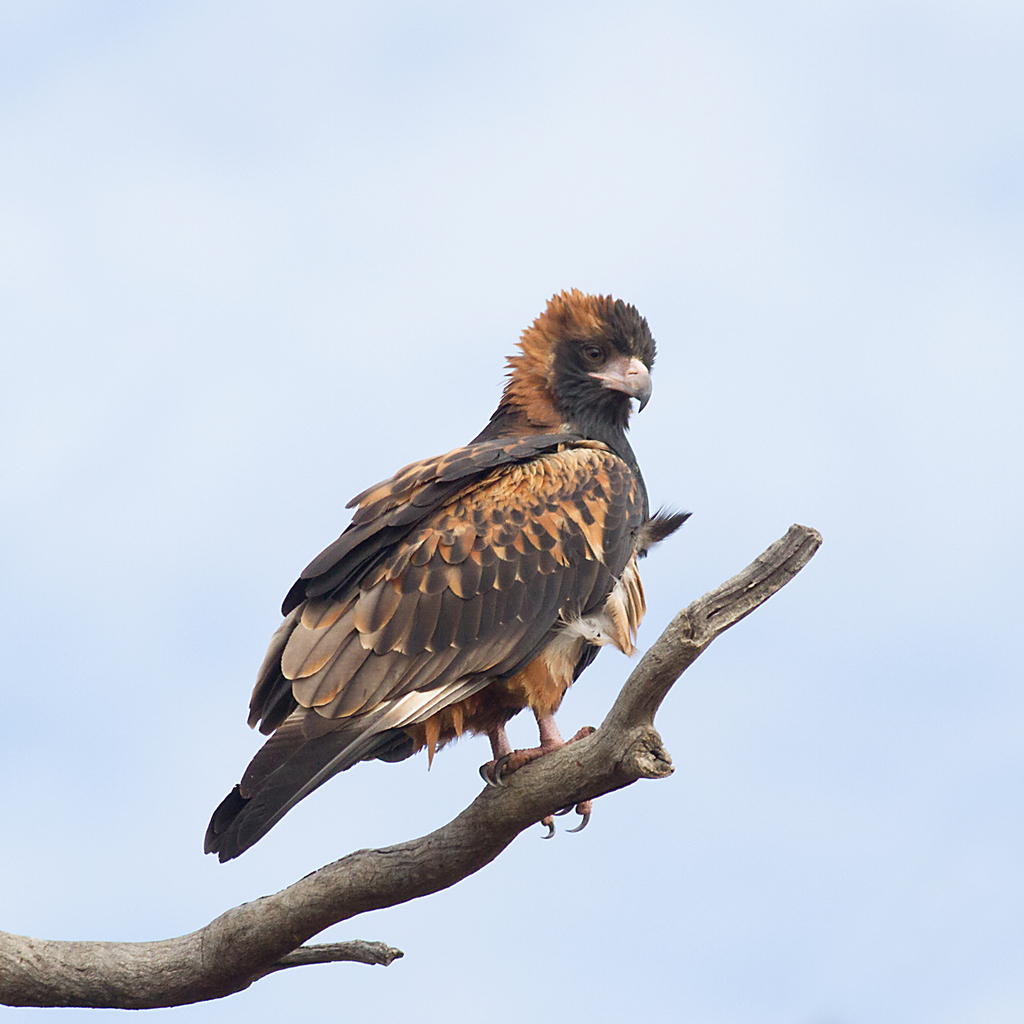
Black-breasted Buzzard
Photo © Kym Nicolson
Photo © Kym Nicolson — CC BY 4.0 — Source: iNaturalist #46198439Identification
The black-breasted buzzard is one of Australia's largest birds of prey, measuring 51 to 61 cm in height with an impressive wingspan of 141 to 156 cm. Its most distinctive feature is the striking contrast between mainly black underparts and thick white panels near the wing tips, visible when the bird is in flight. From above, the black plumage is broken by rich mottled red across the back and shoulders. Adults appear sexually monomorphic, though females are slightly larger, weighing around 1,330 g compared to males at 1,196 g. Immature and juvenile birds display pale brown colouring with increasing dark streaks as they age. The species' conspicuously long wings relative to its stout body and short square tail make it distinctive in flight.
Range & Habitat
The black-breasted buzzard is endemic to mainland Australia, widely but sparsely distributed across northern and inland regions receiving less than 500 mm annual rainfall. Its range stretches from north-eastern South Australia, north-western New South Wales, northern Queensland, the Northern Territory, and the north-western reaches of Western Australia. The species is notably absent from Victoria, the Australian Capital Territory, and Tasmania, where wetter temperate climates prevail.
Found in wooded and open habitats, the buzzard shows a strong preference for riparian forests and tall-open woodlands surrounded by mid-dense shrublands. River Red Gum woodlands are particularly favoured across central Australia, representing the species' most commonly observed habitat type.
Behaviour & Diet
The black-breasted buzzard is a versatile and opportunistic hunter employing diverse foraging techniques. It hunts reptiles, small mammals including young rabbits and rodents, large insects, and birds up to the size of pigeons and ducks. The species also raids bird nests for eggs and nestlings, even targeting other raptor species. Carrion of large mammals found along roads, tracks, and creek lines frequently supplements its diet. The buzzard searches for food by soaring in transects over low vegetation, engaging in cooperative hunting with other individuals, or observing from high unconcealed perches, attacking prey by dropping, pouncing, diving, or gliding.
The species is renowned for its remarkable skill in using stones to crack the eggs of large ground-nesting birds such as emus, magpie geese, brolgas, and Australian bustards. Stones are either dropped onto or thrown at eggs to break them open, or the buzzard may use its beak to crack them directly. The common call is a repeated hoarse yelping or sharp yap.
Best Time & Places to See It
The black-breasted buzzard is common throughout most of its range, making it a relatively accessible species for wildlife travellers in northern and inland Australia. River Red Gum woodlands in central Australia offer the best opportunities for observation. The species breeds from August to October, with nestlings fledging around December, potentially offering extended viewing opportunities during this period. Look for the buzzard soaring over open woodland and shrubland habitats, or perched conspicuously on exposed branches in tall trees.
Photography Tips
The buzzard's striking plumage makes it highly photogenic. When shooting from below, emphasise the dramatic contrast between the black underparts and white wing panels, which are most visible during flight. The species' long wingspan relative to body size creates distinctive silhouettes—capture these in backlit conditions for maximum impact. The rich mottled red on the back and shoulders is best photographed when the bird is perched or soaring at angles where dorsal plumage is visible. Adults can be individually identified by broken or missing flight feathers, a useful detail for field photography documentation. Patience is rewarded when photographing from vantage points overlooking River Red Gum woodlands, where the birds soar in transects at predictable heights.
Uluru-Kata Tjuta National Park
Petermann, Australia
+146 birds+10 mammals
Uluru-Kata Tjuta National Park is one of Australia’s most iconic protected areas, renowned for its breathtaking desert landscapes, extraordinary geological formations, and deep cultural significance. Located…
VIEW NATIONAL PARKKakadu National Park
Kakadu, Australia
+273 birds+46 mammals
Kakadu National Park is Australia’s largest national park and one of the world’s most remarkable protected areas, covering nearly 20,000 square kilometres in the tropical north…
VIEW NATIONAL PARKDaintree National Park
Dedin, Australia
+362 birds+37 mammals
Daintree National Park is one of the world’s oldest and most biologically diverse tropical rainforests, protecting an extraordinary landscape where ancient forests meet the Great Barrier…
VIEW NATIONAL PARKIkara-Flinders Ranges National Park
Australia
+149 birds+10 mammals
Where ancient quartzite ridges rise across the semi-arid heart of South Australia, Ikara-Flinders Ranges National Park unfolds across nearly two thousand square kilometres of one of…
VIEW NATIONAL PARKVulkathunha-Gammon Ranges National Park
Australia
+97 birds+8 mammals
Granite ridges and quartzite peaks rise abruptly from the red earth of South Australia's mid-north, their steep slopes carved into gorges where seasonal waterfalls cascade through…
VIEW NATIONAL PARKEndeavour River National Park
Philadelphia, Australia
+203 birds+1 mammals
Where the Endeavour River winds through northeastern Queensland's tropical lowlands, a compact mosaic of rainforest, open woodland, and riverine corridor creates one of Australia's most ecologically…
VIEW NATIONAL PARKRinyirru National Park
Lakefield, Australia
+258 birds+7 mammals
Where the savanna grasslands of far north Queensland meet seasonal wetlands and eucalypt woodlands, Rinyirru National Park sprawls across more than 12,500 square kilometres of rugged,…
VIEW NATIONAL PARKLitchfield National Park
Australia
+175 birds+15 mammals
Where weathered sandstone plateaus rise above the savanna woodlands of Australia's Top End, Litchfield National Park unfolds as a landscape of dramatic contrasts shaped by a…
VIEW NATIONAL PARKNitmiluk National Park
Australia
+186 birds+27 mammals
Dramatic sandstone gorges carved by the Katherine River slice through the tropical savanna of Australia's Top End, creating a landscape where escarpments tower above crystalline pools…
VIEW NATIONAL PARKWooroonooran National Park
Australia
+240 birds+28 mammals
Where the Great Dividing Range rises sharply inland from Queensland's tropical coast, Wooroonooran National Park encompasses a landscape of steep, forested gorges and cascading waterways carved…
VIEW NATIONAL PARKBoodjamulla National Park
Australia
+142 birds+3 mammals
Where red sandstone gorges carve through the semi-arid interior of far north Queensland, Boodjamulla National Park reveals a landscape shaped by seasonal water availability and ancient…
VIEW NATIONAL PARKMurray-Sunset National Park
Australia
+205 birds+2 mammals
Across the semi-arid borderlands of northwestern Victoria, where the Murray River defines the state's edge, sprawls a landscape of remarkable resilience and subtle beauty. Murray-Sunset National…
VIEW NATIONAL PARKKalbarri National Park
Australia
+157 birds+6 mammals
Where ochre cliffs and weathered gorges slice through Western Australia's semi-arid interior, Kalbarri National Park reveals a landscape shaped by millions of years of erosion and…
VIEW NATIONAL PARKKarijini National Park
Australia
+117 birds+5 mammals
Ochre ridges and rust-coloured gorges slice through the Pilbara's ancient landscape, where Karijini National Park sprawls across a wilderness of iron-rich plateaus and plunging ravines carved…
VIEW NATIONAL PARKCape Range National Park
Australia
+159 birds+15 mammals
Where arid limestone ridges plunge toward turquoise waters, Cape Range National Park frames one of Australia's most dramatic desert-ocean interfaces. The park's spine—a stark, weathered range…
VIEW NATIONAL PARKPurnululu National Park
Australia
+114 birds
Towering sandstone domes and dramatic gorges carved by seasonal watercourses define this remote corner of the Kimberley, where ancient rock formations create a maze of narrow…
VIEW NATIONAL PARKNo community photos yet. Log in to add the first one.
No community observations of this species yet.