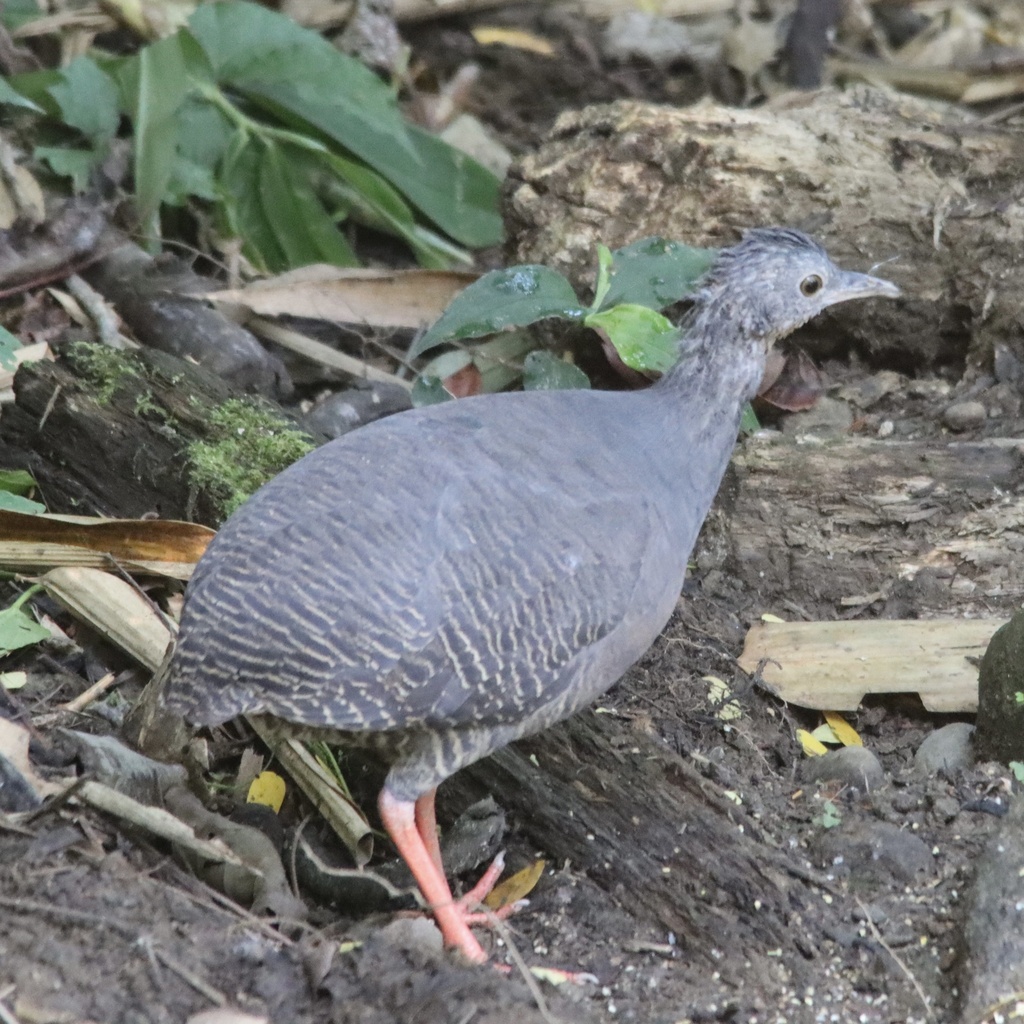
Black-capped Tinamou
Photo © Sean Vanderluit
Photo © Sean Vanderluit — CC BY 4.0 — Source: iNaturalist #142385044Identification
The Black-capped Tinamou is a compact forest bird measuring approximately 28 to 30 centimetres in length. True to its name, it features a distinctive blackish cap, while its upper parts are brown with blackish mottling and barring. The throat and neck display rufescent (reddish-brown) colouration, contrasting with a dark grey breast. The remaining underparts range from cinnamon to buff. The bird's legs are notably pale red or bright red, providing another useful field mark. Females tend to be more heavily barred on their upper parts than males, which can aid in sex identification for attentive observers.
Range & habitat
This species is native to the lowland forests of southeastern Peru and northern Bolivia, where it inhabits moist forest environments in subtropical and tropical regions at elevations up to 900 metres. The bird has recently been recorded in Brazil, expanding its known range. The Black-capped Tinamou shows a preference for dense, moist lowland forests where it can forage among leaf litter and low vegetation.
Behaviour & diet
Like other tinamous, the Black-capped Tinamou is primarily a ground forager, feeding on fallen fruit and low-lying vegetation. Its diet is supplemented with small invertebrates, flower buds, tender leaves, seeds, and roots. This species has an unusual breeding system in which males incubate eggs that may originate from as many as four different females. After the eggs hatch, the male alone raises the chicks until they become independent, typically at 2–3 weeks of age. Ground nests are constructed in dense brush or sheltered between the buttress roots of trees, providing protection for the vulnerable incubating male and developing chicks.
Best time & places to see it
The Black-capped Tinamou is found in moist lowland forests of southeastern Peru and northern Bolivia, with recent records from Brazil. Travellers and birdwatchers exploring these regions should focus their efforts in lowland forest habitats below 900 metres elevation, particularly in areas with dense undergrowth and abundant leaf litter. The species' secretive nature and preference for dense vegetation make it a challenge to observe, requiring patience and careful listening for vocalisations.
Photography tips
Photographing the Black-capped Tinamou presents a rewarding challenge for patient wildlife photographers. The bird's habit of foraging on the ground in dense brush means working with lower angles and often dim forest-floor lighting. The distinctive blackish cap and reddish legs provide useful identification features to capture. Early mornings when the bird is most active and light penetrates the forest canopy will offer the best opportunities. A telephoto lens will be essential for distant shooting, as the bird's wary nature means close approach is difficult. Focusing on the characteristic head markings and leg coloration will produce the most diagnostic images.
Otishi National Park
Río Tambo, Peru
+108 birds
Where the Andes descend toward the Amazon basin, vast cloud forests cloak the ridges and valleys of Peru's Río Tambo watershed, and this is where Otishi…
VIEW NATIONAL PARKManu National Park
Manu, Peru
+892 birds+26 mammals
Across the eastern slopes of the Peruvian Andes, tropical rainforest descends into the Amazon basin with a complexity that few terrestrial ecosystems match. Manu National Park…
VIEW NATIONAL PARKNo community photos yet. Log in to add the first one.
No community observations of this species yet.