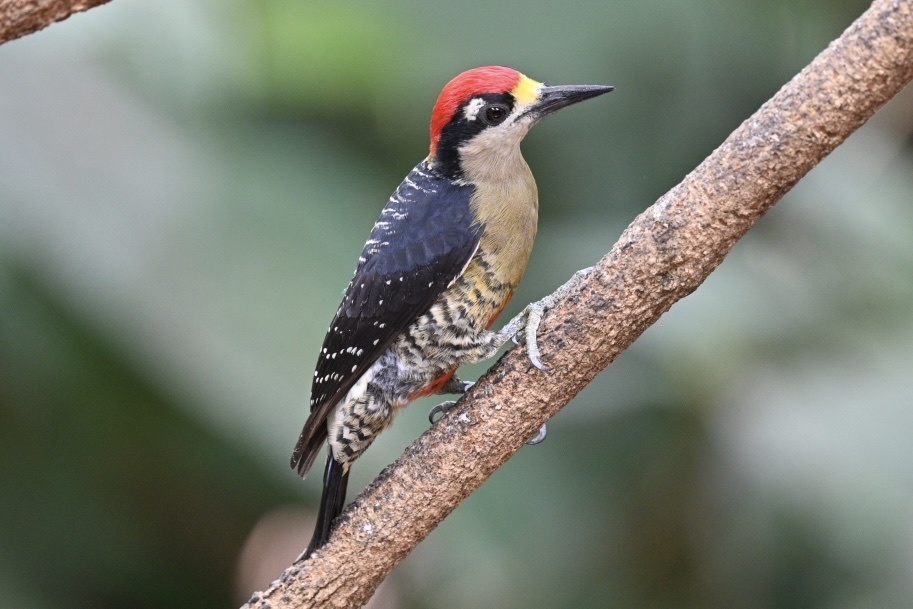
Black-cheeked Woodpecker
Photo © Лариса Артемьева
Photo © Лариса Артемьева — CC0 1.0 — Source: iNaturalist photo #621209831Identification
The black-cheeked woodpecker is a compact woodpecker, measuring 17 to 19 cm long and weighing 42 to 68 g. Males are distinctive with a golden yellow forehead contrasting sharply with a bright red crown and nape, while females show a white to buffy white forehead with a black central crown and red hindcrown. Both sexes share the species' defining feature: bold black markings around the eye extending down the side of the neck, with a white line running behind the eye. The upper back displays striking black and white barring, while the lower back and uppertail coverts are predominantly white with a pale buff tinge. The flight feathers are dark with narrow white tips and white barring throughout. The underparts are buffish white with wavy barring and a distinctive red spot in the center of the belly. Juveniles appear duller and browner overall, with more diffuse markings and a reduced red belly patch.
Range & Habitat
This species ranges from southern Mexico (Veracruz and Chiapas) southward through Central America into South America, occurring along the Caribbean slope through Costa Rica and on both slopes in Panama, western Colombia, and western Ecuador, with populations extending slightly into Peru. The black-cheeked woodpecker favors humid to wet evergreen forest interiors and edges, mature secondary forest, abandoned plantations, and clearings with scattered trees. It shows a remarkable adaptability to human-modified landscapes, occasionally appearing in gardens even far from forest. Elevationally, the species typically inhabits between 700 and 900 m, though it ranges up to 1,200 m regularly and can occur as high as 1,500 m in Ecuador.
Behaviour & Diet
The black-cheeked woodpecker is a year-round resident throughout its range. This active and agile forager feeds on an impressive variety of food sources: arthropods including spiders, beetles, ants, and aerial insects, along with extensive plant material such as fruits, berries, seeds, and catkins. It regularly takes nectar from large tree flowers. While typically foraging singly or in pairs, the species readily joins mixed-species foraging flocks and may gather in groups at fruiting trees. Its foraging technique is remarkably versatile, ranging from the forest midlevel to the crown, where it probes, pecks, gleans, and hawks for prey with considerable agility, sometimes even clinging to branch undersides.
Breeding occurs from March to July, with both sexes sharing incubation duties. The woodpecker excavates nest holes in dead trunks or branches, typically positioning them 4 to 30 m above ground. Clutches contain two to four eggs, with an incubation period of 14 days and fledging occurring approximately three weeks after hatching. The species produces various vocalizations, most commonly a series of short rattling trills on the same pitch described as "churrr, churrr, churrr, churrr." It also delivers longer smoother rattles, loud full-toned krrrr calls, and higher-pitched piercing notes. Both sexes drum, though infrequently.
Best Time & Places to See It
The black-cheeked woodpecker is a permanent resident throughout its range, making it potentially observable year-round. However, the breeding season from March to July offers increased activity and visibility as birds forage more actively and engage in breeding behaviors. The species occurs in several protected areas within its range, and travelers should focus on humid to wet evergreen forests, forest edges, and mature secondary growth between 700 and 900 m elevation—though higher elevations up to 1,500 m in Ecuador are worth exploring. Look for birds in mixed-species foraging flocks and at fruiting trees, where multiple individuals may gather.
Photography Tips
Photograph the black-cheeked woodpecker in good light to capture the striking contrast between the males' golden yellow and red head markings and the bold black facial markings that give the species its name. Position yourself where the midlevel to canopy foraging height receives adequate light; early morning often provides the clearest conditions. The bird's active, agile behavior—including its habit of clinging to branch undersides—offers dynamic compositional opportunities. Listen for its characteristic rattling trills and other calls to locate individuals, then approach slowly to avoid flushing the bird. Forest edges and clearings with scattered trees typically offer better photographic conditions than deep forest interior.
Arenal Volcano National Park
Peñas Blancas, Costa Rica
+551 birds+21 mammals
Straddling the border between Alajuela and Guanacaste in northwestern Costa Rica, this national park rises dramatically around one of Central America's most active volcanic systems. The…
VIEW NATIONAL PARKTortuguero National Park
Roxana, Costa Rica
+420 birds+23 mammals
Canals and lagoons thread through a labyrinth of lowland rainforest where the Caribbean coast of Costa Rica meets the wetland frontier. This is terrain shaped by…
VIEW NATIONAL PARKBraulio Carrillo National Park
Las Horquetas, Costa Rica
+547 birds+18 mammals
Where the Caribbean slope descends from the central volcanic cordillera toward the humid lowlands of Heredia, Braulio Carrillo National Park preserves one of Costa Rica's most…
VIEW NATIONAL PARKSanta Rosa National Park
Santa Elena, Costa Rica
+359 birds+30 mammals
Where Pacific-facing slopes descend from volcanic uplands toward the Guanacaste lowlands, Santa Rosa National Park unfolds across a mosaic of tropical dry forest, gallery woodland, and…
VIEW NATIONAL PARKGuanacaste National Park
Santa Elena, Costa Rica
+461 birds+17 mammals
Where the Pacific slopes of northwestern Costa Rica rise toward the Continental Divide, dry tropical forest gives way to cloud-laden peaks and misty ridges—a landscape that…
VIEW NATIONAL PARKCerros de Amotape National Park
District of San Jacinto, Ecuador
+246 birds+1 mammals
Arid mountains rise abruptly from Peru's northwestern frontier, their slopes clothed in xerophytic scrubland and seasonal deciduous forest that transforms these Andean foothills into one of…
VIEW NATIONAL PARKNatural Utría National Park
Alto Baudó (Pie de Pató), Colombia
+372 birds+11 mammals
Where the Chocó's coastal mountains plunge toward the Pacific, Utría National Park preserves one of Colombia's most biodiverse and least-visited wilderness expanses. Sprawling across 1,287 square…
VIEW NATIONAL PARKNatural Farallones de Cali National Park
Buenaventura, Colombia
+733 birds+27 mammals
Where the Pacific coastal plain meets the western slopes of the Andes, Farallones de Cali National Park sprawls across nearly 3,500 square kilometers of dramatic topography…
VIEW NATIONAL PARKNatural Uramba Bahía Málaga National Park
Buenaventura, Colombia
+308 birds+15 mammals
Where the Pacific coastal rainforest descends to mangrove estuaries and rocky headlands, Uramba Bahía Málaga National Park unfolds across nearly 1,000 square kilometres of Colombia's Valle…
VIEW NATIONAL PARKGeneral de División Omar Torrijos Herrera National Park
La Pintada, Panama
+401 birds+2 mammals
Across the highlands of central Panama, where the continental divide funnels moisture-laden trade winds into steep river valleys, the terrain rises and falls in a landscape…
VIEW NATIONAL PARKSoberanía National Park
Cristóbal, Panama
+495 birds+34 mammals
Rainforest and riverine woodland blanket the rolling terrain of this 714-square-kilometre national park in Colón Province, where the Caribbean watershed feeds a maze of streams and…
VIEW NATIONAL PARKChagres National Park
Caimitillo, Panama
+486 birds+19 mammals
Where the Chagres River carves through the humid tropics of central Panama, a vast montane and lowland forest sprawls across more than 2,300 square kilometers, anchoring…
VIEW NATIONAL PARKDarién National Park
Tucutí, Panama
+534 birds+13 mammals
Where the spine of Central America crumbles into wetland and rainforest, Darién National Park sprawls across more than 20,000 square kilometres of some of the tropics'…
VIEW NATIONAL PARKPortobelo National Park
Portobelo, Panama
+366 birds+9 mammals
Where the Caribbean's turquoise waters meet the Darién's verdant shore, Portobelo National Park sprawls across 570 square kilometers of coastal forest, mangrove wetland, and coral-fringed islands…
VIEW NATIONAL PARKMontes Azules
Candelaria, Mexico
+395 birds+47 mammals
Where jungle-clad limestone plateaus plunge into canyon systems carved by the Usumacinta River, Mexico's most pristine rainforest reserve unfolds across the Lacandón region of Chiapas. Montes…
VIEW BIOSPHERE RESERVETikal National Park
Tikal, Guatemala
+399 birds+16 mammals
Dense rainforest canopy rises above the limestone plateau of Petén, where archaeological wonder and ecological richness merge seamlessly across one of Central America's most biodiverse landscapes.…
VIEW NATIONAL PARKLaguna del Tigre National Park
Petén, Guatemala
+399 birds+29 mammals
Where the Petén lowlands dissolve into wetland and forest, Laguna del Tigre National Park protects one of Guatemala's most ecologically vital landscapes. This sprawling reserve encompasses…
VIEW NATIONAL PARKSierra del Lacandón National Park
Petén, Guatemala
+348 birds+7 mammals
Where the Petén rainforest rises into limestone ridges and deep ravines, Sierra del Lacandón National Park protects one of Central America's most intact tropical wilderness zones.…
VIEW NATIONAL PARKCahuita National Park
Talamanca, Costa Rica
+359 birds+15 mammals
Where the Caribbean shoreline dissolves into mangrove creeks and coral gardens, Cahuita's mosaic of habitats unfolds across the Limón coast. The park's signature feature—a living coral…
VIEW NATIONAL PARKRincón de la Vieja National Park
Liberia, Costa Rica
+451 birds+30 mammals
Where volcanic slopes rise abruptly from the Guanacaste lowlands, Rincón de la Vieja National Park sprawls across a landscape shaped by geothermal drama and seasonal extremes.…
VIEW NATIONAL PARKTapantí Macizo de la Muerte National Park
Orosi, Costa Rica
+503 birds+18 mammals
Where montane cloud forest rises steeply from the Orosi Valley, Tapantí Macizo de la Muerte National Park enfolds a landscape of perpetual moisture and emerald complexity.…
VIEW NATIONAL PARKLa Amistad International Park
Crorina, Costa Rica
+532 birds+20 mammals
Where the Caribbean slopes of Costa Rica's Talamanca Mountains rise steeply inland from Limón, the boundary between two nations dissolves into an unbroken expanse of rainforest.…
VIEW NATIONAL PARKBarbilla National Park
Chirripó, Costa Rica
+226 birds
Where the Caribbean slope of Costa Rica's eastern cordillera plunges into perpetual moisture, Barbilla National Park rises as one of Central America's most water-rich ecosystems. Fed…
VIEW NATIONAL PARKVolcán Tenorio National Park
Guatuso, Costa Rica
+480 birds+12 mammals
Where volcanic slopes rise through Costa Rica's northwestern borderlands, Volcán Tenorio National Park sprawls across terrain shaped by ancient lava flows and mineral-rich springs. The park's…
VIEW NATIONAL PARKCaño Negro National Wildlife Refuge
Caño Negro District, Costa Rica
+486 birds+16 mammals
Where the San Juan River's seasonal floodplain opens into expansive wetlands, Caño Negro Wildlife Sanctuary sprawls across one of Central America's most productive freshwater ecosystems. This…
VIEW WILDLIFE SANCTUARYGandoca-Manzanillo National Wildlife Refuge
Manzanillo, Costa Rica
+394 birds+18 mammals
Where the Caribbean coastal plain surrenders to water-logged forest and mangrove tangles, Gandoca-Manzanillo Wildlife Sanctuary shelters one of Costa Rica's most biodiverse lowland wetland ecosystems. The…
VIEW WILDLIFE SANCTUARYBarra del Colorado National Wildlife Refuge
Tortuguero, Costa Rica
+462 birds+36 mammals
Where the Caribbean's restless waters meet the Limón Province coastline, Barra del Colorado National Wildlife Sanctuary unfolds across a landscape of extraordinary ecological complexity. This equatorial…
VIEW WILDLIFE SANCTUARYNo community photos yet. Log in to add the first one.
No community observations of this species yet.