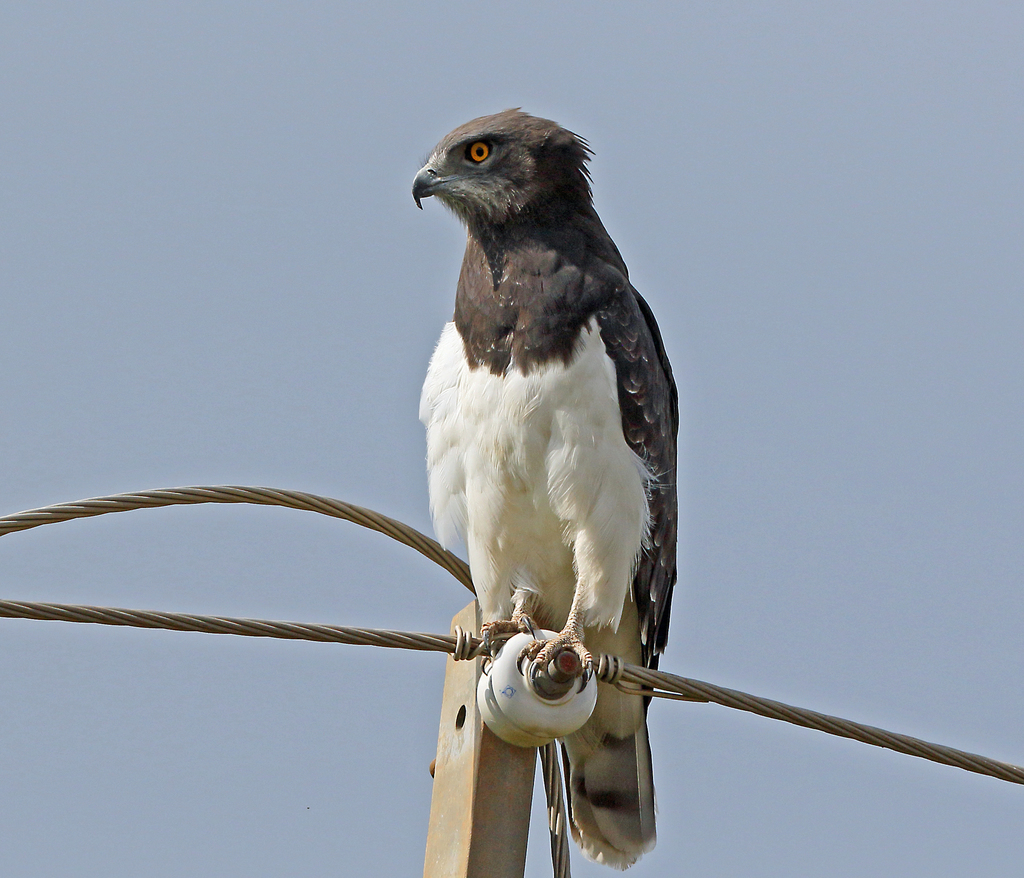
Black-chested Snake Eagle
Photo © Nigel Voaden
Photo © Nigel Voaden — CC BY 4.0 — Source: iNaturalist photo #1550890Identification
The black-chested snake eagle is a large African bird of prey instantly recognizable by its distinctive dark brown-black head and chest contrasting sharply with uniform white lower underparts and underwings. In flight, this striking pattern is unmistakable—watch for the white belly and wing undersides marked only by three narrow black terminal bars. The bright yellow-orange eye, horn-coloured bill, and pale grey unfeathered legs are diagnostic features shared with other snake eagles. The sexes are alike in plumage, though females are noticeably larger than males.
Several similar species could cause confusion in the field. Unlike the short-toed snake eagle, this species lacks darkly blotched belly markings, and differs from Beaudouin's snake eagle by having unmarked rather than narrowly barred lower underparts. The martial eagle might seem similar at distance, but is larger with spotted (not unmarked) breast plumage and brown-black (not white) underwings. Listen for the distinctive whistled call: a series of kwo kwo kwo notes ending in kweeoo.
Range & Habitat
This Afrotropical species ranges throughout southern and East Africa, from Ethiopia and Sudan in the north to South Africa (north of 26°S) in the south, extending west to the southern Democratic Republic of the Congo and southeastern Gabon. It is a partial migrant; many populations in southern and East Africa are resident year-round, while birds in Sudan breed only seasonally and those in Ethiopia and the former Transvaal are largely non-breeding visitors. Even in resident populations, seasonal movements occur—notably an influx of birds into Zimbabwe during the dry winter months.
The species shows remarkable habitat flexibility, thriving in open acacia and miombo woodlands, grasslands, thornbush savannas, semi-arid savanna, and even desert areas. It avoids mountains and forests, and readily adapts to anthropogenic habitats such as farmland and electricity or telephone poles. Communal roosts of up to 200 birds have been recorded during the non-breeding period. Interestingly, it is sympatric with the brown snake eagle across much of its range, and the two species have been observed nesting in the same pylon without conflict.
Behaviour & Diet
True to its name, the black-chested snake eagle feeds primarily on snakes—particularly venomous species up to 80 centimetres in length—but supplements its diet with lizards, insects, small mammals, and frogs. It hunts from a perch or by hovering and scanning the ground, stalking prey on the wing before executing a slow parachuting descent to capture it. The species demonstrates strong dependence on seasonal fluctuations in small mammal availability; populations in the Serengeti increase markedly during booms in small mammal abundance. A specimen from 1922 contained both rodent fur and a hissing sand snake, illustrating its varied prey preferences.
Usually found singly, this eagle becomes gregarious only during the non-breeding season when communal roosts form. Its hunting strategy combines patience at favoured perches with active aerial searching, making it an efficient predator across open and semi-open landscapes.
Best Time & Places to See It
The black-chested snake eagle is widely distributed across southern and East African savannas, making it accessible to travellers throughout much of the region. Look for it in open woodlands and grasslands rather than forested areas. The species is usually encountered singly, perched prominently on trees, pylons, or poles where it scans for prey, or hovering low over grassland and thornbush savanna.
Seasonal movements vary by location. Southern African populations show influx during dry winter months, making June to August particularly rewarding in countries like Zimbabwe and South Africa. In the Serengeti and other East African parks, numbers correlate with small mammal population cycles. Year-round residents in many areas mean the species can be found consistently, though communal roosts during the non-breeding period offer excellent opportunities for viewing multiple individuals together.
Photography Tips
The black-chested snake eagle's bold plumage pattern—dark head and chest against white underparts—photographs beautifully in good light. The contrasting white belly and underwings are especially striking in flight shots. Position yourself to capture the bird in profile or against clear sky to emphasize the stark colour contrast. The characteristic hovering hunting behaviour provides dynamic flight photography opportunities; patience watching from a vehicle in open savanna often rewards photographers with hunting sequences.
Perched birds offer chances to capture the bright yellow-orange eye and overall posture. Early morning and late afternoon light enhance the plumage contrast. Communal roosts during the non-breeding period, though challenging to locate, offer exceptional opportunities for capturing multiple birds and group behaviour. Use a telephoto lens to maintain distance from this powerful predator while filling the frame with detail.
Serengeti National Park
Tanzania
+558 birds+57 mammals
Across Tanzania's northern plateau, where volcanic soils meet acacia woodland and open grassland, unfolds one of Earth's most dynamic ecosystems. The Serengeti National Park sprawls across…
VIEW NATIONAL PARKArusha National Park
Tanzania
+555 birds+16 mammals
Where the slopes of Mount Mawenzi rise above the Arusha region, a compact yet ecologically rich national park unfolds across montane forest, moorland, and alpine zones.…
VIEW NATIONAL PARKMapungubwe National Park
Musina Local Municipality, South Africa
+358 birds+29 mammals
Where the Limpopo River cuts through sandstone ridges at the convergence of South Africa, Botswana, and Zimbabwe, Mapungubwe National Park preserves a landscape of profound ecological…
VIEW NATIONAL PARKChobe National Park
Botswana
+446 birds+45 mammals
Where the Chobe River cuts a sinuous path through northern Botswana, the landscape transforms into one of Africa's most dynamic wetland-savanna mosaics. This national park encompasses…
VIEW NATIONAL PARKNxai Pan National Park
Botswana
+226 birds+16 mammals
Across the northwestern reaches of Botswana stretches a landscape of profound seasonal transformation—a sprawling pan system where shallow depressions fill and empty with the rains, creating…
VIEW NATIONAL PARKKhaudum National Park
Botswana
+213 birds+13 mammals
Where the Okavango's northern tributaries meander through miombo woodland and riverine forest, Khaudum National Park unfolds across a landscape of profound ecological richness and isolation. This…
VIEW NATIONAL PARKVirunga National Park
Uganda
+418 birds+13 mammals
Where the Western Rift Valley fractures the landscape of North Kivu, Virunga National Park sprawls across terrain as geologically dramatic as it is ecologically vital. Volcanic…
VIEW NATIONAL PARKBwindi Impenetrable National Park
Kanyashogi, Uganda
+603 birds+26 mammals
Steep ridges cloaked in montane forest rise from Uganda's southwestern borderlands, where the landscape grows so dense and tangled that early explorers named it impenetrable. At…
VIEW NATIONAL PARKKidepo Valley National Park
Uganda
+478 birds+24 mammals
Where the Narus and Kidepo rivers carve through northeastern Uganda's semi-arid lowlands, a landscape of sparse acacia woodland, grassland, and riverine thickets creates one of East…
VIEW NATIONAL PARKMurchison Falls National Park
Uganda
+608 birds+33 mammals
Where the Victoria Nile compresses through a narrow gorge and explodes across a 45-meter precipice, the landscape speaks in thunder. Murchison Falls National Park sprawls across…
VIEW NATIONAL PARKLake Mburo National Park
Uganda
+505 birds+24 mammals
Rolling acacia woodland and scattered lakes define this intimate savanna preserve in southwestern Uganda, where the rift valley's geological drama shapes every water source and grassland.…
VIEW NATIONAL PARKTsavo East National Park
Athi ward, Kenya
+468 birds+50 mammals
Across the semi-arid lowlands of southeastern Kenya, where acacia woodland fragments into scrubland and the landscape rolls toward the Indian Ocean horizon, lies one of Africa's…
VIEW NATIONAL PARKTsavo West National Park
Mwatate, Kenya
+513 birds+49 mammals
Where volcanic ridges and weathered lava flows meet the semi-arid lowlands of south-central Kenya, Tsavo West National Park unfolds across a landscape sculpted by fire and…
VIEW NATIONAL PARKAmboseli National Park
Etonet/Lenkism ward, Kenya
+501 birds+43 mammals
Where the Amboseli basin opens toward the Tanzanian frontier, a shallow alkaline lake mirrors vast skies across one of East Africa's most iconic savanna landscapes. The…
VIEW NATIONAL PARKMount-Kenya National Park
Abothuguchi west ward, Kenya
+334 birds+11 mammals
Where the slopes of Kenya's second-highest mountain rise steeply from the Meru County foothills, a landscape of profound ecological richness unfolds across Mount Kenya National Park.…
VIEW NATIONAL PARKTarangire National Park
Tanzania
+527 birds+50 mammals
Acacia woodland and grassland sweep across the Manyara Region where the Tarangire River carves through low hills and volcanic soils, creating one of East Africa's most…
VIEW NATIONAL PARKNgorongoro Conservation Area
Tanzania
+626 birds+55 mammals
Volcanic calderas and open grassland dominate this high plateau in northern Tanzania, where the landscape rises above 2,000 metres and ancient geological forces have shaped both…
VIEW WILDLIFE MANAGEMENT AREAToro-Semliki Proposed National Park
Uganda
+474 birds+5 mammals
Where the Albertine Rift's western escarpment rises above the Semliki River valley, a vast mosaic of forest, savanna and wetland converges to create one of East…
VIEW NATIONAL PARKQueen Elizabeth National Park
Uganda
+672 birds+30 mammals
Across the southwestern escarpment of Uganda, where the Western Rift Valley descends through ancient volcanic terrain, Queen Elizabeth National Park sprawls across more than 8,300 square…
VIEW NATIONAL PARKMabamba Swamp
Memere, Uganda
+464 birds+2 mammals
Across the Central Region of Uganda spreads one of Africa's most biodiverse freshwater wetlands, a sprawling nature reserve of roughly 283 square kilometres where papyrus swamps…
VIEW NATURE RESERVEPilanesberg National Park
Moses Kotane Local Municipality, South Africa
+364 birds+49 mammals
Granite peaks and volcanic ridges rise unexpectedly from the savanna floor across this 734-square-kilometre expanse in the North West province, creating a landscape of profound ecological…
VIEW NATIONAL PARKMokala National Park
Siyancuma Local Municipality, South Africa
+246 birds+35 mammals
Across the semi-arid savanna of the Northern Cape, where red earth meets sparse acacia woodland and open grassland punctuated by rocky outcrops, lies a landscape shaped…
VIEW NATIONAL PARKKruger National Park
Ba-Phalaborwa Local Municipality, South Africa
+540 birds+91 mammals
Across the low-lying savanna of northeastern South Africa unfolds one of Africa's largest and most ecologically intact protected areas, where acacia woodlands merge into mopane scrub…
VIEW NATIONAL PARKTankwa-Karoo National Park
Hantam Local Municipality, South Africa
+201 birds+20 mammals
Across the semi-arid heartland of the Northern Cape, where winter rains carve ephemeral watercourses through endless ochre plains, Tankwa-Karoo National Park sprawls across more than 3,100…
VIEW NATIONAL PARKMountain Zebra National Park
Inxuba Yethemba Local Municipality, South Africa
+265 birds+35 mammals
Across the windswept plateaus and deeply incised valleys of the Eastern Cape's interior, Mountain Zebra National Park unfolds as a landscape of geological drama and ecological…
VIEW NATIONAL PARKAugrabies Falls National Park
Kai !Garib Local Municipality, South Africa
+176 birds+20 mammals
Where the Orange River cuts a dramatic scar through the Northern Cape's arid interior, Augrabies Falls National Park sprawls across nearly 1,200 square kilometers of raw,…
VIEW NATIONAL PARKAddo Elephant National Park
Sundays River Valley Local Municipality, South Africa
+388 birds+55 mammals
Where the Eastern Cape's semi-arid scrublands meet transitional woodland, Addo sprawls across 13,478 square kilometres of one of southern Africa's most biodiverse landscapes. The terrain rises…
VIEW NATIONAL PARKIthala Game Reserve
uPhongolo Local Municipality, South Africa
+328 birds+26 mammals
Rolling thornbush savanna and acacia woodland dominate the landscape of this 494-square-kilometre national park in KwaZulu-Natal's uPhongolo Local Municipality, where granite outcrops punctuate grassland plateaus and…
VIEW NATIONAL PARKMarakele National Park
Modimolle Local Municipality, South Africa
+341 birds+36 mammals
Granite ridges and sprawling grasslands dominate this 1,176-square-kilometre reserve in Limpopo's heartland, where bushveld transitions between rocky outcrops and open savanna. The park's rugged topography creates…
VIEW NATIONAL PARKCamdeboo National Park
Camdeboo Local Municipality, South Africa
+272 birds+24 mammals
Granite ridges and weathered sandstone cliffs rise across a semi-arid landscape where the Karoo transitions into the eastern escarpment of South Africa, creating Camdeboo National Park's…
VIEW NATIONAL PARKZiwa Rhino and Wildlife Ranch
Nakasongola, Uganda
+359 birds+11 mammals
Where papyrus wetlands merge into sprawling savanna, Uganda's central landscape opens into one of East Africa's most vital rhino recovery zones. Ziwa Rhino and Wildlife Ranch…
VIEW WILDLIFE SANCTUARYKhaudum National Park
Namibia
+221 birds+13 mammals
Where the Kavango River flows through northeastern Namibia, vast miombo woodlands and riverine forests create one of southern Africa's most remote and biodiverse wilderness corridors. Khaudum…
VIEW NATIONAL PARKSperrgebiet National Park
Barcelona, Namibia
+181 birds+18 mammals
Where the Namib's ancient gravel plains meet the Atlantic coast, one of Africa's most remote and geologically austere landscapes unfolds across more than 56,000 square kilometres.…
VIEW NATIONAL PARKDorob National Park
Henties Bay, Namibia
+230 birds+13 mammals
Where the Skeleton Coast meets the Namib Desert's inland reaches, Dorob National Park sprawls across 34,021 square kilometres of one of southern Africa's most austere and…
VIEW NATIONAL PARKSkeleton Coast Park
Barcelona, Namibia
+143 birds+7 mammals
Where the Atlantic's cold Benguela Current collides with one of Africa's most hostile coastlines, the Skeleton Coast Park sprawls across more than 104,000 square kilometres of…
VIEW OBSERVATION POINTNamib-Naukluft National Park
Namibia
+217 birds+33 mammals
Across nearly 94,000 square kilometers of southwestern Namibia, a landscape of extremes unfolds where towering sand dunes meet rugged mountain ranges, and ancient riverbeds carve through…
VIEW NATIONAL PARKNkasa Rupara National Park
Namibia
+283 birds+17 mammals
Where the Zambezi's floodplains spill across the border between Namibia and Botswana, Nkasa Rupara National Park unfolds across 518 square kilometers of wetland and woodland mosaic.…
VIEW NATIONAL PARKBwabwata National Park
Namibia
+377 birds+35 mammals
Where the Kavango River winds through northeastern Namibia, vast floodplains and dense riparian woodland create one of southern Africa's most ecologically dynamic protected landscapes. Spanning 14,249…
VIEW NATIONAL PARKEtosha National Park
Namibia
+356 birds+58 mammals
Across northern Namibia's stark semi-arid plateau, a vast shallow depression transforms seasonally into one of Africa's most dramatic wildlife theaters. Etosha National Park, encompassing more than…
VIEW NATIONAL PARKNamibRand Nature Reserve
Hammerstein, Namibia
+107 birds+12 mammals
Where rust-coloured dunes surrender to sculpted granite outcrops and vast plains stretch toward an endless horizon, one of southern Africa's most pristine wilderness areas unfolds. The…
VIEW NATURE RESERVEWaterberg Plateau National Park
Okambukonde, Namibia
+198 birds+27 mammals
Where ancient sandstone cliffs rise 200 metres above the surrounding bushveld, a fortress of geology creates one of southern Africa's most compelling ecosystems. The plateau's steep…
VIEW NATIONAL PARKAbijata-Shalla Lakes National Park
Ethiopia
+438 birds+7 mammals
Two crater lakes of contrasting chemistry define this remote corner of Ethiopia's Rift Valley, where soda lakes and freshwater basins create a mosaic of distinct aquatic…
VIEW NATIONAL PARKBale Mountains National Park
Ethiopia
+397 birds+20 mammals
Where the Ethiopian highlands rise above 4,000 metres, the Bale Mountains create a landscape of stunning ecological extremes—from afroalpine grasslands swept by wind and mist to…
VIEW NATIONAL PARKAwash National Park
Didiga, Ethiopia
+473 birds+23 mammals
Where the Ethiopian Rift Valley carves through volcanic plateaus, a ribbon of riverine forest winds through acacia scrubland and grassland, creating a mosaic of habitats that…
VIEW NATURAL PARKYabelo Wildlife Sanctuary
Bedewera, Ethiopia
+359 birds+5 mammals
Where acacia woodlands meet volcanic plateaus in southern Ethiopia, a landscape of austere beauty unfolds across nearly 2,500 square kilometers. Yabelo Wildlife Sanctuary sprawls across semi-arid…
VIEW WILDLIFE SANCTUARYMakgadikgadi Pans National Park
Gucta, Botswana
+272 birds+27 mammals
Where salt-crusted flatlands stretch endlessly toward a shimmering horizon, one of Africa's most extraordinary ecosystems awakens with the rains. The Makgadikgadi Pans comprise vast mineral-rich basins…
VIEW NATIONAL PARKNairobi National Park
Nairobi, Kenya
+515 birds+35 mammals
Just minutes from Kenya's capital, where the Nairobi River winds through acacia woodland and open grassland, lies one of Africa's most paradoxical wildlife sanctuaries. The park's…
VIEW NATIONAL PARKLake Nakuru National Park
Nakuru West, Kenya
+494 birds+32 mammals
Alkaline waters ringed by acacia woodland and grassland create one of East Africa's most distinctive wetland ecosystems, where the interplay of geology and climate sustains a…
VIEW NATIONAL PARKAberdare National Park
Mweiga ward, Kenya
+394 birds+30 mammals
Where the central highlands of Kenya rise to their elemental grandeur, the Aberdare range unfolds across Nyeri County as a montane stronghold of cool, misty forest…
VIEW NATIONAL PARKMeru National Park
Igembe Central, Kenya
+408 birds+38 mammals
Granite outcrops and acacia woodland rise across the northern reaches of Meru, where semi-arid savanna transitions into drier scrubland under the fierce equatorial sun. The park's…
VIEW NATIONAL PARKSamburu National Reserve
Samburu, Kenya
+430 birds+42 mammals
Across the arid plains of northern Kenya, where scattered acacia woodland gives way to rocky outcrops and dry riverbeds, Samburu National Park unfolds as one of…
VIEW NATURE RESERVEHell’s Gate National Park
Olkaria ward, Kenya
+388 birds+18 mammals
Volcanic scarps and geothermal vents dominate the floor of Hell's Gate, where the East African Rift has carved a dramatic gorge through crystalline rock formations. The…
VIEW NATIONAL PARKRuma National Park
Suba, Kenya
+250 birds+8 mammals
Where the Winam Gulf narrows toward the Kenyan mainland, Ruma National Park rises as a sanctuary of evergreen woodland set within the humid tropics of Homa…
VIEW NATIONAL PARKSaiwa Swamp National Park
Sinyerere ward, Kenya
+255 birds+4 mammals
Where papyrus and sedge marshes stretch across a highland plateau in western Kenya, Saiwa Swamp National Park shelters one of East Africa's most productive freshwater wetland…
VIEW NATIONAL PARKSibiloi National Park
Kenya
+118 birds
Where the northern deserts of Kenya meet the volcanic Chalbi Plain, Sibiloi National Park sprawls across a landscape shaped by millennia of tectonic upheaval and semi-arid…
VIEW NATIONAL PARKArabuko Sokoke Forest Reserve
Kilifi, Kenya
+383 birds+29 mammals
Coastal forest rises from the Indian Ocean plains of Kilifi County, where sandy soils and seasonal rainfall have sculpted a woodland ecosystem unlike anywhere else on…
VIEW NATURE RESERVEWatamu Marine National Park
Dabaso ward, Kenya
+328 birds+12 mammals
Where mangrove channels meet coral gardens and sandy shallows blend into the warm waters of the Indian Ocean, Watamu Marine National Park unfolds across the Kilifi…
VIEW NATIONAL PARKNo community photos yet. Log in to add the first one.
No community observations of this species yet.