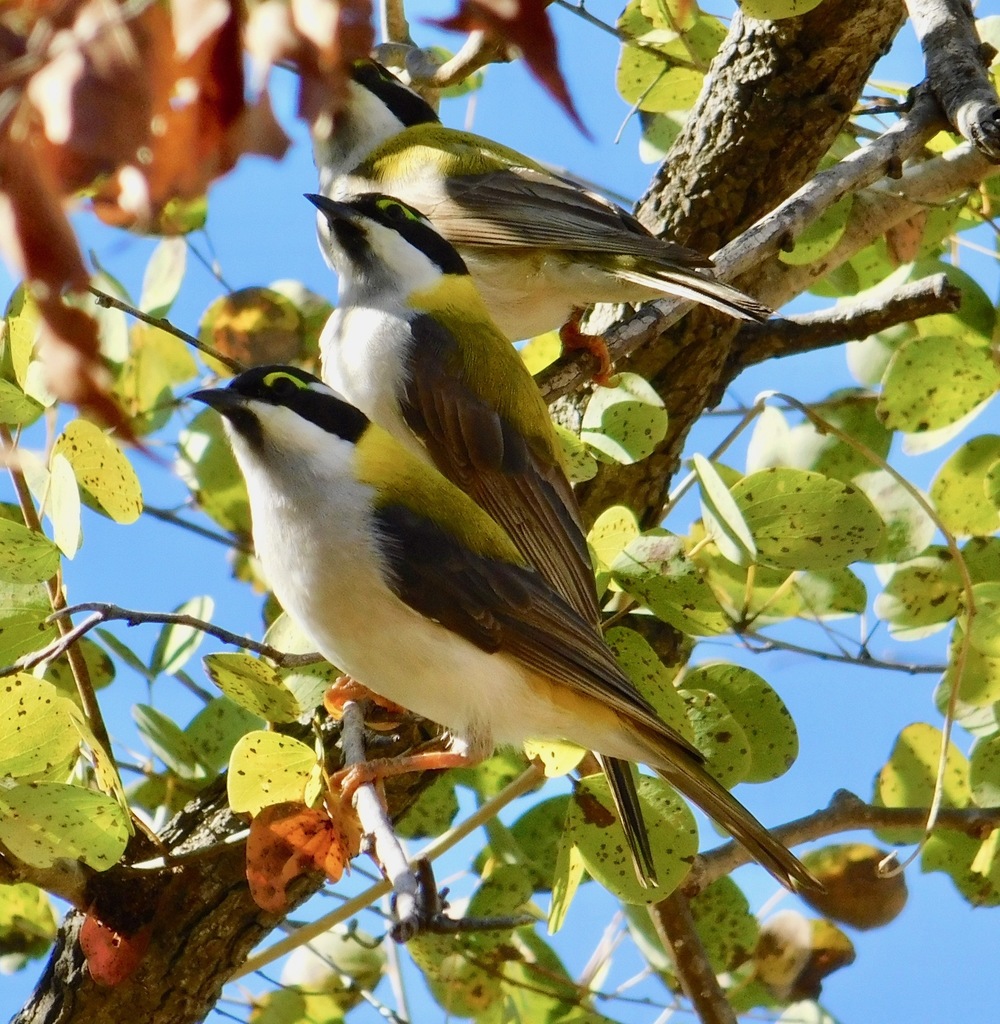
Black-chinned Honeyeater
Photo © desertnaturalist
Photo © desertnaturalist — CC BY 4.0 — Source: iNaturalist #28636497Identification
The black-chinned honeyeater is a mid-sized honeyeater measuring 14 to 16 cm in length. It is readily identified by its distinctive black head, nape and throat contrasting with olive-brown upperparts and buff underparts. A striking bluish patch of bare skin over the eye and a white crescent-shaped patch on the nape are diagnostic features. The legs and feet are bright orange. Juveniles are overall browner in plumage and lack the sharp contrasts of adults. The bird makes a scratchy "creep-creep-creep" call as well as more melodious vocalizations.
Two subspecies are recognized. The nominate black-chinned form occurs across much of eastern and central Australia, while the golden-backed subspecies, found in northern Australia, differs significantly with yellow nape and rump, a green-yellow back, smaller black marking on the chin, and greener bare skin around the eyes.
Range & Habitat
The black-chinned honeyeater is endemic to Australia, ranging across northern Australia from northwest Western Australia (including the Kimberley, Pilbara and Great Sandy deserts) through the Top End and Gulf Country to Cape York in Queensland. It extends southward through central and eastern Queensland and into central New South Wales east of the Great Divide, with populations becoming increasingly rare south of the Northern Rivers region. The species also occurs across central and northern Victoria into eastern South Australia, though it is considered vulnerable in New South Wales and South Australia while remaining secure overall.
The species inhabits open woodland and dry sclerophyll forest, characteristically near watercourses. It is notably absent from savanna on the western edge of the Einasleigh Uplands in Queensland, particularly around the Newcastle and Gregory Ranges.
Behaviour & Diet
Insects form the bulk of the black-chinned honeyeater's diet. Like its close relatives the brown-headed and strong-billed honeyeaters, it forages by probing in the bark of tree trunks and branches, a specialized feeding technique that distinguishes these forest-dwelling species from other honeyeaters that typically forage in foliage. The species congregates in relatively small flocks and remains closely associated with forested habitats.
Breeding occurs between July and December, with pairs raising one or two broods during this period. The nest is a thick-walled bowl constructed from grasses and bark fragments, lined with softer plant material, and concealed in the outer foliage of tall trees, typically eucalypts. Clutches consist of one or two eggs, measuring 22 × 16 mm, with a shiny buff-pink coloration sparsely spotted with red-brown markings, concentrated toward the larger end.
Best Time & Places to See It
The breeding season from July to December offers the best opportunity to locate black-chinned honeyeaters, as birds are actively engaged in nesting and feeding activities. The species is most reliably encountered in its northern range across Queensland, the Northern Territory and northern Western Australia. Eastern populations, particularly around central and eastern Queensland, remain relatively accessible to visiting birders.
Look for the species in open woodlands and dry sclerophyll forests, especially in areas adjacent to watercourses where foraging opportunities are concentrated. The bird's preference for probing in bark makes it relatively stationary compared to more mobile honeyeater species, potentially offering extended viewing opportunities once located.
Photography Tips
The black-chinned honeyeater's distinctive head markings—the black cap and throat contrasting with the white nape crescent and blue bare skin around the eye—are key features to capture. Position yourself to record these diagnostic plumage details, particularly the facial patch coloration, which varies subtly between the two subspecies.
The bird's foraging behavior on tree bark offers excellent photography opportunities, as individuals often remain relatively still while probing for insects. Early morning light will best reveal the contrast between the black head and buff underparts. The orange legs and feet provide additional points of interest worth highlighting in images. Patience near suitable woodland habitat near watercourses will reward photographers seeking this specialised forest feeder.
Uluru-Kata Tjuta National Park
Petermann, Australia
+146 birds+10 mammals
Uluru-Kata Tjuta National Park is one of Australia’s most iconic protected areas, renowned for its breathtaking desert landscapes, extraordinary geological formations, and deep cultural significance. Located…
VIEW NATIONAL PARKNerang National Park
Gold Coast, Australia
+126 birds+13 mammals
Steep subtropical rainforest clads the hinterland ridges of southeast Queensland's Gold Coast, where Nerang National Park sprawls across 34 square kilometres of protected bushland between the…
VIEW NATIONAL PARKKakadu National Park
Kakadu, Australia
+273 birds+46 mammals
Kakadu National Park is Australia’s largest national park and one of the world’s most remarkable protected areas, covering nearly 20,000 square kilometres in the tropical north…
VIEW NATIONAL PARKDaintree National Park
Dedin, Australia
+362 birds+37 mammals
Daintree National Park is one of the world’s oldest and most biologically diverse tropical rainforests, protecting an extraordinary landscape where ancient forests meet the Great Barrier…
VIEW NATIONAL PARKGreater Bendigo National Park
Whipstick, Australia
+202 birds+8 mammals
Across the red volcanic plains of inland Victoria, Greater Bendigo National Park sprawls across more than 1,000 square kilometres of eucalyptus woodland, open grassland, and scattered…
VIEW NATIONAL PARKChiltern-Mt Pilot National Park
Australia
+229 birds+12 mammals
Granite ridges and eucalyptus woodlands define this 869-square-kilometre park straddling the border between Victoria and New South Wales, where rugged terrain rises sharply from gentler foothill…
VIEW NATIONAL PARKLamington National Park
Australia
+227 birds+24 mammals
Where subtropical rainforest rises steeply from the Queensland coast, Lamington National Park spreads across 541 square kilometres of one of Australia's most biodiverse mountain landscapes. The…
VIEW NATIONAL PARKLittle Desert National Park
Australia
+200 birds+11 mammals
Across northwestern Victoria's semi-arid interior, sandstone ridges and heathland plateaus rise from red earth in a landscape sculpted by fire and drought rather than water. Little…
VIEW NATIONAL PARKCleland National Park
Australia
+127 birds+14 mammals
Eucalypt woodlands rise and fall across Adelaide's nearby hills, where Cleland National Park sprawls across some twenty square kilometres of native South Australian bushland. The terrain…
VIEW NATIONAL PARKNaracoorte Caves National Park
Australia
+116 birds+12 mammals
Beneath the grassy limestone plains of southeastern South Australia lies one of the Southern Hemisphere's most significant underground landscapes. Naracoorte Caves National Park encompasses a mosaic…
VIEW NATIONAL PARKLockyer National Park
Australia
+130 birds+5 mammals
Steep ridges and weathered escarpments rise from the Brisbane Valley in southeastern Queensland, where Lockyer National Park sprawls across 267 square kilometres of eucalypt woodland and…
VIEW NATIONAL PARKSundown National Park
Australia
+211 birds+9 mammals
Granite ridges and eucalypt woodlands define this 305-square-kilometre expanse of southeastern Queensland, where the landscape descends from sandstone plateaus into open forests and grassy clearings that…
VIEW NATIONAL PARKRinyirru National Park
Lakefield, Australia
+258 birds+7 mammals
Where the savanna grasslands of far north Queensland meet seasonal wetlands and eucalypt woodlands, Rinyirru National Park sprawls across more than 12,500 square kilometres of rugged,…
VIEW NATIONAL PARKGirraween National Park
Australia
+193 birds+21 mammals
Granite boulders rise like the bones of the earth across these 278 square kilometres of southeastern Queensland, where the Great Dividing Range descends towards the coastal…
VIEW NATIONAL PARKMorton National Park
Australia
+253 birds+57 mammals
Across nearly 4,800 square kilometers of New South Wales's Southern Tablelands, rugged sandstone plateaus rise above sheltered valleys where cool-climate eucalypt woodland meets grassy heath and…
VIEW NATIONAL PARKNitmiluk National Park
Australia
+186 birds+27 mammals
Dramatic sandstone gorges carved by the Katherine River slice through the tropical savanna of Australia's Top End, creating a landscape where escarpments tower above crystalline pools…
VIEW NATIONAL PARKGreat Sandy National Park
Australia
+306 birds+40 mammals
Where coastal dunes rise inland from the Queensland coastline, Great Sandy National Park encompasses a landscape of remarkable ecological diversity shaped by subtropical humid conditions year-round.…
VIEW NATIONAL PARKGirringun National Park
Australia
+231 birds+10 mammals
Where granite gorges cleave through subtropical woodland in North Queensland, Girringun National Park unfolds across rugged terrain shaped by millions of years of weathering and erosion.…
VIEW NATIONAL PARKBoodjamulla National Park
Australia
+142 birds+3 mammals
Where red sandstone gorges carve through the semi-arid interior of far north Queensland, Boodjamulla National Park reveals a landscape shaped by seasonal water availability and ancient…
VIEW NATIONAL PARKBlue Mountains National Park
Australia
+220 birds+43 mammals
Dramatic sandstone cliffs rise in tiers across this mountainous plateau west of Sydney, their rust-coloured faces weathered into amphitheatres and gorges where eucalyptus forest clings to…
VIEW NATIONAL PARKKu-ring-gai Chase National Park
Sydney, Australia
+216 birds+39 mammals
Where Hawkesbury sandstone cliffs plunge toward sheltered bays and creeks, Ku-ring-gai Chase National Park unfolds across rugged terrain just north of Sydney, a mosaic of eucalyptus…
VIEW NATIONAL PARKWarrumbungle National Park
Coonabarabran, Australia
+183 birds+22 mammals
Volcanic peaks and weathered ridges rise abruptly from the inland tablelands of central New South Wales, their exposed rock faces glowing ochre and rust in the…
VIEW NATIONAL PARKOxley Wild Rivers National Park
Australia
+202 birds+45 mammals
Where the New England Tablelands descend toward the coast, river gorges carve through temperate forests in a landscape of dramatic geological contrast. Oxley Wild Rivers National…
VIEW NATIONAL PARKGrampians National Park
Australia
+214 birds+18 mammals
Where sandstone ridges rise above the Western District of Victoria, Grampians National Park unfolds across rolling terrain sculpted by ancient geology and sustained by a temperate…
VIEW NATIONAL PARKMurray-Sunset National Park
Australia
+205 birds+2 mammals
Across the semi-arid borderlands of northwestern Victoria, where the Murray River defines the state's edge, sprawls a landscape of remarkable resilience and subtle beauty. Murray-Sunset National…
VIEW NATIONAL PARKKarijini National Park
Australia
+117 birds+5 mammals
Ochre ridges and rust-coloured gorges slice through the Pilbara's ancient landscape, where Karijini National Park sprawls across a wilderness of iron-rich plateaus and plunging ravines carved…
VIEW NATIONAL PARKPurnululu National Park
Australia
+114 birds
Towering sandstone domes and dramatic gorges carved by seasonal watercourses define this remote corner of the Kimberley, where ancient rock formations create a maze of narrow…
VIEW NATIONAL PARKNo community photos yet. Log in to add the first one.
No community observations of this species yet.