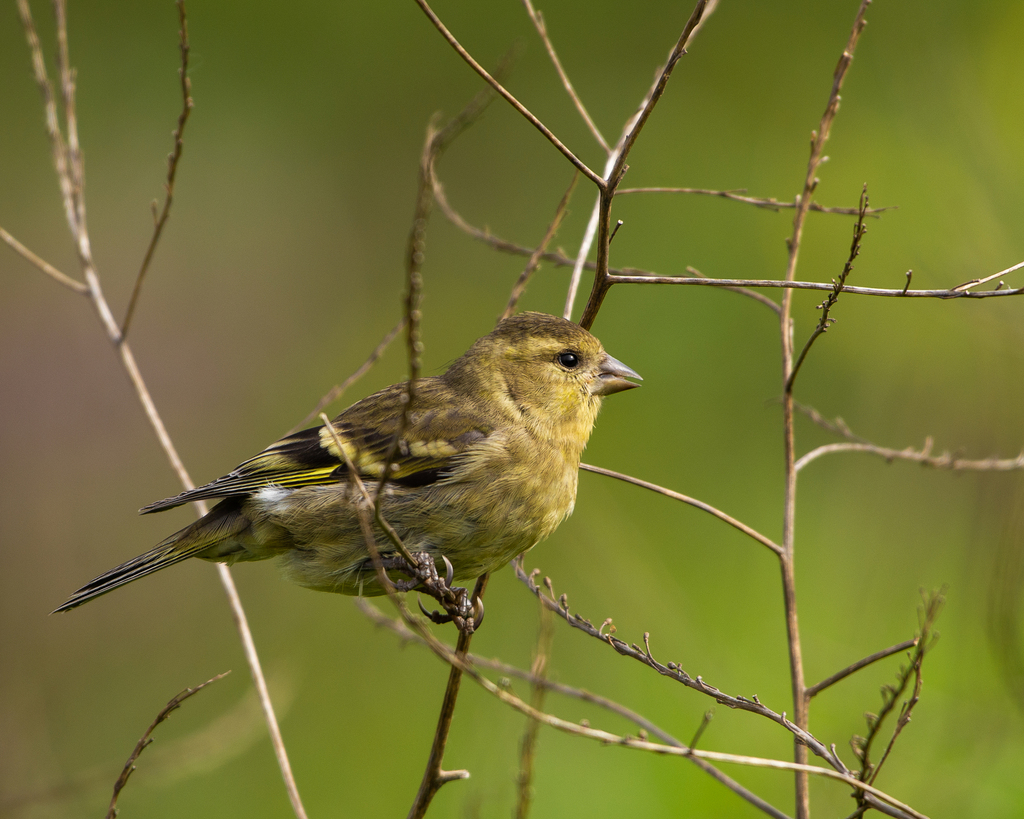
Black-chinned Siskin
Photo © Nicolás Villaseca Merino
Photo © Nicolás Villaseca Merino — CC BY-SA 4.0 — Source: iNaturalist photo #323679079Identification
The black-chinned siskin is a small finch, measuring 12 to 13 cm long and weighing 13 to 20 grams. Males are distinctively marked with a black forehead, lores, and crown, contrasting with an olive-green face washed with yellow and a bright yellow supercilium extending from behind the eye to the neck side. The back is olive-green with fine dark streaks, while the rump glows yellow to yellowish-green. The tail is mostly black with yellow bases, and the wings display a complex pattern of black feathers edged in pale green or buff, with bright yellow bases on the flight feathers creating striking wing bars. The chin and throat center are black, the breast bright yellow with green-washed flanks, and the belly whitish. Females lack the bold black head markings, instead showing a greenish-yellow head with a bright yellow forehead and supercilium, duller olive-green backs, and less yellow in the wings and tail. Juveniles resemble females but are paler overall with no bright facial yellow.
Range & Habitat
This is the southernmost siskin of its genus, found throughout Chile from the Atacama Region to Magallanes, across southern Argentina from Mendoza and La Pampa to Tierra del Fuego, and on the Falkland Islands. On the mainland, it primarily inhabits tall coniferous and broadleaf forests, though it also frequents more open country with brush, thickets, and Nothofagus shrubs, and occasionally visits suburban gardens. On the Falklands, it favors areas with tall tussock grass and introduced vegetation. Elevations range mostly below 1,500 metres, though records extend to 1,850 metres.
Behaviour & Diet
The black-chinned siskin is a partial migrant, with many individuals moving from higher elevations to plains and valleys after breeding, and others shifting from Chile's Chiloé Island to the mainland seasonally. It feeds primarily on seeds, though it also takes insect larvae from under bark and has been observed consuming flowers and farmed crops. Birds forage in pairs and small flocks during breeding season, expanding to flocks of up to 100 individuals outside breeding. They feed at all levels, from weedy ground patches to the forest canopy. The species breeds from July to February, building cup nests of grasses, plant fibers, and animal hair in shrub branches up to 2 metres high. Clutches contain three to five pinkish-white eggs marked with reddish-brown. The bird's loud, musical song incorporates phrases and trills along with varied calls: a rising tsooeet, an abrupt chit, a subdued tsi-tsi-tsi trill, and a short chup in flight.
Best Time & Places to See It
The black-chinned siskin is widespread and common throughout most of its range, making it a reliable species for travellers visiting southern Chile and Argentina. Coastal regions, temperate forests, and open brushy areas all offer good viewing opportunities. The breeding season from July to February is particularly active, with vocal birds visible at various heights from ground to canopy. Falkland Islands visitors should search tall tussock-grass areas. The species' habit of forming flocks of up to 100 individuals outside breeding season can produce spectacular sightings when birds congregate in favourable feeding areas.
Photography Tips
The black-chinned siskin's striking sexual dimorphism and complex plumage pattern reward careful observation. Males are more visually distinctive with their black-and-yellow contrast, making them easier subjects, while females require patience to capture their subtler greenish and yellow tones. The species' activity at multiple canopy levels means shooting opportunities range from ground feeders to high perches; consider both angles. During breeding season, look for birds near nesting shrubs where parental behaviour creates compelling photographic moments. Flocking behaviour outside breeding offers chances for group shots, though individual detail becomes challenging in larger assemblies. The bird's vocal nature helps location—listen for the loud musical song and distinctive calls to pinpoint birds before visual searching.
Sea Lion Island
Sealion Island Settlement, Falkland Islands
+74 birds+3 mammals
Windswept tussock grasslands roll across volcanic terrain where Southern Ocean swells crash against rocky shores, creating one of the Falkland Islands' most dramatic wildlife theatres. This…
VIEW ISLAND & ARCHIPELAGOKidney Island
Stanley, Falkland Islands
+47 birds
Wind-scoured tussock grassland sweeps across this remote South Atlantic outcrop, where peaty soils and exposed rock formations create a landscape as austere as it is vital.…
VIEW ISLAND & ARCHIPELAGOPort Stephens
Port Stephens, Falkland Islands
+29 birds
Windswept moorlands sweep down to pristine beaches where kelp forests fringe the turquoise shallows, their giant fronds swaying in the southern current. Port Stephens, cradled on…
VIEW NATURE RESERVEMurrell Farm
falskland islands, Falkland Islands
+54 birds
Rolling grasslands sweep across windswept plateaux where the South Atlantic exerts its relentless influence on the vegetation, sculpting tussock grassland into a tapestry of browns and…
VIEW NATURE RESERVECape Dolphin
falskland islands, Falkland Islands
+54 birds+1 mammals
Where windswept grasslands meet dramatic coastal cliffs, the Falkland Islands' northern reaches reveal one of the Southern Hemisphere's most compelling seabird sanctuaries. The terrain here is…
VIEW NATURE RESERVEVolunteer Point
Stanley, Falkland Islands
+70 birds+3 mammals
Windswept grasslands meet volcanic black sand beaches where three penguin species converge in the South Atlantic's most theatrical wildlife theatre. This remote peninsula on East Falkland…
VIEW NATURE RESERVEWest Point Island
West Point, Falkland Islands
+67 birds+3 mammals
Windswept cliffs plunge dramatically into the South Atlantic, their rust-coloured rock faces sculpted by millennia of gales and spray. This northwestern outpost of the Falkland Islands…
VIEW ISLAND & ARCHIPELAGOChiloé National Park
Dalcahue, Chile
+122 birds+6 mammals
Temperate rainforest cloaks the Chiloé archipelago's northwestern reaches, where granite ridges thrust through dense, moisture-laden canopy and freshwater streams carve ravines toward the Pacific. Across approximately…
VIEW NATIONAL PARKAlerce Costero National Park
Corral, Chile
+34 birds
Where temperate rainforest descends to the Pacific coast in southern Chile, Alerce Costero National Park protects one of the continent's rarest and most ancient ecosystems across…
VIEW NATIONAL PARKCabo de Hornos National Park
Cape Horn, Chile
+88 birds+9 mammals
Where the Andes plunge into the Southern Ocean and the Drake Passage churns between two continents, Cabo de Hornos National Park sprawls across one of Earth's…
VIEW NATIONAL PARKCorcovado National Park
Chaitén, Chile
+39 birds+1 mammals
Where temperate rainforest meets the raw Pacific coastline of Chilean Patagonia, Corcovado National Park sprawls across 6,585 square kilometres of some of South America's most pristine…
VIEW NATIONAL PARKTorres del Paine National Park
Torres del Paine, Chile
+143 birds+10 mammals
Where granite spires pierce the Patagonian sky, Torres del Paine commands one of South America's most dramatic landscapes. Across 4,106 square kilometres of southern Chile, jagged…
VIEW NATIONAL PARKLaja National Park Lagoon
Antuco, Chile
+123 birds+1 mammals
Where the Andes descend into the Biobío Region's temperate forests, a vast lagoon fills the caldera of the extinct Antuco volcano, cradled by steep native woodland…
VIEW NATIONAL PARKPuyehue National Park
Puyehue, Chile
+110 birds+4 mammals
Across the volcanic spine of the Los Lagos Region, where the Andes descend toward temperate rainforest, Puyehue National Park encompasses nearly 2,600 square kilometers of one…
VIEW NATIONAL PARKVicente Pérez Rosales National Park
Puerto Varas, Chile
+109 birds+8 mammals
Where the Andes descend toward the temperate rainforests of Chile's Lake District, nearly 4,641 square kilometers of pristine wilderness unfolds across Vicente Pérez Rosales National Park.…
VIEW NATIONAL PARKCerro Castillo National Park
Coyhaique, Chile
+89 birds+3 mammals
Granite peaks and windswept steppe converge across this vast Patagonian landscape, where the Andes' eastern flank drops into terrain sculpted by ice age glaciers and relentless…
VIEW NATIONAL PARKPatagonia National Park
Cochrane, Chile
+133 birds+8 mammals
Where the Andes meet the Patagonian steppe, vast grasslands and shrublands sweep across rolling terrain carved by ancient glaciation, their contours softened by distance and dramatic…
VIEW NATIONAL PARKReserva Nacional Magallanes
Punta Arenas, Chile
+78 birds+2 mammals
Where windswept steppe meets sub-Antarctic forest near the southern tip of continental South America, Reserva Nacional Magallanes unfolds across roughly 352 square kilometres of profound ecological…
VIEW NATIONAL PARKParque Provincial Península de Magallanes
Argentina
+125 birds+4 mammals
Granite peaks and windswept steppe converge across this 415-square-kilometre peninsula jutting into the cold Atlantic waters of southern Patagonia, where the Magallanes landscape embodies the raw,…
VIEW NATIONAL PARKParque Municipal Llao Llao
San Carlos de Bariloche, Argentina
+73 birds+1 mammals
Where the Andes meet the Patagonian lakes, granite peaks rise above temperate rainforest in a landscape of startling contrasts. Parque Municipal Llao Llao, sprawling across 23…
VIEW NATIONAL PARKMonte León National Park
Argentina
+100 birds+4 mammals
Where the Patagonian steppe meets the Atlantic, Monte León National Park protects a landscape of windswept coastal cliffs, rocky outcrops, and semi-arid grassland spanning over 1,200…
VIEW NATIONAL PARKLos Glaciares National Park
Argentina
+121 birds+3 mammals
Where granite peaks and sprawling ice fields dominate the landscape, Los Glaciares National Park encompasses over ten thousand square kilometres of Patagonian wilderness in southern Argentina.…
VIEW NATIONAL PARKPerito Moreno National Park
Argentina
+78 birds
Where the Patagonian steppe descends into a landscape carved by ancient ice, Perito Moreno National Park sprawls across nearly 1,590 square kilometres of some of South…
VIEW NATIONAL PARKNahuel Huapi National Park
Argentina
+124 birds+11 mammals
Where the Andes descend toward Patagonia, vast glacial lakes cut through a landscape of southern beech forest and granite peaks, creating one of South America's most…
VIEW NATIONAL PARKLanín National Park
Argentina
+128 birds+7 mammals
Where the volcanic spine of the Andes plunges into Patagonian steppe, Lanín National Park sprawls across nearly 4,700 square kilometers of one of Argentina's most visually…
VIEW NATIONAL PARKLago Puelo National Park
Argentina
+109 birds+1 mammals
Where temperate forests descend to crystalline waters in the foothills of the Andes, Lago Puelo National Park sprawls across nearly 300 square kilometers of pristine wilderness…
VIEW NATIONAL PARKLos Alerces National Park
Argentina
+84 birds+3 mammals
Where the temperate rainforests of southern Patagonia sweep down towards crystalline lakes, Los Alerces National Park unfolds across nearly 3,000 square kilometres of one of South…
VIEW NATIONAL PARKNo community photos yet. Log in to add the first one.
No community observations of this species yet.