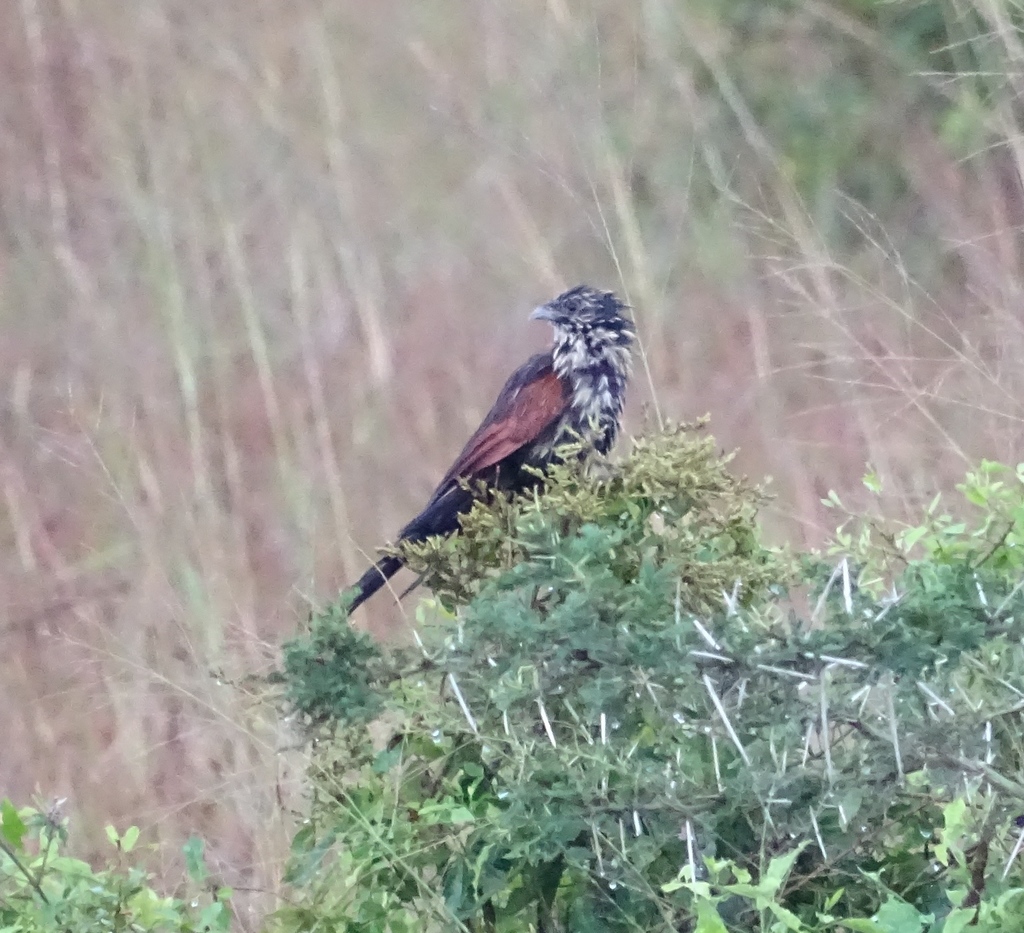
Black Coucal
Photo © Sandra Keller
Photo © Sandra Keller — CC BY 4.0 — Source: iNaturalist #27562668Identification
The black coucal is a medium-sized cuckoo measuring 30 cm in males and 34 cm in females. During breeding season, males display striking all-black plumage on the head, body, and tail, with rufous wings and buff barring on the rump. Females are similar in this striking breeding dress. Outside the breeding season, the upper parts transition to dark brown with rufous barring throughout. The eyes are brown, while the beak and legs remain black year-round. Juveniles are more heavily rufous with variable dark and light barring and streaking, making them quite distinct from adults.
Range & Habitat
This species has an impressively wide distribution across sub-Saharan Africa, occurring in over thirty countries from West Africa to southern Africa. It inhabits marshes, savannah, grassland, bracken, and undergrowth, often favoring clearings within woodland. The species also uses reeds and papyrus habitat occasionally. Black coucals typically remain below 1,500 meters elevation, though they are occasionally encountered up to 2,000 meters. Some populations are resident year-round while others are migratory, depending on location.
Behaviour & Diet
The black coucal exhibits a remarkable reversal of typical gender roles: males tend the nest while females are polyandrous, maintaining their own territories. This unusual breeding system is controlled by hormonal mechanisms, with progesterone regulating female aggressiveness. Like other cuckoos, this species likely exhibits parasitic breeding behavior, though detailed dietary and foraging information remains limited in available literature.
Best Time & Places to See It
The black coucal is generally uncommon throughout its range, making encounters somewhat unpredictable. Your best chances occur in suitable habitat—particularly marshes, grasslands, and savannah regions with dense undergrowth—across the numerous African countries where it occurs. Given its wide but patchy distribution, consult local birding guides for current sightings in your specific travel destination, as presence varies seasonally in migratory populations.
Photography Tips
Photographing black coucals presents challenges due to their preference for dense vegetation and generally uncommon status. Focus on early morning hours when birds are most active. The dramatic contrast of breeding plumage—jet black against rufous wings—offers striking photographic potential if you can locate an individual. Patient stalking through suitable marsh and grassland habitat with attention to alarm calls may reward you with viewing opportunities. Off-season birds in brown plumage are considerably more cryptic and demand extra vigilance to detect.
Bwindi Impenetrable National Park
Lake Mburo National Park
Mabamba Swamp
Murchison Falls National Park
Queen Elizabeth National Park
Amboseli National Park
Bwabwata National Park
Chobe National Park
Kafue National Park
Nothing matches these filters.
No community photos yet. Log in to add the first one.
No community observations of this species yet.