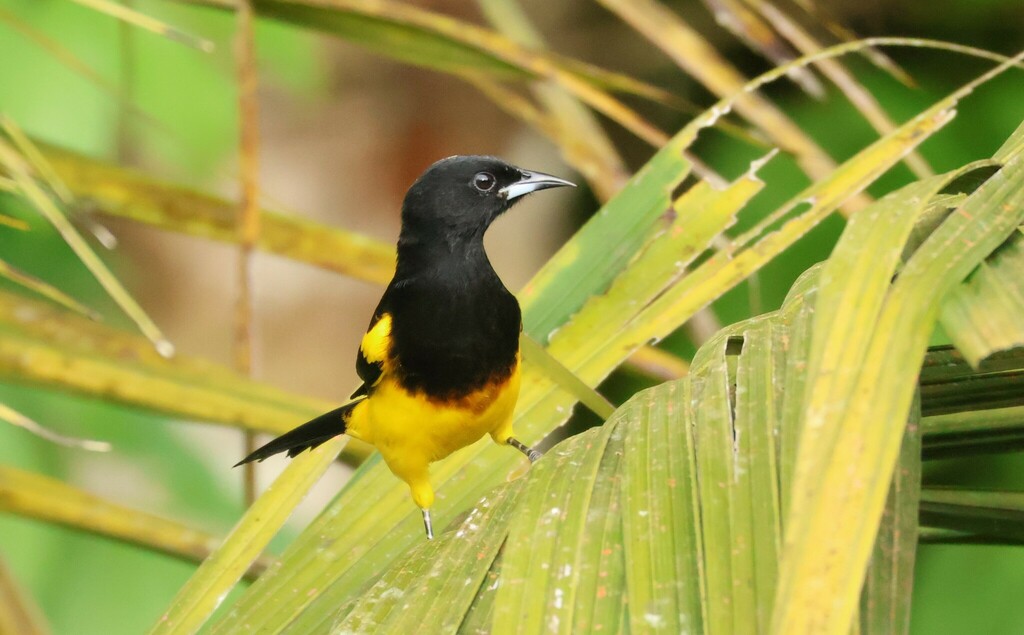
Black-cowled Oriole
Photo © Millie Basden
Photo © Millie Basden — CC BY 4.0 — Source: iNaturalist photo #331719527Identification
The Black-cowled Oriole is a medium-sized passerine, measuring 18.5–21 cm in length. Adult males are striking: predominantly black with bright yellow patches on the shoulder, rump, and uppertail coverts, and entirely yellow wing linings, lower breast, thighs, and crissum. A narrow chestnut wash separates black from yellow on the breast. Females show geographic variation—in the northern part of the range, they display black face, throat, and upper breast with olive-yellow crown and upperparts; in the south, plumage varies from similar to males to a mix of black and yellow feathers on the head and back. Both sexes have a slender, slightly decurved black bill with a silvery base to the lower mandible, blue-gray legs and feet, and brown eyes. Immature birds of the southern subspecies are dull yellow-olive above with black-based feathers and dull yellow below, with matte black face, forehead, throat, wings and tail.
Range & Habitat
This species is common and widespread throughout the Caribbean lowlands and foothills from southern Mexico to western Panama. Two subspecies are recognized: I. p. prosthemelas occurs from Mexico to central Costa Rica, while I. p. praecox ranges from southeastern Costa Rica to western Panama. The Black-cowled Oriole inhabits humid and semihumid forests, forest edges and clearings, plantations, semi-open areas with scattered trees and bushes, and gardens. Its large range and apparently stable population mean it is classified as Least Concern by the IUCN.
Behaviour & Diet
These orioles forage mostly at mid-levels, gleaning a mixed diet of arthropods, nectar, and fruit. During breeding season, females construct distinctive shallow pendent nests stitched to the underside of large leaves. Each female lays three eggs. Both parents actively defend the nest, brood the young, and provide food. The bird's song is a fairly quiet, complicated series of soft, whistled notes and harsher chattering, described variously as clear, metallic, slurred, and mellow, delivered in apparently random order. Its repertoire of calls includes scratchy rising weets, nasal deeps and eeahnks, quiet tee-u notes, and sharper beehk or bihk sounds. When alarmed, it delivers a scolding series of sharp cherp and chep notes, sometimes interspersed with song fragments.
Best Time & Places to See It
The Black-cowled Oriole's abundance and widespread distribution throughout its range make it a reliable find for travellers visiting suitable habitat. Look for them in humid lowland and foothill forests, particularly along forest edges and in semi-open areas with flowering trees and fruiting vegetation. They may also be found in gardens and plantations where flowering plants and fruiting trees are present. Their relatively quiet song and mid-level foraging habits mean they may be more readily located by watching flowering canopy and mid-story trees than by sound alone.
Photography Tips
The striking yellow-and-black plumage of adult males makes them relatively straightforward subjects, though their preference for mid-level foraging can require patience and positioning. The sexual and geographic plumage variation makes documentation of females and immatures particularly valuable. Their affinity for flowering trees and plants provides excellent opportunities for capturing birds in natural foraging behaviour. Early morning sessions often yield the best light and bird activity. A telephoto lens is recommended for capturing detail of the delicate nest construction and the bird's facial markings. Patience in semi-open areas and gardens where they are more exposed will reward photographers with clearer shots than in dense forest.
Manuel Antonio National Park
Quepos, Costa Rica
+426 birds+22 mammals
Where tropical rainforest descends steeply to a rocky Pacific coastline, Manuel Antonio National Park distills Central American biodiversity into one of Costa Rica's most compressed and…
VIEW NATIONAL PARKArenal Volcano National Park
Peñas Blancas, Costa Rica
+551 birds+21 mammals
Straddling the border between Alajuela and Guanacaste in northwestern Costa Rica, this national park rises dramatically around one of Central America's most active volcanic systems. The…
VIEW NATIONAL PARKTortuguero National Park
Roxana, Costa Rica
+420 birds+23 mammals
Canals and lagoons thread through a labyrinth of lowland rainforest where the Caribbean coast of Costa Rica meets the wetland frontier. This is terrain shaped by…
VIEW NATIONAL PARKBraulio Carrillo National Park
Las Horquetas, Costa Rica
+547 birds+18 mammals
Where the Caribbean slope descends from the central volcanic cordillera toward the humid lowlands of Heredia, Braulio Carrillo National Park preserves one of Costa Rica's most…
VIEW NATIONAL PARKGuanacaste National Park
Santa Elena, Costa Rica
+461 birds+17 mammals
Where the Pacific slopes of northwestern Costa Rica rise toward the Continental Divide, dry tropical forest gives way to cloud-laden peaks and misty ridges—a landscape that…
VIEW NATIONAL PARKSian Ka’an
Chunyaxché, Mexico
+350 birds+16 mammals
Where the Yucatán Peninsula dissolves into wetland and mangrove, a vast mosaic of forest, lagoon, and coastal margin creates one of Mexico's most biodiverse strongholds. Across…
VIEW BIOSPHERE RESERVEMontes Azules
Candelaria, Mexico
+395 birds+47 mammals
Where jungle-clad limestone plateaus plunge into canyon systems carved by the Usumacinta River, Mexico's most pristine rainforest reserve unfolds across the Lacandón region of Chiapas. Montes…
VIEW BIOSPHERE RESERVETikal National Park
Tikal, Guatemala
+399 birds+16 mammals
Dense rainforest canopy rises above the limestone plateau of Petén, where archaeological wonder and ecological richness merge seamlessly across one of Central America's most biodiverse landscapes.…
VIEW NATIONAL PARKLaguna del Tigre National Park
Petén, Guatemala
+399 birds+29 mammals
Where the Petén lowlands dissolve into wetland and forest, Laguna del Tigre National Park protects one of Guatemala's most ecologically vital landscapes. This sprawling reserve encompasses…
VIEW NATIONAL PARKSierra del Lacandón National Park
Petén, Guatemala
+348 birds+7 mammals
Where the Petén rainforest rises into limestone ridges and deep ravines, Sierra del Lacandón National Park protects one of Central America's most intact tropical wilderness zones.…
VIEW NATIONAL PARKCarara National Park
Tárcoles, Costa Rica
+397 birds+19 mammals
Where the Pacific coastal plain meets transitional forest, Carara National Park straddles one of Central America's most dynamic ecological boundaries. The park's landscape encompasses lowland deciduous…
VIEW NATIONAL PARKCahuita National Park
Talamanca, Costa Rica
+359 birds+15 mammals
Where the Caribbean shoreline dissolves into mangrove creeks and coral gardens, Cahuita's mosaic of habitats unfolds across the Limón coast. The park's signature feature—a living coral…
VIEW NATIONAL PARKRincón de la Vieja National Park
Liberia, Costa Rica
+451 birds+30 mammals
Where volcanic slopes rise abruptly from the Guanacaste lowlands, Rincón de la Vieja National Park sprawls across a landscape shaped by geothermal drama and seasonal extremes.…
VIEW NATIONAL PARKTapantí Macizo de la Muerte National Park
Orosi, Costa Rica
+503 birds+18 mammals
Where montane cloud forest rises steeply from the Orosi Valley, Tapantí Macizo de la Muerte National Park enfolds a landscape of perpetual moisture and emerald complexity.…
VIEW NATIONAL PARKLa Amistad International Park
Crorina, Costa Rica
+532 birds+20 mammals
Where the Caribbean slopes of Costa Rica's Talamanca Mountains rise steeply inland from Limón, the boundary between two nations dissolves into an unbroken expanse of rainforest.…
VIEW NATIONAL PARKBarbilla National Park
Chirripó, Costa Rica
+226 birds
Where the Caribbean slope of Costa Rica's eastern cordillera plunges into perpetual moisture, Barbilla National Park rises as one of Central America's most water-rich ecosystems. Fed…
VIEW NATIONAL PARKVolcán Tenorio National Park
Guatuso, Costa Rica
+480 birds+12 mammals
Where volcanic slopes rise through Costa Rica's northwestern borderlands, Volcán Tenorio National Park sprawls across terrain shaped by ancient lava flows and mineral-rich springs. The park's…
VIEW NATIONAL PARKMarino Ballena National Park
Bahía Ballena, Costa Rica
+336 birds+8 mammals
Where mangrove forests meet coral-fringed shorelines along Costa Rica's southern Pacific coast, Marino Ballena National Park encompasses a marine and terrestrial mosaic that ranks among Central…
VIEW NATIONAL PARKCaño Negro National Wildlife Refuge
Caño Negro District, Costa Rica
+486 birds+16 mammals
Where the San Juan River's seasonal floodplain opens into expansive wetlands, Caño Negro Wildlife Sanctuary sprawls across one of Central America's most productive freshwater ecosystems. This…
VIEW WILDLIFE SANCTUARYGandoca-Manzanillo National Wildlife Refuge
Manzanillo, Costa Rica
+394 birds+18 mammals
Where the Caribbean coastal plain surrenders to water-logged forest and mangrove tangles, Gandoca-Manzanillo Wildlife Sanctuary shelters one of Costa Rica's most biodiverse lowland wetland ecosystems. The…
VIEW WILDLIFE SANCTUARYBarra del Colorado National Wildlife Refuge
Tortuguero, Costa Rica
+462 birds+36 mammals
Where the Caribbean's restless waters meet the Limón Province coastline, Barra del Colorado National Wildlife Sanctuary unfolds across a landscape of extraordinary ecological complexity. This equatorial…
VIEW WILDLIFE SANCTUARYNo community photos yet. Log in to add the first one.
No community observations of this species yet.