Black Crake
Photo © Laura Gaudette
Photo © Laura Gaudette — CC BY 4.0 — Source: iNaturalist #147528209Identification
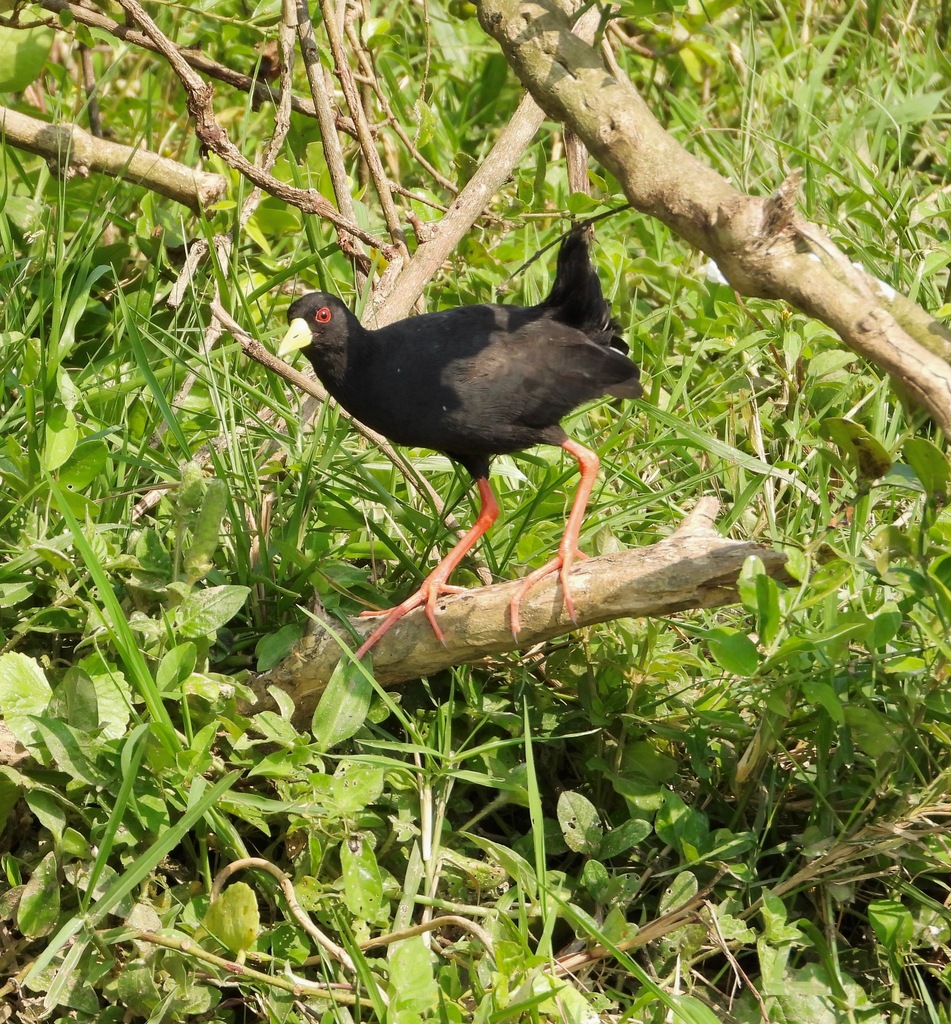
The black crake is a compact waterbird measuring 19–23 cm long, with notably long toes and a short tail characteristic of the rail family. Adults are unmistakable: predominantly black plumage with a distinctive yellow bill, red eye, and red legs and feet (duller when not breeding). The wings and upperparts show a subtle brown-olive tone that is rarely noticeable in the field. Males are slightly larger than females, and most males—but only 10% of females—sport a hooked upper mandible. Immature birds look quite different, with brown upperparts, dark grey head and underparts, greenish-yellow bills, and dull red legs.
The black crake's vocalizations are memorable and distinctive. Its main call is a duet: the bird starts with a throaty, chattering krrrok-kraaaa, which prompts a response of dove-like cooing: coo-crr-COO. These calls are often your best clue to the bird's presence in dense marsh vegetation.
Range & Habitat
The black crake breeds throughout most of sub-Saharan Africa, being absent only from the most arid regions. Where its range experiences seasonal drought, this species undertakes migratory movements to track suitable conditions. It is a common to abundant bird across its range and has benefited from human landscape modifications, particularly deforestation.
This species inhabits freshwater marshes of all types, provided there is sufficient vegetation for cover. Unlike many secretive rails, the black crake is often seen in the open, making it more visible than its relatives. It rarely falls victim to hunting because its flesh is unpalatable to humans.
Behaviour & Diet
The black crake is notably aggressive during breeding season and will attack a wide range of bird species, particularly other rails—sometimes killing rails of comparable size to itself. Both sexes build the nest, a deep and neat bowl constructed from wetland plants. Nests are typically placed in marsh vegetation or on dry ground, but may occasionally be built up to 3 metres high in a bush. Clutches consist of two to six eggs, usually three, which are cream or white with brown or chestnut spots. Both parents and sometimes helpers from previous broods incubate for 13–19 days. The precocial chicks leave the nest within 1–3 days but remain fed by parents and helpers for several weeks, becoming independent at 6–12 weeks of age.
This diurnal, confiding bird forages openly and often near humans, feeding on a diverse diet of invertebrates, small fish, frogs, and seeds. It also takes bird eggs and scavenges carcasses. The black crake hunts both on the ground and by climbing reeds to catch flying insects. Interestingly, it has been observed perching on hippopotamuses and warthogs to pick parasites from their skin—a mutually beneficial arrangement.
Best Time & Places to See It
Look for black crakes in freshwater marshes throughout sub-Saharan Africa, particularly where vegetation is dense but not impenetrable. The species' abundance and habit of feeding in the open make it more reliably encountered than many other rails. Listen for their distinctive duetting calls, especially during the breeding season, which will help you locate birds in reed beds and marsh vegetation.
In regions subject to seasonal drought, timing your visit during the wet season will maximize your chances of encountering this species, as birds congregate in available wetland habitat during these periods.
Photography Tips
The black crake's willingness to feed in the open and its relatively bold behaviour toward humans make it more accessible to photographers than secretive rail species. Early morning and late afternoon typically offer the best light and increased activity. Position yourself quietly near marsh edges where the birds forage and be patient—their confiding nature means they may approach closer than you might expect from other rails.
The bird's striking colour contrast—black plumage against the yellow bill and red eye and legs—photographs well in good natural light. The long red legs and toes are a distinctive feature worth capturing. Listen for the characteristic calls to pinpoint birds before you spot them visually, increasing your chances of a successful encounter.
Serengeti National Park
Tanzania
+558 birds+57 mammals
Across Tanzania's northern plateau, where volcanic soils meet acacia woodland and open grassland, unfolds one of Earth's most dynamic ecosystems. The Serengeti National Park sprawls across…
VIEW NATIONAL PARKArusha National Park
Tanzania
+555 birds+16 mammals
Where the slopes of Mount Mawenzi rise above the Arusha region, a compact yet ecologically rich national park unfolds across montane forest, moorland, and alpine zones.…
VIEW NATIONAL PARKRubondo Island National Park
Tanzania
+99 birds+8 mammals
Across the waters of Lake Victoria's northeastern arm, Rubondo Island rises as a freshwater wilderness where papyrus swamps grade into acacia woodlands and dense thickets of…
VIEW NATIONAL PARKMapungubwe National Park
Musina Local Municipality, South Africa
+358 birds+29 mammals
Where the Limpopo River cuts through sandstone ridges at the convergence of South Africa, Botswana, and Zimbabwe, Mapungubwe National Park preserves a landscape of profound ecological…
VIEW NATIONAL PARKChobe National Park
Botswana
+446 birds+45 mammals
Where the Chobe River cuts a sinuous path through northern Botswana, the landscape transforms into one of Africa's most dynamic wetland-savanna mosaics. This national park encompasses…
VIEW NATIONAL PARKKidepo Valley National Park
Uganda
+478 birds+24 mammals
Where the Narus and Kidepo rivers carve through northeastern Uganda's semi-arid lowlands, a landscape of sparse acacia woodland, grassland, and riverine thickets creates one of East…
VIEW NATIONAL PARKMurchison Falls National Park
Uganda
+608 birds+33 mammals
Where the Victoria Nile compresses through a narrow gorge and explodes across a 45-meter precipice, the landscape speaks in thunder. Murchison Falls National Park sprawls across…
VIEW NATIONAL PARKMgahinga Gorilla National Park
Cyanika, Uganda
+429 birds+6 mammals
Where the Virunga Mountains rise steeply from the Uganda–Rwanda–Democratic Republic of Congo frontier, montane forest cloaks the volcanic slopes in a dense, moisture-laden embrace. Mgahinga Gorilla…
VIEW NATIONAL PARKLake Mburo National Park
Uganda
+505 birds+24 mammals
Rolling acacia woodland and scattered lakes define this intimate savanna preserve in southwestern Uganda, where the rift valley's geological drama shapes every water source and grassland.…
VIEW NATIONAL PARKTsavo East National Park
Athi ward, Kenya
+468 birds+50 mammals
Across the semi-arid lowlands of southeastern Kenya, where acacia woodland fragments into scrubland and the landscape rolls toward the Indian Ocean horizon, lies one of Africa's…
VIEW NATIONAL PARKTsavo West National Park
Mwatate, Kenya
+513 birds+49 mammals
Where volcanic ridges and weathered lava flows meet the semi-arid lowlands of south-central Kenya, Tsavo West National Park unfolds across a landscape sculpted by fire and…
VIEW NATIONAL PARKAmboseli National Park
Etonet/Lenkism ward, Kenya
+501 birds+43 mammals
Where the Amboseli basin opens toward the Tanzanian frontier, a shallow alkaline lake mirrors vast skies across one of East Africa's most iconic savanna landscapes. The…
VIEW NATIONAL PARKMount-Kenya National Park
Abothuguchi west ward, Kenya
+334 birds+11 mammals
Where the slopes of Kenya's second-highest mountain rise steeply from the Meru County foothills, a landscape of profound ecological richness unfolds across Mount Kenya National Park.…
VIEW NATIONAL PARKNgorongoro Conservation Area
Tanzania
+626 birds+55 mammals
Volcanic calderas and open grassland dominate this high plateau in northern Tanzania, where the landscape rises above 2,000 metres and ancient geological forces have shaped both…
VIEW WILDLIFE MANAGEMENT AREAMabamba Swamp
Memere, Uganda
+464 birds+2 mammals
Across the Central Region of Uganda spreads one of Africa's most biodiverse freshwater wetlands, a sprawling nature reserve of roughly 283 square kilometres where papyrus swamps…
VIEW NATURE RESERVEPilanesberg National Park
Moses Kotane Local Municipality, South Africa
+364 birds+49 mammals
Granite peaks and volcanic ridges rise unexpectedly from the savanna floor across this 734-square-kilometre expanse in the North West province, creating a landscape of profound ecological…
VIEW NATIONAL PARKMokala National Park
Siyancuma Local Municipality, South Africa
+246 birds+35 mammals
Across the semi-arid savanna of the Northern Cape, where red earth meets sparse acacia woodland and open grassland punctuated by rocky outcrops, lies a landscape shaped…
VIEW NATIONAL PARKKruger National Park
Ba-Phalaborwa Local Municipality, South Africa
+540 birds+91 mammals
Across the low-lying savanna of northeastern South Africa unfolds one of Africa's largest and most ecologically intact protected areas, where acacia woodlands merge into mopane scrub…
VIEW NATIONAL PARKBontebok National Park
Swellendam Local Municipality, South Africa
+204 birds+11 mammals
Where the Cape Fold Mountains give way to coastal lowlands, a landscape of rolling sandstone hills and fynbos heathland creates one of South Africa's most compact…
VIEW NATIONAL PARKAugrabies Falls National Park
Kai !Garib Local Municipality, South Africa
+176 birds+20 mammals
Where the Orange River cuts a dramatic scar through the Northern Cape's arid interior, Augrabies Falls National Park sprawls across nearly 1,200 square kilometers of raw,…
VIEW NATIONAL PARKAddo Elephant National Park
Sundays River Valley Local Municipality, South Africa
+388 birds+55 mammals
Where the Eastern Cape's semi-arid scrublands meet transitional woodland, Addo sprawls across 13,478 square kilometres of one of southern Africa's most biodiverse landscapes. The terrain rises…
VIEW NATIONAL PARKIthala Game Reserve
uPhongolo Local Municipality, South Africa
+328 birds+26 mammals
Rolling thornbush savanna and acacia woodland dominate the landscape of this 494-square-kilometre national park in KwaZulu-Natal's uPhongolo Local Municipality, where granite outcrops punctuate grassland plateaus and…
VIEW NATIONAL PARKMarakele National Park
Modimolle Local Municipality, South Africa
+341 birds+36 mammals
Granite ridges and sprawling grasslands dominate this 1,176-square-kilometre reserve in Limpopo's heartland, where bushveld transitions between rocky outcrops and open savanna. The park's rugged topography creates…
VIEW NATIONAL PARKZiwa Rhino and Wildlife Ranch
Nakasongola, Uganda
+359 birds+11 mammals
Where papyrus wetlands merge into sprawling savanna, Uganda's central landscape opens into one of East Africa's most vital rhino recovery zones. Ziwa Rhino and Wildlife Ranch…
VIEW WILDLIFE SANCTUARYDorob National Park
Henties Bay, Namibia
+230 birds+13 mammals
Where the Skeleton Coast meets the Namib Desert's inland reaches, Dorob National Park sprawls across 34,021 square kilometres of one of southern Africa's most austere and…
VIEW NATIONAL PARKNkasa Rupara National Park
Namibia
+283 birds+17 mammals
Where the Zambezi's floodplains spill across the border between Namibia and Botswana, Nkasa Rupara National Park unfolds across 518 square kilometers of wetland and woodland mosaic.…
VIEW NATIONAL PARKNo community photos yet. Log in to add the first one.
No community observations of this species yet.