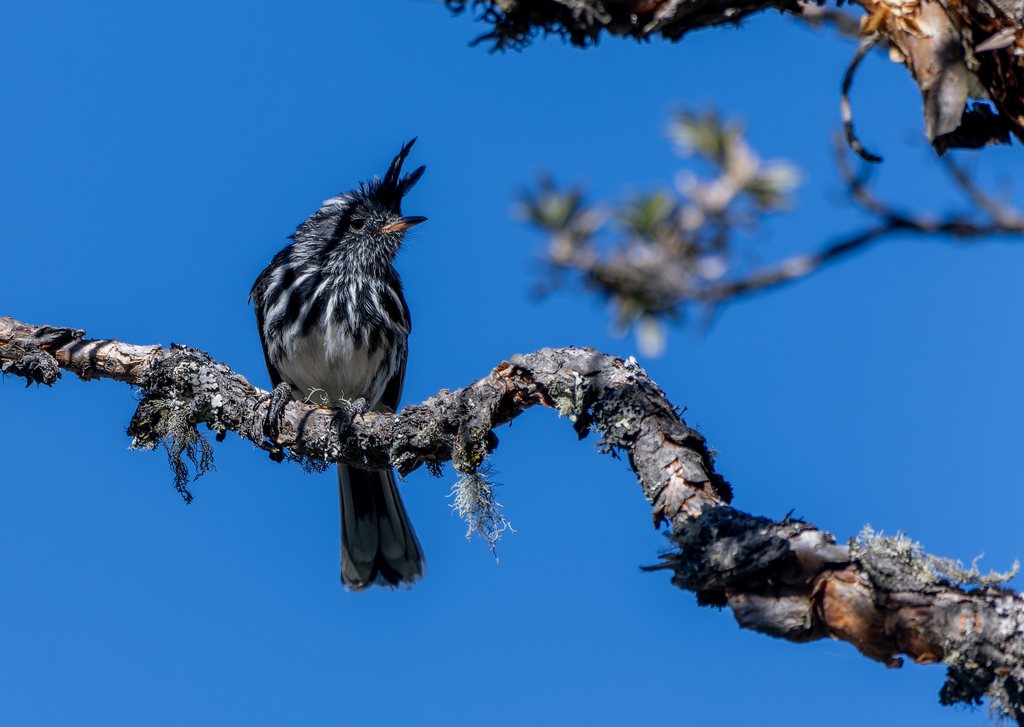
Black-crested Tit-Tyrant
Photo © David F. Belmonte
Photo © David F. Belmonte — CC BY 4.0 — Source: iNaturalist #231061022Identification
The black-crested tit-tyrant is a small but boldly marked flycatcher, 13 cm long and the largest member of its genus. Males are unmistakable: they display a dramatic black crest of elongated crown feathers, white nape and front crown contrasting sharply with black on the rest of the head. The upperparts are black with thin white streaks, while the wings are black with conspicuous wide white edges on the flight feathers and two prominent white bars on the closed wing. The black tail features wide white tips, with the outermost feathers almost entirely white on the outer webs. The underparts are distinctively streaked black and white on the throat, breast, and flanks, with plain yellowish-white belly and undertail coverts. Look for the bright orange bill with blackish tip and dark brown iris. Females are duller, with a shorter crest, darker front of head, and dusky rather than black markings. Juveniles show an even shorter crest and dusky tones with dark streaking on the back and breast.
Range & Habitat
This species has a restricted Andean range from southern Loja Province in extreme southern Ecuador southward along the western Andes slope through Peru to Ancash Department. It also occurs in the upper Marañón River valley and very locally on the eastern Andean slope in Huánuco Department. The black-crested tit-tyrant inhabits Polylepis (queñoa) woodlands and adjacent montane scrub near treeline and in ravines, typically between 2,100 and 4,000 meters elevation. It is considered very local in Ecuador but uncommon to locally fairly common in Peru, occurring in at least two national parks.
Behaviour & Diet
This is a year-round resident throughout its range. The black-crested tit-tyrant is an active insectivore, typically foraging in pairs or small groups and frequently joining mixed-species feeding flocks. It feeds primarily by gleaning insects from leaves and twigs while perched, with frequent short upward flights to hover-glean from foliage. It occasionally takes prey in mid-air during brief sallies. The species is highly vocal, producing distinctive squeaky, sputtered calls—a rapid "trreek! trreek! trreek!," a descending, squeaky, chattered "tee! titititititer," and a rising-falling "trrreeeer." Breeding occurs around June and July, though little else is known about its reproductive biology.
Best Time & Places to See It
As a year-round resident, the black-crested tit-tyrant can be encountered in any season within its range. Your best opportunities are in the montane Polylepis woodlands and adjacent scrublands of Ecuador and Peru between 2,100 and 4,000 meters. Visiting the species in protected areas—such as the Peruvian national parks where it is confirmed to occur—offers the most reliable chances. The species' active foraging behavior and habit of joining mixed-species flocks make it relatively conspicuous once you reach suitable habitat. Early morning hours often yield the best sightings and vocalizations.
Photography Tips
The black-crested tit-tyrant's bold plumage patterns and compact size reward patient photographers. Males are more visually striking than females, with their dramatic black crest and crisp black-and-white contrasts. The bird's active foraging behavior means it rarely sits still for long, so be prepared with a fast shutter speed and good tracking capability. The high-elevation habitat often offers excellent lighting during morning hours; use this to your advantage to capture the bright orange bill and the intricate white streaking on the wings and underparts. The species' habit of joining mixed feeding flocks means scanning these groups carefully may reveal individuals. A telephoto lens of at least 300 mm is recommended given the species' small size and preference for high-altitude terrain.
Podocarpus National Park
Zamora, Ecuador
+496 birds+6 mammals
Where the Andes descend toward the Amazon basin, Podocarpus National Park sprawls across nearly 2,800 square kilometres of the most biodiverse terrain in Ecuador's southern highlands.…
VIEW NATIONAL PARKHuascarán National Park
Independencia, Peru
+201 birds+5 mammals
Where granite peaks pierce the Andean sky above 6,000 metres, Huascarán National Park sprawls across more than 11,500 square kilometres of Peru's Cordillera Blanca, a landscape…
VIEW NATIONAL PARKNo community photos yet. Log in to add the first one.
No community observations of this species yet.