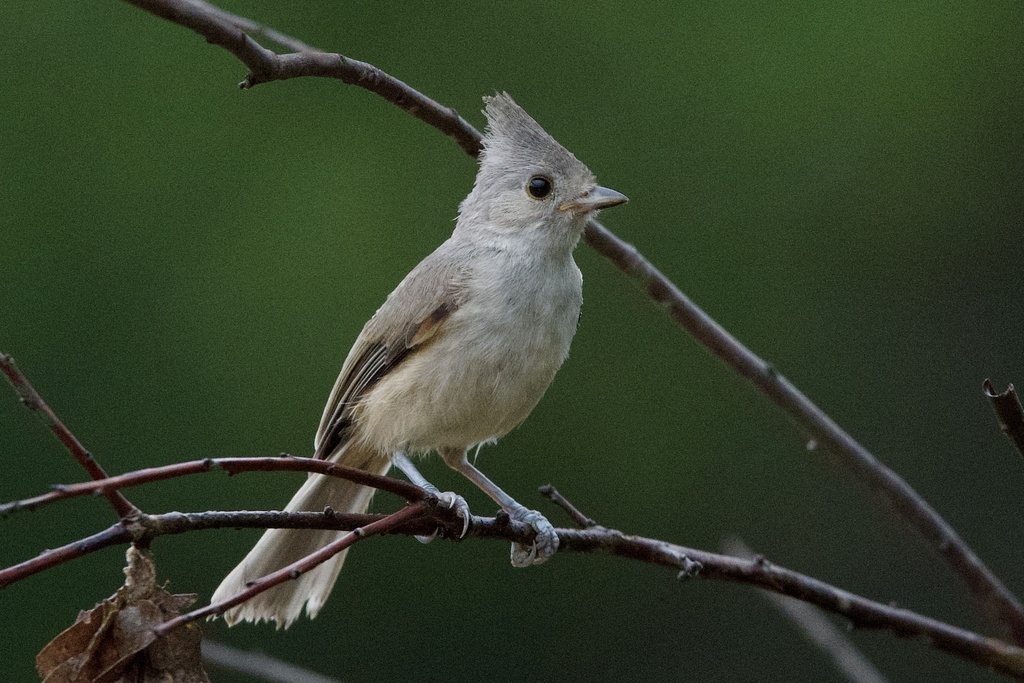
Black-crested Titmouse
Photo © Nate Sabo
Photo © Nate Sabo — CC BY 4.0 — Source: iNaturalist photo #280203502Identification
The Black-crested Titmouse is a moderately large member of the tit family, measuring about 15 cm (5.9 inches) long and weighing approximately 16.5 grams. Its most distinctive feature is its prominent crest—black in adult males and dark gray in females. Both sexes share a buffy-white forehead, white lores, and a striking white eye-ring with a black spot above it. The upperparts are deep plumbeous gray with a greenish cast on the mantle and rump, while the underparts are white with rich cinnamon-rufous flanks. The wings and tail display greenish-gray edges, and the bird has a black bill and bluish-gray legs. Juveniles are duller overall, with a shorter gray crest, buffy eye-rings, and light pinkish-buff flanks. The three subspecies show subtle variations, with B. a. sennetti having noticeably medium gray upperparts.
Range & Habitat
The Black-crested Titmouse is found in Mexico and the U.S. states of Oklahoma and Texas, with occasional vagrant records in other areas. Its three subspecies occupy distinct but overlapping ranges: B. a. paloduro inhabits the Davis Mountains of western Texas and the Texas panhandle south into Coahuila; B. a. sennetti ranges from southwestern Oklahoma south through central and southern Texas; and B. a. atricristatus occupies the lower Rio Grande Valley and extends through eastern Mexico.
This species inhabits diverse landscapes including evergreen, semi-deciduous, and deciduous forests and woodlands at elevations from sea level to approximately 2,300 meters (7,500 feet). It shows a particular preference for oak and mesquite-dominated areas, and readily adapts to human-modified landscapes such as orchards, parks, and residential gardens.
Behaviour & Diet
The Black-crested Titmouse is a year-round resident throughout its range. It feeds primarily on a wide variety of insects, their larvae, and eggs, supplemented by nuts, seeds, berries, and corn. The bird forages deliberately, gleaning food from tree trunks, branches, and foliage, typically working in the inner parts of trees. During winter months, it frequently joins mixed-species feeding flocks with other parids, kinglets, gnatcatchers, and warblers.
Breeding occurs between February and late June in Texas. The species nests in cavities, primarily those abandoned by woodpeckers in living or dead trees, fence posts, and utility poles, and also readily uses nest boxes. Females line the cavity with soft materials including animal hair, moss, grass, and human-made items. Clutches typically contain six eggs, though four to seven occur. The female incubates for 12 to 14 days, with fledging occurring 15 to 18 days after hatching.
Best Time & Places to See It
The Black-crested Titmouse is a year-round resident, making it viewable throughout the year within its range. The species is considered common overall, though it is uncommon and local in western Texas. Winter mixed-species feeding flocks offer particularly good viewing opportunities. Suitable habitats include oak and mesquite woodlands, parks with mature trees, and residential gardens with native vegetation, especially in Oklahoma, Texas, and northern Mexico.
Photography Tips
The bird's distinctive black crest and contrasting facial markings make it visually striking for photography. The white eye-ring with its black spot and the cinnamon-rufous flanks provide excellent color contrast against the deep gray upperparts. The species forages deliberately in the inner canopy, which can make it challenging to photograph in good light—patience and positioning yourself with the sun at your back will improve results. Winter feeding flocks offer concentrated viewing opportunities. Listen for its distinctive vocalizations—a rapid "peew peew peew" song or the characteristic "chick-a-dee" calls—to locate birds in dense vegetation. Perched birds offer the best photo opportunities for capturing the crest detail and facial pattern.
Big Bend National Park
Brewster County, United States
+345 birds+34 mammals
Where the Chisos Mountains rise abruptly from the Sonoran Desert floor, Big Bend National Park spans over 7,300 square kilometers of one of North America's most…
VIEW NATIONAL PARKSierra de Tamaulipas
El Porvenir, Mexico
+98 birds+19 mammals
Where limestone peaks thrust skyward through dense subtropical forest, Mexico's northeastern frontier reveals one of the continent's most biodiverse mountain ranges. Canyons carved by perennial rivers…
VIEW NATURE RESERVELaguna Atascosa National Wildlife Refuge
Cameron County, United States
+365 birds+19 mammals
Where coastal prairie meets shallow lagoon along the southernmost tip of Texas, Laguna Atascosa National Wildlife Sanctuary sprawls across a landscape sculpted by salt spray and…
VIEW WILDLIFE SANCTUARYSanta Ana National Wildlife Refuge
Hidalgo County, United States
+349 birds+12 mammals
Where the Rio Grande delta meets the semi-arid scrublands of South Texas, Santa Ana National Wildlife Sanctuary preserves a rare mosaic of wetland and thornforest habitat…
VIEW WILDLIFE SANCTUARYLower Rio Grande Valley National Wildlife Refuge
Starbase, United States
+311 birds+11 mammals
Where the Rio Grande delta spreads across the coastal plain of South Texas, a sanctuary of subtropical wetlands and riparian corridors creates a landscape that pulses…
VIEW WILDLIFE SANCTUARYNo community photos yet. Log in to add the first one.
No community observations of this species yet.