Black-crowned Antshrike
Photo © Aitor
Photo © Aitor — CC BY 4.0 — Source: iNaturalist photo #63435269Identification
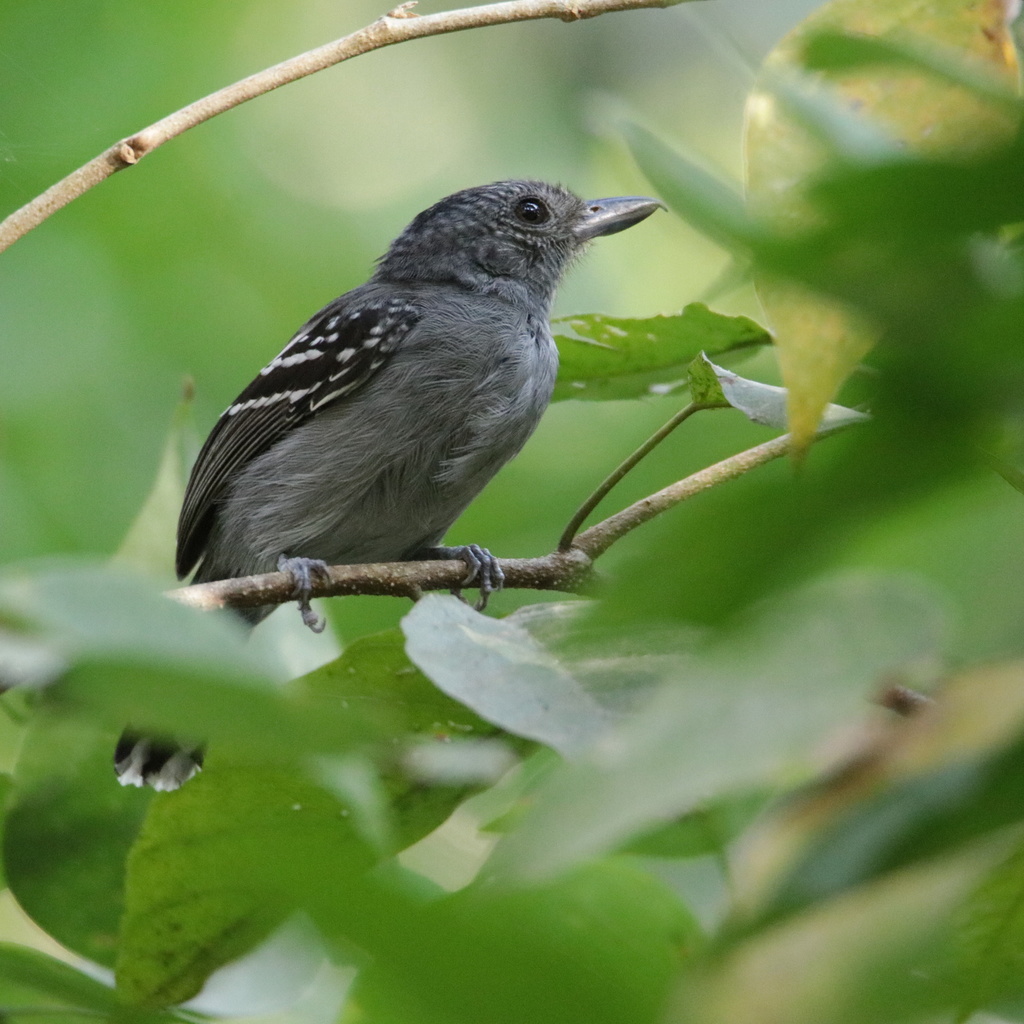
The black-crowned antshrike is a small passerine, 14–15 cm long and weighing 20–28.5 g. Like all members of genus Thamnophilus, it has a stout, hooked bill characteristic of the antbird family. This species exhibits striking sexual dimorphism. Males of the nominate subspecies are slaty gray above with a distinctive black crown and nape, gray forehead, and black wings with white-tipped coverts. They display a hidden white patch between the scapulars and black uppertail coverts with white tips. The face is grizzled gray, and underparts are slaty gray. Females are quite different: buffy brown to brown above with fuscous-black wings edged in brown and white-tipped flight feathers, and buffy brown to grayish-brown underparts. Both sexes show brownish-red to chocolate-brown irises and medium to dark gray legs; males have dark gray bills while females have lighter gray. The subspecies T. a. gorgonae shows geographic variation, with males displaying more gray on the forehead and lighter underparts, while females have darker crowns, more rufous upperparts, and darker underparts than the nominate form.
Range & Habitat
The black-crowned antshrike is found throughout Central America except El Salvador, and in Colombia, Ecuador, Peru, and Venezuela. The nominate subspecies has the wider range, occurring on the Caribbean slope from southern Belize through Panama, and on the Pacific slope in northwestern Costa Rica and Panama. In South America it ranges across northern Colombia including the Magdalena Valley, northwestern Venezuela, and along the Pacific slope into far northwestern Peru. Subspecies T. a. gorgonae is endemic to Gorgona Island off southwestern Colombia. The species inhabits primary and secondary semi-deciduous and evergreen forests, favoring the interior but occurring at forest edges. It typically forages in the understorey and mid-storey, though it reaches the canopy. Elevation ranges from sea level to 1,250 m in Central America, up to 1,500 m in Colombia, mostly below 1,100 m in Ecuador, and to 1,000 m in Venezuela; in Peru it occurs between 400–800 m.
Behaviour & Diet
A year-round resident throughout its range, the black-crowned antshrike feeds on a diverse diet of insects, other arthropods, and occasionally small lizards. It typically forages singly or in pairs and regularly joins mixed-species feeding flocks. Foraging techniques are varied and methodical: gleaning from perches, making short upward sallies with brief hovering, chasing insects in mid-air, and flipping leaves on the ground. It hunts on live and dead leaves, palm fronds, branches, vines, spiderwebs, and moss, sometimes following army ant swarm edges. Breeding occurs between April and July, varying geographically and annually. The nest is an intricately woven cup of fungal rhizomorphs, moss, rootlets, and spider silk, suspended from a branch fork typically within 2 m of the ground but up to 7 m high. Clutches contain two eggs; both parents incubate for 14–16 days and fledging occurs about 10 days after hatching. Both sexes sing, particularly in early morning but throughout the day, producing a distinctive series of notes ending with a higher-pitched call.
Best Time & Places to See It
The black-crowned antshrike is fairly common to common across its range and considered of Least Concern by the IUCN, with a stable population and very large range. To locate this species, focus on forest interior and edges in suitable elevation ranges, particularly during the breeding season (April–July) when vocal activity is highest. Early morning visits increase sighting chances due to increased singing. Look for mixed-species feeding flocks moving through the understorey and mid-storey, as the antshrike regularly joins these aggregations. The species is year-round resident, making it accessible throughout the year, though presence may vary locally and seasonally.
Photography Tips
The pronounced sexual dimorphism makes photographing both male and female plumages rewarding. Males are more conspicuous with their striking black crowns and slaty-gray coloring, while females blend into brown forest understory vegetation and require patience. Position yourself along forest trails during early morning when birds are most vocal and active. The species' habit of joining mixed-species flocks provides multiple viewing opportunities as flocks move through predictable routes. Use a slow shutter speed to capture the bird's characteristic foraging behavior—gleaning, hovering, and leaf-flipping. The hidden white scapular patch and white-tipped tail feathers are diagnostic but require clear angles to photograph effectively. Work with natural forest light filtering through the canopy rather than using flash, which may startle the birds or blow out the subtle plumage tones.
Arenal Volcano National Park
Peñas Blancas, Costa Rica
+551 birds+21 mammals
Straddling the border between Alajuela and Guanacaste in northwestern Costa Rica, this national park rises dramatically around one of Central America's most active volcanic systems. The…
VIEW NATIONAL PARKTortuguero National Park
Roxana, Costa Rica
+420 birds+23 mammals
Canals and lagoons thread through a labyrinth of lowland rainforest where the Caribbean coast of Costa Rica meets the wetland frontier. This is terrain shaped by…
VIEW NATIONAL PARKBraulio Carrillo National Park
Las Horquetas, Costa Rica
+547 birds+18 mammals
Where the Caribbean slope descends from the central volcanic cordillera toward the humid lowlands of Heredia, Braulio Carrillo National Park preserves one of Costa Rica's most…
VIEW NATIONAL PARKSanta Rosa National Park
Santa Elena, Costa Rica
+359 birds+30 mammals
Where Pacific-facing slopes descend from volcanic uplands toward the Guanacaste lowlands, Santa Rosa National Park unfolds across a mosaic of tropical dry forest, gallery woodland, and…
VIEW NATIONAL PARKGuanacaste National Park
Santa Elena, Costa Rica
+461 birds+17 mammals
Where the Pacific slopes of northwestern Costa Rica rise toward the Continental Divide, dry tropical forest gives way to cloud-laden peaks and misty ridges—a landscape that…
VIEW NATIONAL PARKCerros de Amotape National Park
District of San Jacinto, Ecuador
+246 birds+1 mammals
Arid mountains rise abruptly from Peru's northwestern frontier, their slopes clothed in xerophytic scrubland and seasonal deciduous forest that transforms these Andean foothills into one of…
VIEW NATIONAL PARKNatural Farallones de Cali National Park
Buenaventura, Colombia
+733 birds+27 mammals
Where the Pacific coastal plain meets the western slopes of the Andes, Farallones de Cali National Park sprawls across nearly 3,500 square kilometers of dramatic topography…
VIEW NATIONAL PARKNatural Uramba Bahía Málaga National Park
Buenaventura, Colombia
+308 birds+15 mammals
Where the Pacific coastal rainforest descends to mangrove estuaries and rocky headlands, Uramba Bahía Málaga National Park unfolds across nearly 1,000 square kilometres of Colombia's Valle…
VIEW NATIONAL PARKGeneral de División Omar Torrijos Herrera National Park
La Pintada, Panama
+401 birds+2 mammals
Across the highlands of central Panama, where the continental divide funnels moisture-laden trade winds into steep river valleys, the terrain rises and falls in a landscape…
VIEW NATIONAL PARKSoberanía National Park
Cristóbal, Panama
+495 birds+34 mammals
Rainforest and riverine woodland blanket the rolling terrain of this 714-square-kilometre national park in Colón Province, where the Caribbean watershed feeds a maze of streams and…
VIEW NATIONAL PARKChagres National Park
Caimitillo, Panama
+486 birds+19 mammals
Where the Chagres River carves through the humid tropics of central Panama, a vast montane and lowland forest sprawls across more than 2,300 square kilometers, anchoring…
VIEW NATIONAL PARKDarién National Park
Tucutí, Panama
+534 birds+13 mammals
Where the spine of Central America crumbles into wetland and rainforest, Darién National Park sprawls across more than 20,000 square kilometres of some of the tropics'…
VIEW NATIONAL PARKPortobelo National Park
Portobelo, Panama
+366 birds+9 mammals
Where the Caribbean's turquoise waters meet the Darién's verdant shore, Portobelo National Park sprawls across 570 square kilometers of coastal forest, mangrove wetland, and coral-fringed islands…
VIEW NATIONAL PARKCahuita National Park
Talamanca, Costa Rica
+359 birds+15 mammals
Where the Caribbean shoreline dissolves into mangrove creeks and coral gardens, Cahuita's mosaic of habitats unfolds across the Limón coast. The park's signature feature—a living coral…
VIEW NATIONAL PARKRincón de la Vieja National Park
Liberia, Costa Rica
+451 birds+30 mammals
Where volcanic slopes rise abruptly from the Guanacaste lowlands, Rincón de la Vieja National Park sprawls across a landscape shaped by geothermal drama and seasonal extremes.…
VIEW NATIONAL PARKTapantí Macizo de la Muerte National Park
Orosi, Costa Rica
+503 birds+18 mammals
Where montane cloud forest rises steeply from the Orosi Valley, Tapantí Macizo de la Muerte National Park enfolds a landscape of perpetual moisture and emerald complexity.…
VIEW NATIONAL PARKLa Amistad International Park
Crorina, Costa Rica
+532 birds+20 mammals
Where the Caribbean slopes of Costa Rica's Talamanca Mountains rise steeply inland from Limón, the boundary between two nations dissolves into an unbroken expanse of rainforest.…
VIEW NATIONAL PARKBarbilla National Park
Chirripó, Costa Rica
+226 birds
Where the Caribbean slope of Costa Rica's eastern cordillera plunges into perpetual moisture, Barbilla National Park rises as one of Central America's most water-rich ecosystems. Fed…
VIEW NATIONAL PARKVolcán Tenorio National Park
Guatuso, Costa Rica
+480 birds+12 mammals
Where volcanic slopes rise through Costa Rica's northwestern borderlands, Volcán Tenorio National Park sprawls across terrain shaped by ancient lava flows and mineral-rich springs. The park's…
VIEW NATIONAL PARKCaño Negro National Wildlife Refuge
Caño Negro District, Costa Rica
+486 birds+16 mammals
Where the San Juan River's seasonal floodplain opens into expansive wetlands, Caño Negro Wildlife Sanctuary sprawls across one of Central America's most productive freshwater ecosystems. This…
VIEW WILDLIFE SANCTUARYGandoca-Manzanillo National Wildlife Refuge
Manzanillo, Costa Rica
+394 birds+18 mammals
Where the Caribbean coastal plain surrenders to water-logged forest and mangrove tangles, Gandoca-Manzanillo Wildlife Sanctuary shelters one of Costa Rica's most biodiverse lowland wetland ecosystems. The…
VIEW WILDLIFE SANCTUARYBarra del Colorado National Wildlife Refuge
Tortuguero, Costa Rica
+462 birds+36 mammals
Where the Caribbean's restless waters meet the Limón Province coastline, Barra del Colorado National Wildlife Sanctuary unfolds across a landscape of extraordinary ecological complexity. This equatorial…
VIEW WILDLIFE SANCTUARYNo community photos yet. Log in to add the first one.
No community observations of this species yet.