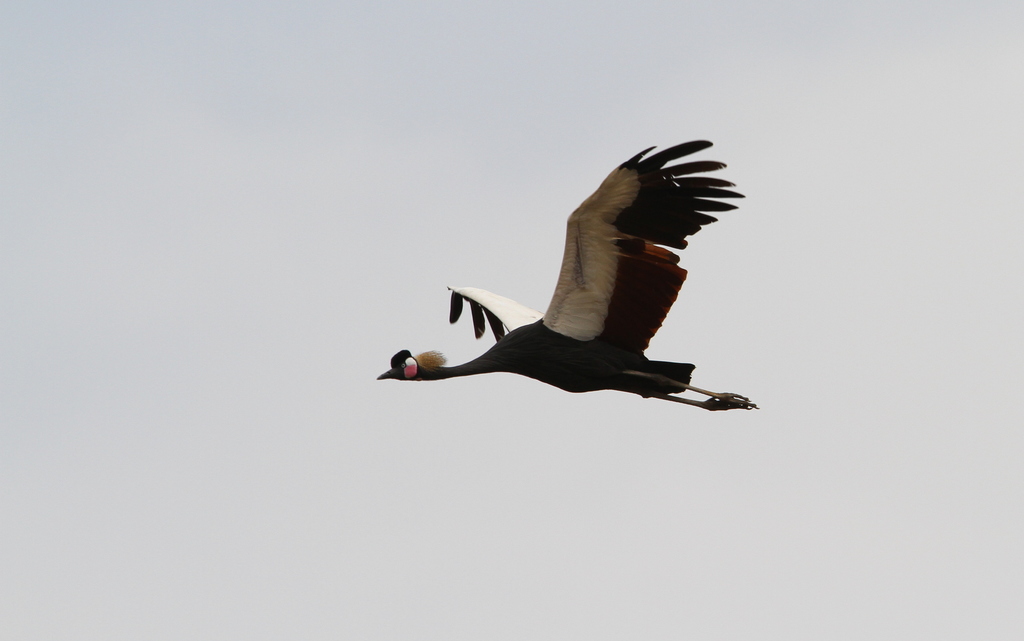
Black Crowned Crane
Photo © Christoph Moning
Photo © Christoph Moning — CC BY 4.0 — Source: iNaturalist photo #95167693The black crowned crane (Balearica pavonina) is a part of the family Gruidae, along with its sister species, the grey crowned crane. It is topped with its characteristic bristle-feathered golden crown. It is usually found in the shallow wetlands of sub-Saharan Africa during the wet season, which act as its principal breeding, feeding and roosting sites although it can also be found foraging in grasslands and near croplands of dry savanna. == Taxonomy == The black crowned crane was formally described in 1758 by the Swedish naturalist Carl Linnaeus in the tenth edition of his Systema Naturae. He placed it with the cranes and herons in the genus Ardea and coined the binomial name Ardea pavonina. He specified the type locality as Africa. Linnaeus cited earlier authors including the English naturalist George Edwards who in 1751 had included a description and a hand-colour etching of the "Crowned African Crane" in the fourth volume of his A Natural History of Uncommon Birds. The black crowned crane is now placed together with the grey crowned crane in the genus Balearica that was introduced in 1760 by the French zoologist Mathurin Jacques Brisson. The genus name is from Latin Baliaricus meaning "of the…
Kidepo Valley National Park
Uganda
+478 birds+24 mammals
Where the Narus and Kidepo rivers carve through northeastern Uganda's semi-arid lowlands, a landscape of sparse acacia woodland, grassland, and riverine thickets creates one of East…
VIEW NATIONAL PARKMurchison Falls National Park
Uganda
+608 birds+33 mammals
Where the Victoria Nile compresses through a narrow gorge and explodes across a 45-meter precipice, the landscape speaks in thunder. Murchison Falls National Park sprawls across…
VIEW NATIONAL PARKAbijata-Shalla Lakes National Park
Ethiopia
+438 birds+7 mammals
Two crater lakes of contrasting chemistry define this remote corner of Ethiopia's Rift Valley, where soda lakes and freshwater basins create a mosaic of distinct aquatic…
VIEW NATIONAL PARKNo community photos yet. Log in to add the first one.
No community observations of this species yet.